

|⚓ About Us | 📋 Training Catalog | 🎯 CIC 2026 Bundle |
🏅 Free Course Access (No Credit Card)
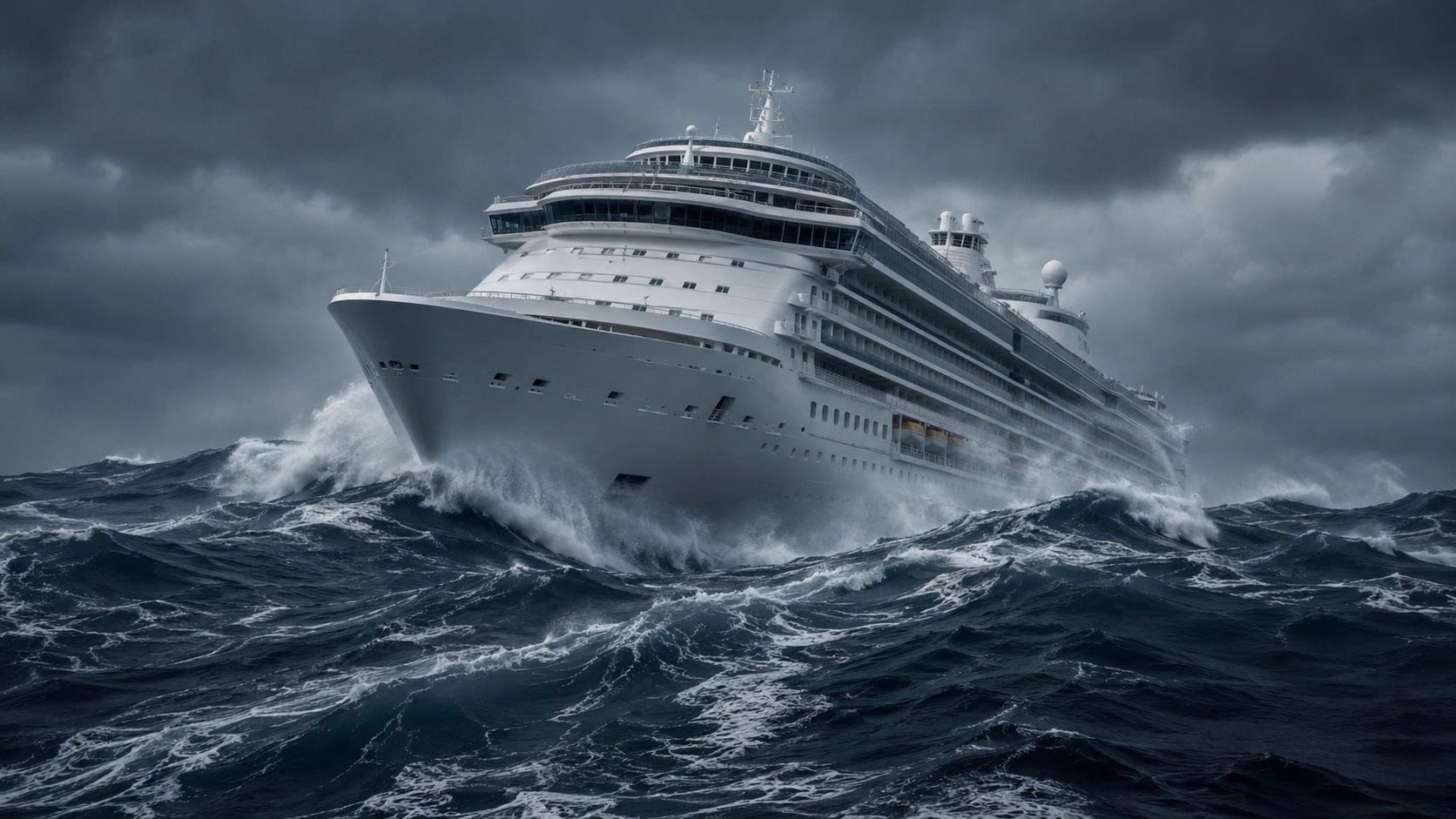
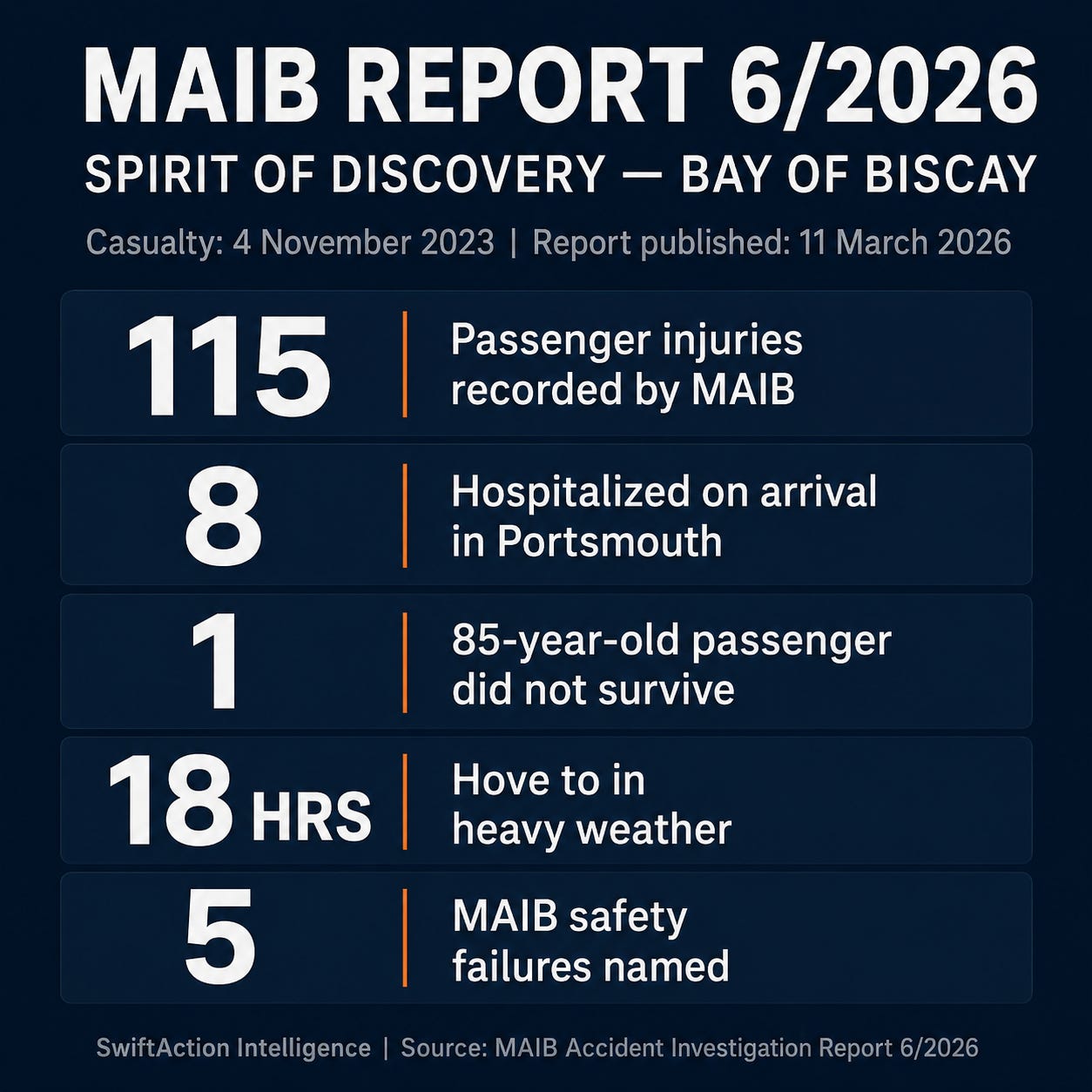
Shortly after 12:30 on 4 November 2023, the UK-flagged cruise ship Spirit of Discovery lost propulsion in heavy weather while crossing the Bay of Biscay. Over the next 18 hours, the vessel rolled violently while the crew attempted to restart its propulsion pods. 115 passengers were treated for injuries. Eight were taken directly to hospital on arrival in Portsmouth. One 85-year-old passenger did not survive his injuries.
On 11 March 2026, the UK Marine Accident Investigation Branch published Accident Investigation Report 6/2026 and named five distinct safety failures. None of them were equipment failures alone. Three of them were competency failures.
The findings were rectified on paper. The competency gap persisted at sea.
📋 In this issue:
🌊 The Incident
📊 By The Numbers
🚨 The Training Failure
🩺 What Should Have Happened
👀 What to Watch
🎯 SwiftAction Signal
🔔 Not yet subscribed? SwiftAction Intelligence Covers Maritime Accidents, Detentions, and the Training Failures Behind Them. Subscribe For Free!
📋 Competency-Based Maritime Training Mapped to Every PSC Deficiency Code → academy.swiftaction.ai
🎯 2026 CIC Cargo Securing Bundle: 30 Courses, Tokyo & Paris MOU Aligned → academy.swiftaction.ai/bundles/2026-cargo-securing-cic-tokyo-paris-mous
🌊 The Incident
Spirit of Discovery (IMO 9802683) is a 58,119 GT cruise ship built in 2019, UK-flagged, classed by Lloyd’s Register, registered owner Saga Cruises V Limited, technical manager V.Ships Leisure SAM. The vessel departed Portsmouth on 24 October 2023 for a two-week “Canary Island Quintet” cruise. At the time of the casualty there were 943 passengers and 503 crew aboard — 1,446 persons in total. The average passenger age was 78.8. The youngest passenger was 50. The oldest was 96.
After the Spanish port of A Coruña closed due to deteriorating weather, the master decided to head directly back to Portsmouth, crossing the Bay of Biscay against weather routing guidance that advised against the passage. According to the MAIB, this decision was not effectively challenged by the bridge team or by operational teams ashore.
At about 12:30 on 4 November, with Force 11 winds and significant wave heights of 8 to 11 metres, Spirit of Discovery’s port propulsion pod’s water leakage stop sequence alarm activated. Within seconds, the port pod overspeed alarm followed, the pod shut down automatically, and the propulsion control system parked it at 90 degrees inboard to the vessel’s heading. Six minutes later, at 12:36, the starboard pod’s water leakage stop alarm activated and the starboard pod also shut down — leaving the vessel without propulsion in storm conditions.
Over the next 18 hours, the vessel was hove to at slow speed. The port and starboard pods intermittently oversped and shut down a further eight times. The ship rolled between 10 and 13 degrees. Furniture flew across decks. High-backed chairs toppled. Passengers and crew were thrown into bulkheads, into stairwells, and into furniture that was not secured.
One 85-year-old passenger was struck when the chair he was sitting in toppled backwards, with the main impact to his neck. He was helped back into the chair and remained upright for more than four hours. MAIB later concluded that decision may have caused additional neurological damage.
He arrived in Portsmouth on 6 November. He did not survive his injuries and was lost in hospital on 8 November 2023, four days after the casualty.
📊 By The Numbers
115 passenger injuries recorded by MAIB
8 seriously injured passengers taken to hospital on arrival in Portsmouth
1 85-year-old passenger did not survive his injuries
1,446 persons on board (943 passengers, 503 crew)
78.8 average passenger age (youngest 50, oldest 96)
18 hours hove to in heavy weather
8 times propulsion pods shut down after initial loss
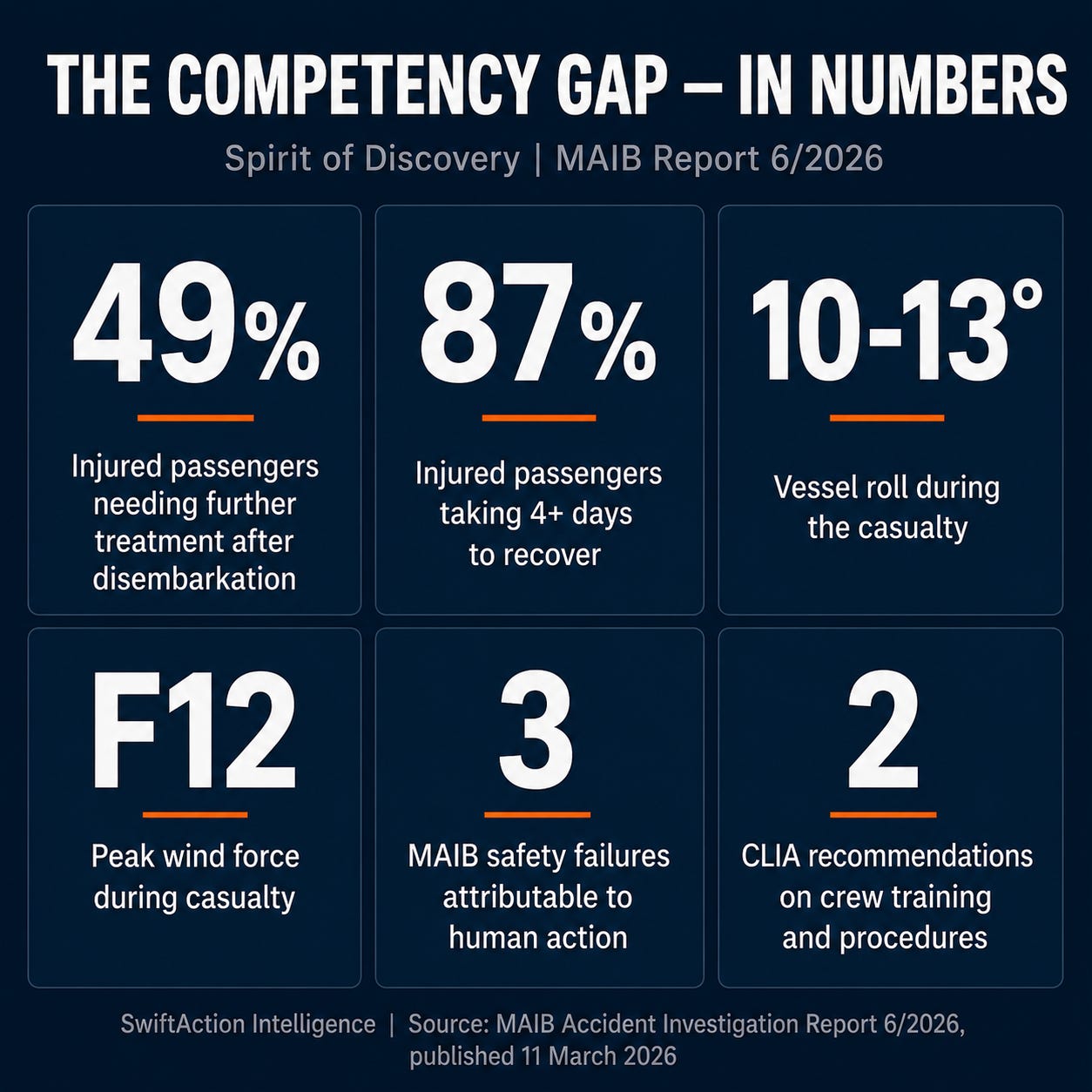
10 to 13 degrees of roll during the casualty
Force 12 peak wind during casualty (Force 8–9 at moment of propulsion loss, building to hurricane Force 12 through the afternoon); 8 to 11 m significant wave height
67% of surveyed injuries occurred at the moment of initial propulsion loss (~12:36)
77% of surveyed injured passengers considered onboard medical treatment adequate
82% of surveyed injured passengers recalled being warned about the heavy weather
36+ hours the 85-year-old passenger’s spinal injury remained undiagnosed on board
5 safety failures named by MAIB
5 recommendations issued to industry
49% of surveyed injured passengers needed further treatment after disembarkation
87% of surveyed injured passengers took four days or more to recover
All data: MAIB Accident Investigation Report 6/2026, published 11 March 2026, scoped to the 4 November 2023 casualty aboard Spirit of Discovery in the Bay of Biscay.
🚨 The Training Failure
The MAIB report did not blame the storm. It did not blame the propulsion manufacturer alone. It named five specific safety issues — and three of them describe what humans onboard did or failed to do.
Failure 1: The decision to cross the Bay of Biscay was not effectively challenged.
Weather routing guidance had advised against the crossing. The master proceeded anyway. The bridge team did not push back. The shore-side operational team — including the vessel’s Designated Person Ashore, who was consulted and agreed the revised passage plan — did not exercise effective challenge. MAIB framed this in operational decision-making terms: not “the challenge was absent,” but “the challenge was not effective.”
This is a Paris MOU code 10127 (Voyage Or Passage Plan), 10133 (Bridge Operation), and 10135 (Monitoring Of Voyage Or Passage Plan) issue, sitting on top of an ISM code 15104 (Masters Responsibility And Authority) and 15102 (Company Responsibility And Authority) finding.
Failure 2: The mass casualty incident plan was not implemented.
A “Code Alpha” medical-emergency announcement was made by the OOW at about 12:40, four minutes after the second pod’s loss. The medical team responded and treated the injured. What was not triggered was the formal mass casualty incident plan (MCIP) — a separate, documented procedure designed to escalate a multi-casualty event beyond standard medical response. The MCIP existed. It was carried onboard. Saga’s head of safety and policy assurance had emailed the captain and doctor the night before, specifically asking the medical team to review the MCIP. The MAIB found that despite all of that, the plan was never activated. The medical team was left “largely unsupported for more than 18 hours.”
This is a Paris MOU code 15107 (Emergency Preparedness) finding, with operational roots in 04120 (Damage Control Drill For Passenger Ships) and 04121 (Crew Familiarization With Emergency Systems).
Failure 3: The medical team lacked advanced trauma training.
The ship’s doctor was an experienced medical practitioner with general practice, emergency department, and intensive care residency background. The nurses were qualified. What the team did not hold was specific advanced trauma certification. MAIB found that the lack of advanced trauma training among the ship’s nurses may have contributed to the spinal injury not being identified earlier. Specialist advice from the Telemedical Maritime Assistance Service (TMAS) was not sought immediately. The passenger’s quadriplegia remained undiagnosed on board for more than 36 hours. He was sat upright in a chair for four hours when he should have been kept flat on a spinal board.
This is a Paris MOU code 01212 (Certificate For Medical Care) and 18404 (Medical Doctor Or PIC Of Medical Care) competency issue, compounded by an 18405 (Medical Advice By Radio Or Satellite) procedural failure on TMAS escalation.
Three failures. Zero of them required new equipment. All of them required a crew that had practiced what was already written down.
🩺 What Should Have Happened
The MAIB report acknowledges that Spirit of Discovery’s owner, manager, medical services provider, propulsion manufacturer and shipyard have already taken significant action — including implementing the mass casualty incident plan, enhancing specialist medical support, improving machinery failure checklists, and improving the securing of objects for heavy weather. Saga has not stood still. MAIB also recorded that 77% of surveyed injured passengers considered onboard medical treatment adequate and that “almost all” praised the crew’s response. The crew worked hard. The system around them did not give them what they needed. That is the SwiftAction thesis in a single passenger-vessel casualty.
MAIB issued five recommendations. The two aimed directly at the human system aboard every passenger vessel — and at every operator running a ship that could face a mass casualty — are training recommendations.
Recommendation to CLIA #1: Increase the number of trauma trained medical personnel carried by passenger vessels (MAIB references Advanced Trauma Life Support qualification as one such standard in section 1.11.4 of the report).
Recommendation to CLIA #2: Update policies on the risk assessment and securing of vessel furniture in heavy weather.
The first is a competency standard. The second is an operational procedure that depends on a crew trained to apply it as conditions deteriorate, not a checklist that lives in the safety management system.
For cruise operators, ferry operators, ro-pax, offshore accommodation units, and any vessel carrying non-crew personnel, the Spirit of Discovery report sets a new evidentiary baseline. After 11 March 2026, “we have a mass casualty plan” is not a defence. The question every DPA, every CSO, every flag state inspector, and every passenger’s family lawyer will now ask is: when did your crew last drill it under realistic load?
SwiftAction Academy modules that map directly to the Spirit of Discovery findings:
15107 — ISM Emergency Preparedness
15104 — Master’s Responsibility and Authority (ISM)
15102 — Company Responsibility and Authority (ISM)
10127 — Voyage or Passage Plan
10133 — Bridge Operation
10135 — Monitoring of Voyage or Passage Plan
04120 — Damage Control Drill for Passenger Ships
04121 — Crew Familiarization with Emergency Systems
04108 — Muster List
01212 — Certificate for Medical Care
18404 — Medical Doctor or PIC of Medical Care
18405 — Medical Advice by Radio or Satellite (TMAS)
10130 — Electronic Inclinometer (corresponds to MAIB’s first recommendation to MCA)
Each module maps 1:1 to its Paris MOU and Tokyo MOU deficiency code. Completion records demonstrate not just attendance but tested competency. That is the evidentiary standard MAIB is implicitly demanding of the cruise industry as of March 2026.
👀 What to Watch
MCA international submission on electronic inclinometers. Spirit of Discovery was fitted with a mechanical inclinometer at the rear of the bridge but not the electronic inclinometer meeting IMO MSC.363(92) performance standards, which is not currently required by international carriage rules. MAIB has recommended the Maritime and Coastguard Agency propose that international carriage requirements include electronic inclinometers (Paris MOU code 10130). Expect this to surface at IMO MSC 111 (13–22 May 2026, London) and in follow-on SOLAS amendment discussions.
CLIA member-line policy updates. Expect public statements from major cruise lines on ATLS coverage, mass casualty drill cadence, and furniture-securing standards in heavy weather. The first lines to update publicly will set the legal floor for the rest.
Paris MOU and Tokyo MOU 2026 Cargo Securing CIC. Joint CIC announced for 2026. Securing of cargo and securing of loose items in heavy weather share a competency root: a crew that understands lashing loads, sea state, and dynamic forces. The Spirit of Discovery furniture finding will sit in inspectors’ minds when they board during the campaign window.
Class society instruction manual revisions. MAIB recommendations to classification societies on improving instruction manual quality. Expect IACS to engage.
Bay of Biscay weather routing precedent. Expect negligence litigation framing the master’s decision against the documented weather routing advice as a precedent test for “effective challenge” obligations under ISM.
🎯 SwiftAction Signal
The Spirit of Discovery did not have a paperwork problem. It had a documented mass casualty plan, a qualified medical team, a modern propulsion package, and a master with the authority to challenge a decision. Every box was ticked on the certificate. None of it was activated when it mattered. That is the gap a $17 SwiftAction Academy module is built to close — because the regulators have moved on from “did you have a plan?” to “when did your crew last run it?”
⚓ The SwiftAction Team
SwiftAction Intelligence Is Published Weekly.
For Partnership Inquiries Contact admin@swiftaction.ai
📋 Full Training Catalog: academy.swiftaction.ai