

|⚓ About Us | 📋 Training Catalog | 🎯 CIC 2026 Bundle |
🏅 Free Course Access (No Credit Card)
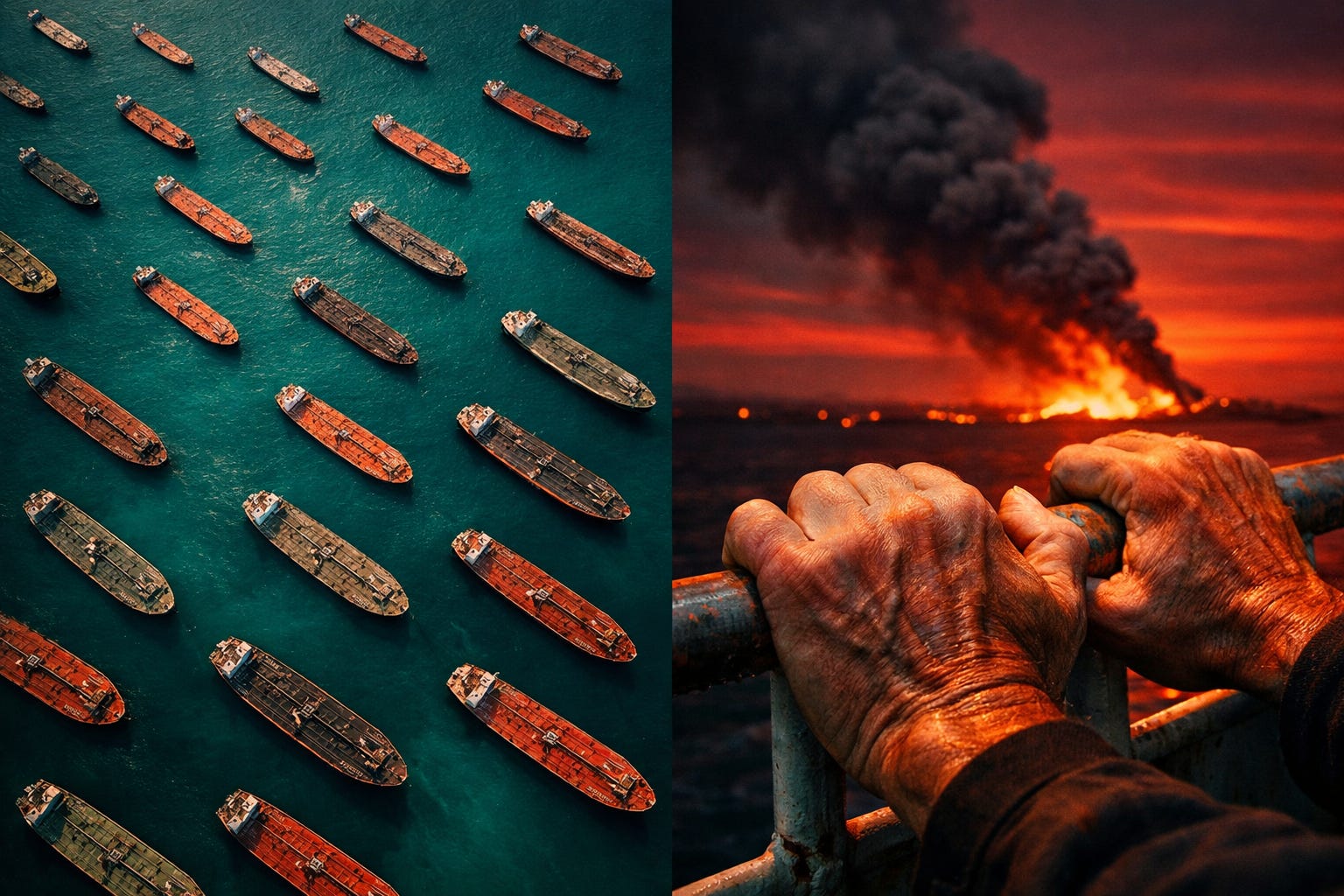
On March 1, 2026, an able seaman was asleep aboard the oil tanker Skylight when two explosions threw him off his bed. The ship was dark. Smoke filled the passageways. He had ten seconds to get out. The vessel’s captain was confirmed lost. A 24-year-old crew member on his first voyage was never found. The seaman returned to India 17 days later with nothing but the clothes on his back. Many of the Skylight’s surviving crew were also on their first voyage. Some did not know how to swim. They put on lifejackets and jumped into the sea.
The Skylight — a tanker sanctioned by the US Department of the Treasury for links to the Iranian shadow fleet — was among the first commercial vessels struck after hostilities began on February 28. The crew aboard her were civilians. Their training gaps were the same regardless of the vessel’s regulatory status. And the Skylight was not the last vessel hit. The IMO has confirmed 21 attacks on commercial shipping since hostilities began. Ten seafarers have been lost. And 20,000 more remain trapped aboard approximately 2,000 vessels in the Persian Gulf, facing what IMO Secretary-General Arsenio Dominguez described as “dwindling supplies, fatigue and severe psychological stress.”
This is not a geopolitics article. The oil price and the ceasefire and the Tehran Tollbooth are covered elsewhere. This is about what happens to crew competency when 20,000 seafarers spend six weeks in a war zone with no drills, no rotations, no shore leave, and no end in sight — and what happens when those vessels finally reach their next port of inspection.
📋 In this issue:
🔥 The Crisis — What’s happening to the crews
📊 By The Numbers — The compliance collapse
🔍 The Training Failure — How competency degrades in captivity
🛡️ What Should Have Happened — The 10 courses every stranded crew should be completing right now
🚨 SwiftAction Signal
🔔 Not yet subscribed? SwiftAction Intelligence Covers Maritime Accidents, Detentions, and the Training Failures Behind Them. Subscribe For Free!
📋 Competency-Based Maritime Training Mapped to Every PSC Deficiency Code → academy.swiftaction.ai
🎯 2026 CIC Cargo Securing Bundle: 30 Courses, 60% Off → academy.swiftaction.ai/bundles/2026-cargo-securing-cic-tokyo-paris-mous
🔥 The Crisis
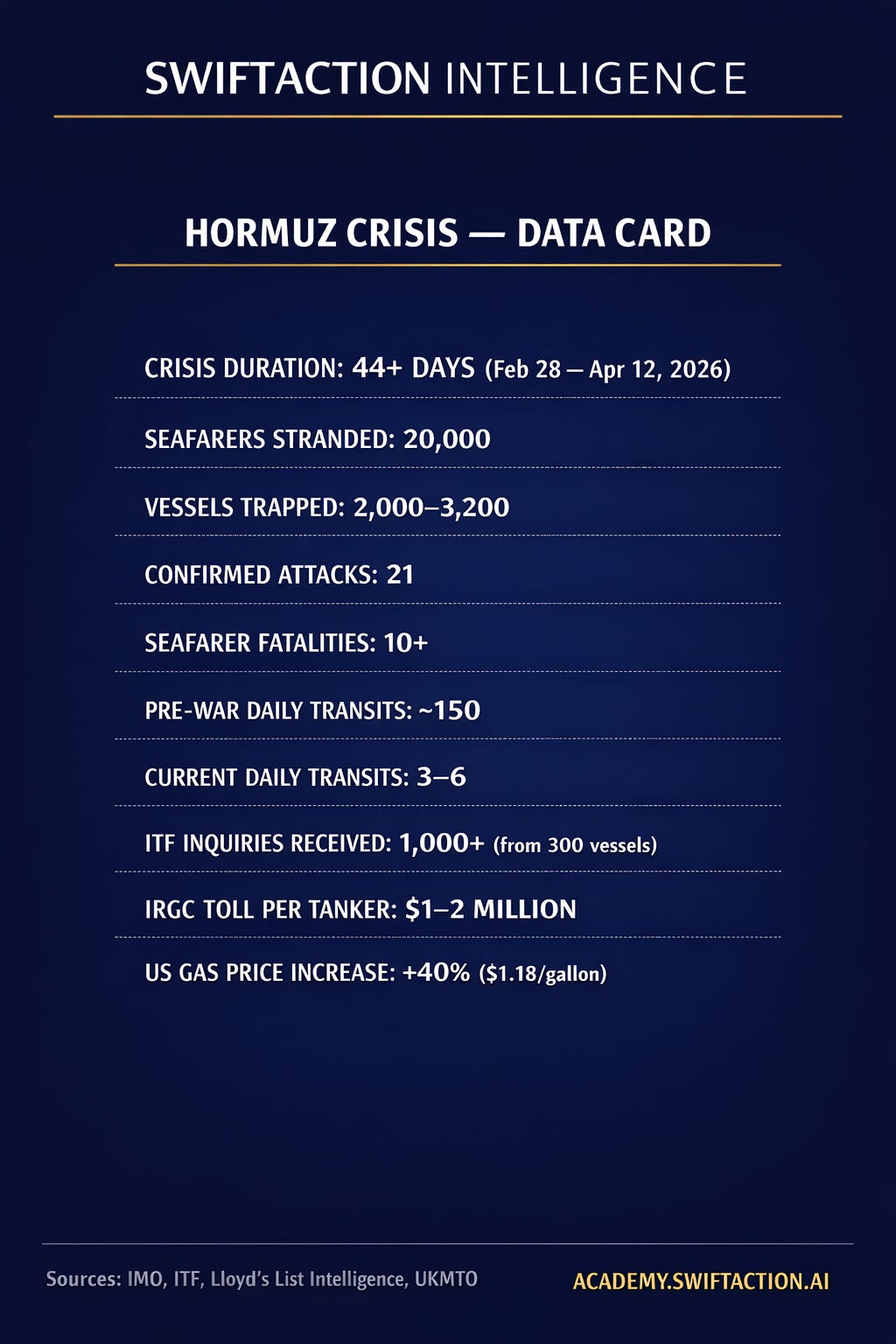
The Strait of Hormuz is 21 nautical miles wide at its narrowest point. Before February 28, approximately 150 vessels transited it daily. As of April 12, that number is between three and six — and most of those are Iranian-linked or sailing under the informal protection of bilateral deals with Tehran.
Iran’s Islamic Revolutionary Guard Corps controls passage through what maritime analysts have termed the “Tehran Tollbooth.” Ships transiting the northern corridor require IRGC permission and, according to multiple reports, pay tolls of $1 to $2 million per tanker in Chinese yuan or cryptocurrency.
The vessels that cannot transit — or will not risk it — sit at anchor. They sit off Fujairah. They sit in Iraqi waters. They sit in the holding areas off the UAE coast. And their crews sit with them.
The human toll is compounding:
Vessels attacked: Skylight (March 1, 1 confirmed casualty, 1 missing), MKD Vyom (March 1, 1 casualty), Stena Imperative (March 1, 1 port worker casualty), Mussafah 2 (March 6, 4 casualties), Mayuree Naree (March 11, 3 missing, presumed lost), Safesea Vishnu (March 11, 1 casualty). Additional vessels struck include Sonangol Namibe, Parimal, Gas Al Ahmadiah, Halul 69, and others.
Crew conditions: A 28-year-old Indian sailor stranded on a small oil vessel in Iraqi waters told NBC News: “We don’t sleep at night. We stay up on deck because you never know what might happen next.” The CEO of a major Hong Kong-based shipping conglomerate described the psychological reality: “When the routine breaks down is when people start to unravel. The sun goes down, and that’s when the fear comes because most of the attacks happen in the dark.”
Without structured competency-based training to anchor the day, that unravelling accelerates — and competency degrades with it.
Medical access: The captain of an oil tanker stranded near Dubai suffered a suspected heart attack on March 18 and was unable to receive medical attention in time. He did not survive.
Repatriation: The International Transport Workers’ Federation has received more than 1,000 inquiries from seafarers on 300 vessels. Most are requesting repatriation. The routes out — through Oman to Muscat, through Saudi Arabia — are slow, bureaucratic, and limited. Many seafarers have lost their documents in attacks or cannot leave vessels that require minimum manning to remain operational.
The IMO Council has appealed for a halt to all attacks on ships and called upon Member States to ensure the continuous provision of water, food, fuel and essential supplies. The UN described the situation as having “no precedent” in the post-World War II era.
📊 By The Numbers
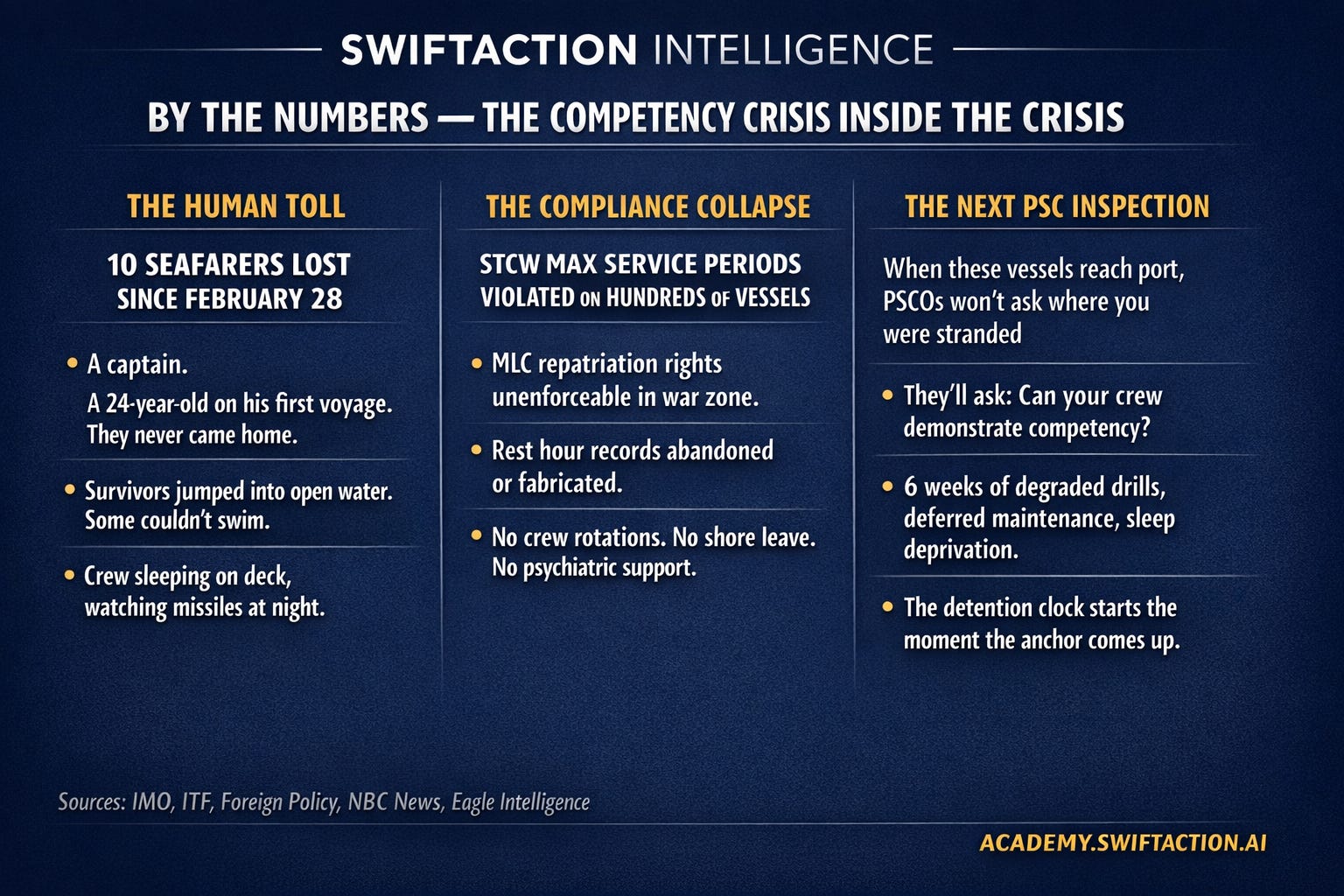
20,000 seafarers stranded aboard vessels in the Persian Gulf, unable to transit, unable to leave, unable to return home. (Source: IMO, April 2026)
2,000–3,200 vessels trapped west of the Strait of Hormuz, including oil and gas tankers, bulk carriers, cargo ships, and six cruise liners. (Source: IMO, Lloyd’s List Intelligence)
10 seafarer fatalities confirmed by IMO since February 28. (Source: IMO Incident Tracker)
21 confirmed attacks on commercial shipping in the Persian Gulf, Strait of Hormuz, and Gulf of Oman. (Source: IMO, UKMTO)
44+ days since the crisis began on February 28. STCW and MLC set maximum continuous service periods. Hundreds of vessels are now in violation. (Source: STCW, MLC 2006)
1,000+ inquiries received by the International Transport Workers’ Federation from seafarers on 300 vessels requesting information or repatriation. (Source: ITF, UN News)
6,223 seafarers abandoned globally in 2025 — a record. Indians were hardest hit with 1,125 abandoned by year-end. The Hormuz crisis is adding to a workforce already at breaking point. (Source: ITF, Foreign Policy)
40% increase in US gasoline prices since the start of the war (approximately $1.18 per gallon). The economic impact is global. The human impact is on 20,000 people the world has largely forgotten. (Source: AAA, CNN)
🔍 The Training Failure
The Hormuz crisis is not a training failure in the traditional SwiftAction Intelligence sense. No PSCO flagged a deficiency that went unaddressed. No single vessel’s inspection record predicted what happened. This is a systemic training failure — one that is being created in real time, across an entire stranded fleet, and will manifest at the next port of inspection for every vessel currently trapped in the Gulf.
Here is what is degrading:
Emergency preparedness is theoretical until it isn’t. Many of the Skylight’s surviving crew were on their first voyage. Some could not swim. They survived because they found lifejackets and jumped. The vessel’s captain was confirmed lost. A 24-year-old crew member was never found. The crew of the Mayuree Naree were rescued by the Royal Navy of Oman after their vessel caught fire — three of their colleagues were never found. These are not drills. These are the scenarios that competency-based STCW emergency preparedness training (PSC Code 15107) is designed to prepare crews for. The question for every other vessel in that Gulf: if a projectile hits your ship tonight, can your crew execute an abandon ship procedure? When was the last time they drilled it?
Rest hours have collapsed. STCW and MLC set maximum continuous service periods and mandatory rest hours. Crews stranded for 6+ weeks beyond their planned rotation are in violation — not through any fault of their own, but through the force of circumstance. Companies are filing force majeure declarations, but these carry limited legal weight in some jurisdictions. What is not theoretical is the effect: fatigued crews make errors. PSC Code 18201 (Fitness For Duty — Work And Rest Hours) exists because the industry knows this. When these vessels finally move, the crews operating them will have been awake, stressed, and underrested for weeks.
Maintenance has been deferred. Vessels at anchor still require planned maintenance. Generators run. Systems need servicing. But when the crew is focused on survival — on watching the sky at night, on rationing supplies, on maintaining communication with families — the PMS entries stop. PSC Code 15109 (Maintenance Of The Ship And Equipment) will be the first thing a PSCO opens when these vessels reach port. Under normal circumstances, a 6-week gap in the maintenance log would be grounds for further investigation, and potentially for detention. Whether MOU regimes will issue guidance for vessels stranded in conflict zones — as some did during COVID — remains to be seen. Fleet operators who prepare as though no exemption will come are the ones who won’t need one.
Fire response readiness is unknown. The vessels that were attacked — Mussafah 2, Mayuree Naree, Skylight, Sonangol Namibe — all experienced fires. The crews that survived did so because they could respond. Some operators have implemented morale and welfare programmes — online libraries, deck activities, regular check-ins with shore teams. These efforts matter. But what about fire drills? PSC Code 04109 (Fire Drills) requires regular fire drills. PSC Code 07125 (Evaluation Crew Performance — Fire Drills) requires that crews can demonstrate competency, not just record attendance. Six weeks of inactivity and psychological stress erode both.
The master’s authority is being tested. Masters are facing pressure from charterers to transit the Tollbooth. MLC gives seafarers the right to refuse to sail into warlike conditions without penalty. PSC Code 15104 (Masters Responsibility And Authority) covers the master’s obligation to exercise independent judgment on safety matters. But as one maritime commentator observed: “Rights on paper are not the same as a way home.” The system assumes a functioning framework around the master’s authority. That framework has collapsed.
🛡️ What Should Have Happened — And What Should Be Happening Right Now
This is not an article about what should have happened before the war. No training program prevents a geopolitical crisis. This is about what should be happening right now, aboard those 2,000 vessels, while the crews wait.
Twenty thousand seafarers have smartphones. Internet access is limited but available on many vessels. Not every crew member is in a position to train — some are on heightened watch, some are rationing supplies, some are managing the psychological weight of six weeks in a war zone. But where connectivity exists and where a crew member has 45 minutes, the question is whether anyone has told them a training option exists.
The following 10 SwiftAction Academy competency-based training courses map directly to the competency gaps this crisis is creating. Each course takes approximately 45 minutes, assesses the seafarer against the specific competency standard, and produces a completion certificate referencing the PSC deficiency code — the same code a PSCO will check at the next port of inspection. Each module is mapped to a single PSC code, tests against a defined competency threshold, and produces documented evidence that the crew member met it.
PSC Code - Course - Why It Matters Right Now
04110 - Abandon Ship Drills - Skylight crew jumped into open water. Mayuree Naree crew abandoned under fire. Can yours?
04109 - Fire Drills - Tankers ablaze across the Gulf. The crew that drills is the crew that survives.
15107 - Emergency Preparedness - 21 attacks, 10 casualties. Emergency preparedness is no longer theoretical for any vessel in this zone.
07125 - Evaluation Crew Performance (Fire Drills) - Not “did you hold a drill” — “can the crew perform?” The assessment code PSCOs check.
11118 - Lifejackets Incl. Provision & Disposition - Skylight survivors wore lifejackets and jumped. Some couldn’t swim. Where are your lifejackets right now?
11119 - Immersion Suits - Crews evacuating into open water after projectile strikes. STCW requires donning within 2 minutes.
15104 - Masters Responsibility And Authority - Masters facing charterer pressure to transit. MLC gives the right to refuse. Does the master know?
18201 - Fitness For Duty — Work And Rest Hours - STCW max service periods blown. Rest hour records abandoned. This code triggers MLC detention.
15109 - Maintenance Of The Ship And Equipment - 6-week PMS gap. Generators running without logged servicing. First thing a PSCO opens.
15105 - Resources And Personnel - No rotations. No shore leave. No psychiatric support. ISM requires adequate resources. Compliance is impossible.
These are among the PSC codes most likely to surface when the Hormuz fleet reaches port. The courses are available. Whether awareness reaches the crews who need them depends on the operators who employ them.
👉 Try a free course with no credit card
👀 What to Watch
The ceasefire is shaky. The two-week ceasefire announced April 8 has not reopened the strait. Iran’s IRGC claimed shipping slowed after what it called an Israeli ceasefire violation in Lebanon. US Navy destroyers entered the strait on April 11 for mine clearance operations. Iran called it a ceasefire violation. The operational status of the strait remains undefined.
The PSC wave is coming. When these vessels eventually transit — whether in days, weeks, or months — they will arrive at ports with PSC regimes that have not yet adjusted their inspection criteria for war-zone exposure. As of April 12, there is no “Hormuz exemption” in the Paris MOU targeting matrix — though flag states and MOU regimes may issue guidance, as some did during COVID. A vessel with a 6-week maintenance gap, expired rest hour records, and a crew that hasn’t drilled in over a month should prepare to be inspected to the same standard as every other vessel.
Crew recruitment will suffer. Multiple manning agencies have flagged recruitment challenges as word of the Hormuz stranding spreads through Filipino and Indian maritime labor markets. Reputation damage for operators who failed to maintain crew welfare will take years to repair. The ITF’s record of 6,223 abandoned seafarers in 2025 was already a crisis. Hormuz is compounding it.
The third crisis in five years. COVID trapped crews aboard vessels for months with no shore leave and no crew changes. The Houthi Red Sea campaign resulted in casualties and hostages. Hormuz is the third large-scale seafarer welfare crisis since 2020. The industry’s response mechanisms — MLC, flag state intervention, P&I coverage — have failed to scale each time. The pattern is no longer an anomaly. It is the operating environment.
The 2026 CIC is coming. The Paris and Tokyo MOUs’ joint Concentrated Inspection Campaign on cargo securing runs September to November 2026. Vessels that have been at anchor for weeks may face cargo shifting or lashing degradation. For vessels emerging from the Gulf into CIC-active ports, the inspection scrutiny will be layered — standard PSC plus CIC questionnaire.
🚨 SwiftAction Signal
The Skylight’s survivors were on their first voyage. Some couldn’t swim. They survived because they found a lifejacket. The vessel’s captain was confirmed lost. A 24-year-old crew member was never found. His family has not seen his body. The MLC says these seafarers have a right to repatriation. The STCW says they should not be serving beyond maximum contract periods. The ISM Code says they should have adequate resources and personnel. Every one of those protections exists on paper.
When these crews finally reach port, the PSCO will not ask about the paper. They will ask the crew to demonstrate competency. A competency-based SwiftAction course takes 45 minutes, costs $17, and tests the seafarer against the specific standard the PSCO will check. Not every stranded crew member can access one. But for those who can, the completion certificate referencing the specific PSC deficiency code may be the only documented proof of competency they carry to their next inspection. After six weeks of fear, fatigue, and deferred everything — that certificate matters.
The MLC rights existed on paper. The competency gap compounded at sea.
⚓ The SwiftAction Team SwiftAction Intelligence Is Published Daily.
For Partnership Inquiries Contact admin@swiftaction.ai