

|⚓ About Us | 📋 Training Catalog | 🎯 CIC 2026 Bundle |
🏅 Free Course Access (No Credit Card)
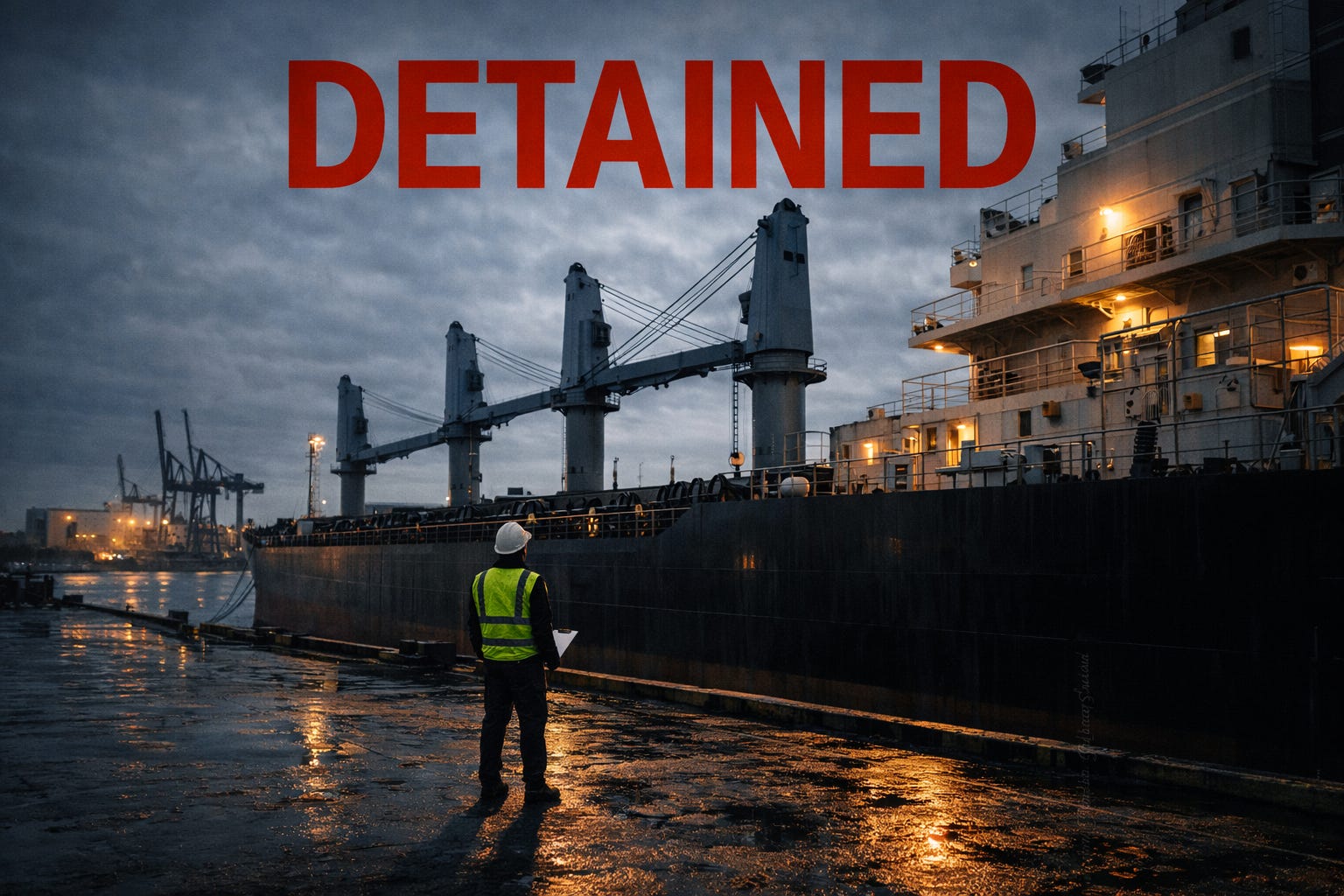
On June 11, 2024, the Liberian-flagged bulk carrier HG PERTH arrived at Newport, Wales, and was boarded by surveyors from the UK Maritime and Coastguard Agency for a port state control inspection under the Paris MOU regime. What they found was not a vessel with one or two items out of place. It was a vessel with fifty-three deficiencies. Ten of those deficiencies were serious enough to constitute grounds for detention. The ship was immediately detained. It did not sail again for thirty-one days.
Nobody died. Nobody was injured. There was no collision, no fire, no grounding. There was just an inspection. And that inspection revealed a vessel where the crew could not demonstrate control of a fire drill, where lifejackets were not as required, where the launching arrangements for survival craft did not function, where fire doors did not meet standards, where personal fire safety equipment was deficient, where ventilators and air pipes were compromised, where the ballast water management system was malfunctioning, where crew sleeping quarters did not meet the Maritime Labour Convention, and where the International Safety Management system, the backbone of every vessel’s operational safety culture, was found to be not as required. Fifty-three findings. Ten grounds for detention. Thirty-one days alongside.
The HG PERTH is a 176-metre, 18,722 GT bulk carrier operated by Shanghai Zhengdong Shipping Co. Vessel databases list her build year variously as 2008 or 2011. She is classified by Bureau Veritas with her ISM Document of Compliance issued by China Classification Society. She was not on a blacklisted flag. She was not classified by a non-IACS society. She was a mainstream commercial vessel. And she could not pass a fire drill.
The HG PERTH was detained in June 2024. The global trends that produced this detention have only worsened since. The PSC detention rate rose to 3.43% in 2025, exceeding the 3% threshold. ISM-related deficiencies remained the most prevalent deficiency category in PSC inspections worldwide. This is not old news. It is a pattern that is accelerating.
📋 In this issue:
🔍 The Inspection: 53 Findings in One Visit
📊 By The Numbers
🔥 The Training Failures the Inspection Exposed
🛡️ How SwiftAction Training Addresses These Gaps
👀 What to Watch
🚨 SwiftAction Signal
🔔 Not yet subscribed? SwiftAction Intelligence Covers Maritime Accidents, Detentions, and the Training Failures Behind Them. Subscribe For Free!
📋 Competency-Based Maritime Training Mapped to Every PSC Deficiency Code
→ Academy.SwiftAction.AI
🎯 2026 CIC Cargo Securing Bundle: 30 Courses, 60% Off
→ CIC Bundle 60% OFF
📌 SwiftAction Data Card
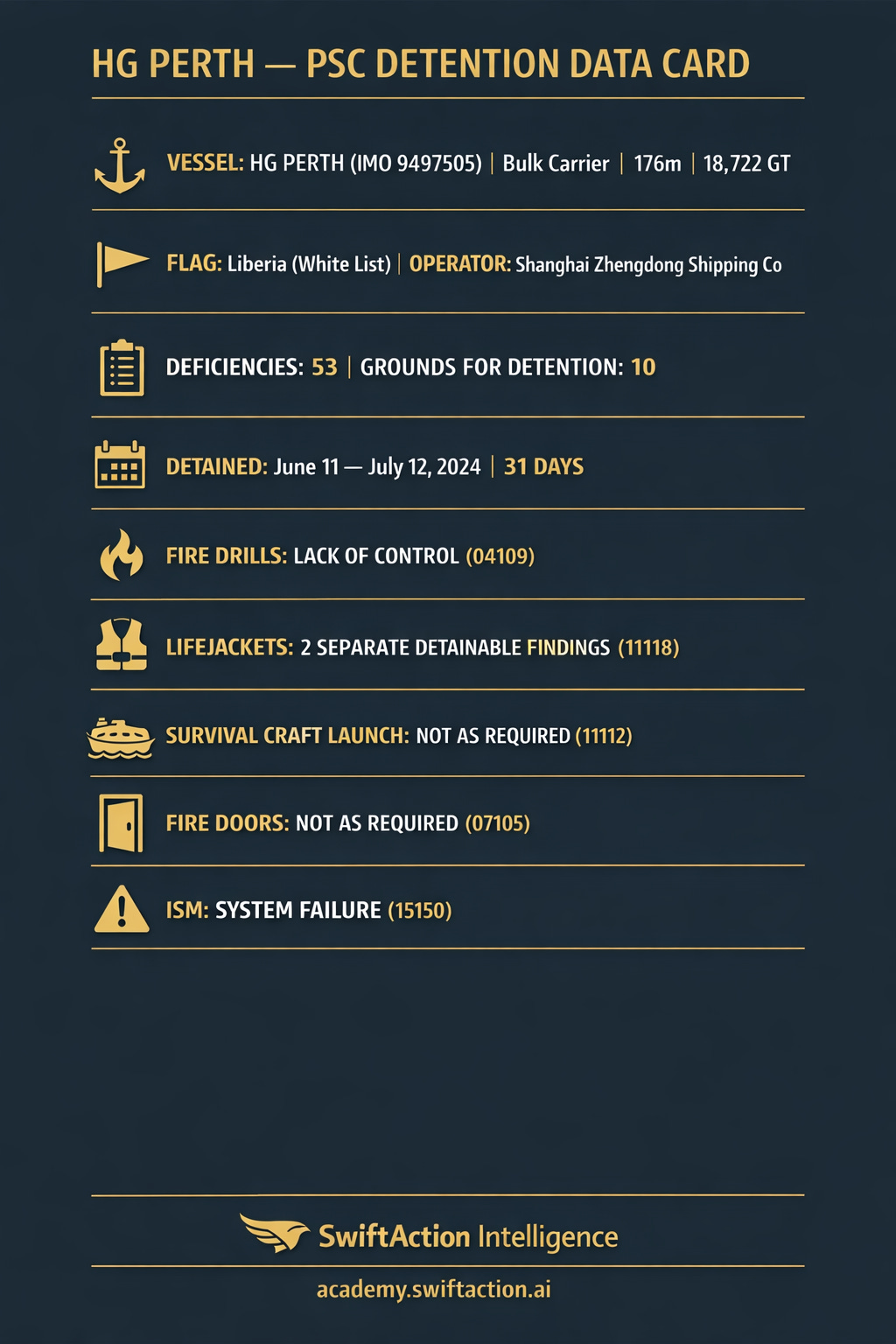
→ ⚓ June 11, 2024: UK Maritime and Coastguard Agency surveyors boarded the bulk carrier HG PERTH (IMO 9497505) at Newport, Wales, for a port state control inspection under the Paris MOU regime. The vessel was immediately detained. (Source: UK MCA Monthly Detention List (July 2024), published August 8, 2024)
→ 📋 53 deficiencies were recorded during the inspection, with 10 grounds for detention. The inspection was suspended due to the volume of findings. (Source: UK MCA Monthly Detention List (July 2024), published August 8, 2024)
→ 🔥 Fire drills — Lack of control (Code 04109). When PSC officers ordered a fire drill, the crew could not demonstrate competent control of the exercise. This is a detainable deficiency under SOLAS Chapter III. (Source: UK MCA Monthly Detention List (July 2024), published August 8, 2024)
→ 🦺 Lifejackets — Not as required (Code 11118). Two separate detainable deficiency entries were recorded for lifejackets, indicating systemic failures in provision, condition, or disposition of lifesaving appliances. (Source: UK MCA Monthly Detention List (July 2024), published August 8, 2024)
→ 🚤 Launching arrangements for survival craft — Not as required (Code 11112). The system designed to get the crew off the ship in an emergency did not function to the required standard. (Source: UK MCA Monthly Detention List (July 2024), published August 8, 2024)
→ 🚪 Fire doors/openings in fire-resisting divisions — Not as required (Code 07105). Fire containment barriers, the structures designed to prevent fire from spreading between compartments, were deficient. (Source: UK MCA Monthly Detention List (July 2024), published August 8, 2024)
→ 🧯 Personal equipment for fire safety — Not as required (Code 07111). The equipment that individual crew members need to fight a fire, including fireman’s outfits and breathing apparatus, was deficient. (Source: UK MCA Monthly Detention List (July 2024), published August 8, 2024)
→ 📄 ISM — Not as required (Code 15150). The International Safety Management system, the documented framework that is supposed to ensure every other safety system functions, had failed. (Source: UK MCA Monthly Detention List (July 2024), published August 8, 2024)
→ 📅 31 days detained. The HG PERTH was detained on June 11, 2024 and released on July 12, 2024. Thirty-one days of lost revenue, off-hire costs, repair expenses, and reputational damage. (Source: UK MCA Monthly Detention List (July 2024), published August 8, 2024)
→ 🏢 Operator: Shanghai Zhengdong Shipping Co. Classification society: Bureau Veritas. ISM Document of Compliance issued by China Classification Society. ISM Safety Management Certificate issued by Bureau Veritas. Flag: Liberia (Paris MOU white list). (Source: UK MCA Monthly Detention List (July 2024), published August 8, 2024)
🔍 The Inspection: 53 Findings in One Visit
On June 11, 2024, UK Maritime and Coastguard Agency surveyors conducted a port state control inspection of the HG PERTH at Newport, Gwent, under the Paris MOU regime, according to the UK MCA monthly detention list for July 2024, published on August 8, 2024.
The HG PERTH is a 176-metre Liberian-flagged bulk carrier, IMO number 9497505, with a gross tonnage of 18,722. Vessel databases list her build year variously as 2008 (FleetMon) or 2011 (VesselFinder, MarineTraffic). She is operated by Shanghai Zhengdong Shipping Co, classified by Bureau Veritas, with her ISM Document of Compliance issued by China Classification Society and her Safety Management Certificate issued by Bureau Veritas.
The inspection recorded fifty-three deficiencies. Ten of those deficiencies were serious enough to constitute grounds for detention. The inspection was suspended, a designation the MCA uses when the volume or severity of findings requires additional time or resources to complete the full assessment.
The ten grounds for detention, as published by the UK MCA, were:
Code - Defective Item - Nature of Defect
18306 - Sleeping room, additional spaces - Not as required
07105 - Fire doors/openings in fire-resisting divisions - Not as required
03108 - Ventilators, air pipes, casings - Not as required
14811 - Ballast Water Management System - Malfunctioning
11118 - Lifejackets incl. provision and disposition - Not as required
11118 - Lifejackets incl. provision and disposition - Not as required
11112 - Launching arrangements for survival craft - Not as required
04109 - Fire drills - Lack of control
15150 - ISM - Not as required
07111 - Personal equipment for fire safety - Not as required
The deficiencies span six of the most critical PSC categories: Emergency Systems (Category 04), Fire Safety (Category 07), Life Saving Appliances (Category 11), MARPOL/Pollution Prevention (Category 14), ISM (Category 15), and Maritime Labour Convention (Category 18). An additional structural category, Load Lines (Category 03), was also represented. When a single inspection produces findings across this many categories, it indicates that the failures are not isolated to one department or one system. They are systemic.
The vessel was detained for thirty-one days, from June 11 to July 12, 2024. During that period, all identified deficiencies had to be rectified to the satisfaction of the MCA before the vessel was permitted to sail. Shanghai Zhengdong Shipping Co has not publicly commented on the detention. The vessel was released on July 12, 2024 after all deficiencies were rectified. For a bulk carrier, thirty-one days of off-hire represents significant commercial losses in addition to the direct costs of rectification, surveyor attendance, and class society involvement.
The HG PERTH had a prior safety incident. In June 2022, a heavy machinery vehicle fell onto the vessel’s cargo deck during offloading operations at Terminal Two, Valparaiso, Chile. The vehicle reportedly was not secured by leading lashes, lost balance, and flipped onto the deck, according to FleetMon reporting. No injuries were reported. The incident, while different in nature from the 2024 PSC detention, points to a pattern of operational and procedural gaps on the same vessel.
📊 By The Numbers
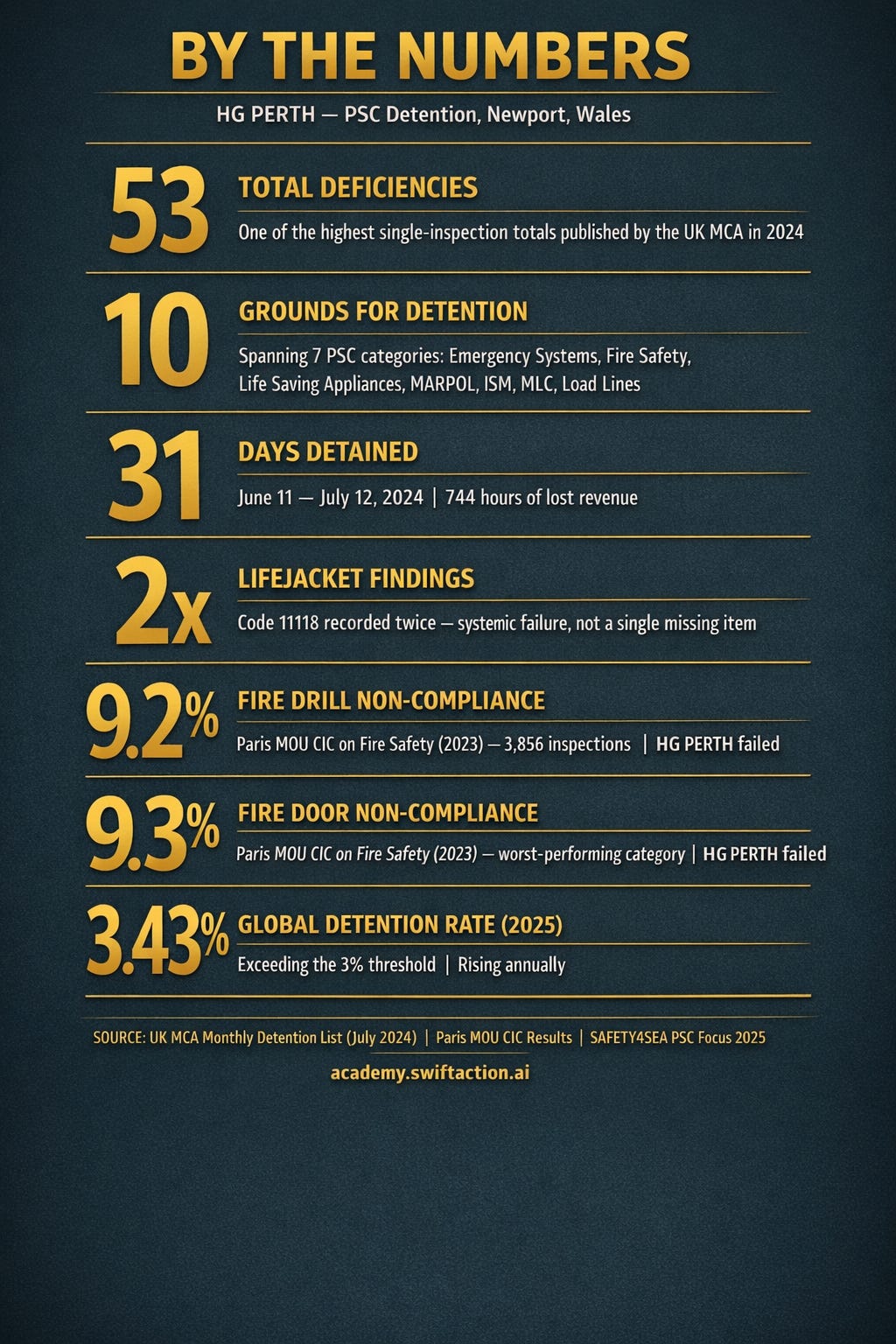
→ 53 total deficiencies recorded in a single port state control inspection, one of the highest single-inspection totals published by the UK MCA in 2024. (Source: UK MCA Monthly Detention List (July 2024), published August 8, 2024)
→ 10 grounds for detention, spanning fire safety, lifesaving appliances, emergency systems, ISM, MARPOL, MLC, and structural categories. (Source: UK MCA Monthly Detention List (July 2024), published August 8, 2024)
→ 31 days detained at Newport, Wales, from June 11 to July 12, 2024. (Source: UK MCA Monthly Detention List (July 2024), published August 8, 2024)
→ 6 categories of PSC deficiency represented in the grounds for detention alone, indicating systemic failure across multiple vessel departments. (Source: UK MCA Monthly Detention List (July 2024), published August 8, 2024)
→ 2 separate lifejacket deficiencies recorded as grounds for detention (Code 11118), indicating the problem was not a single missing item but a systemic failure in provision, maintenance, or disposition. (Source: UK MCA Monthly Detention List (July 2024), published August 8, 2024)
→ 9.2% non-compliance for fire drill performance and 9.3% non-compliance for fire door maintenance — the two worst-performing categories in the Paris MOU’s 2023 Concentrated Inspection Campaign on Fire Safety across 3,856 inspections. The HG PERTH had detainable findings in both. (Source: Paris MOU CIC results, as reported by SAFETY4SEA and IIMS)
→ ISM-related deficiencies remained the most prevalent deficiency category in PSC inspections in 2025, according to AMSA’s 2025 Annual PSC Report. DNV’s Q2 2025 detention summary identified ISM as one of the primary reasons vessels are detained. The HG PERTH’s ISM finding (Code 15150) indicates the safety management system failed to prevent or identify the other fifty-two deficiencies before the PSCO did. (Sources: AMSA 2025 PSC Annual Report; DNV Q2 2025 PSC Summary)
→ 3.43% — the global PSC detention rate in 2025, which exceeded the 3% threshold, according to SAFETY4SEA. The detention rate has been rising annually. (Source: SAFETY4SEA PSC Focus 2025)
Related Coverage
Fifty-three deficiencies is not a bad day. It is a failed system. The crew could not run a fire drill. They could not demonstrate that lifejackets were where they should be. The survival craft launching arrangements did not work. The fire doors were deficient. The personal firefighting equipment was deficient. The ISM system that is designed to catch all of this before a PSCO does had itself failed. Below: the specific training failures behind each finding, the PSC codes that map to each gap, and what fleet managers can do before their next inspection.
🔥 The Training Failures the Inspection Exposed
The HG PERTH’s fifty-three deficiencies describe a vessel where multiple layers of the safety system failed simultaneously. But the training-related findings are the ones that matter most, because they reveal not just broken equipment but a crew that was not competent to use the equipment even if it had been working.
Fire drills — Lack of control.
Code 04109. This is the finding that defines this case. When a PSCO orders a fire drill during a PSC inspection, they are not checking whether the crew has read a manual. They are watching whether the crew can execute a coordinated emergency response under observation. SOLAS Chapter III, Regulation 19 requires every crew member to participate in at least one fire drill per month. If more than 25% of the crew has not participated in a fire drill within the previous month, a drill must be conducted within 24 hours of leaving port. The crew of the HG PERTH could not demonstrate control of this exercise. The PSCO recorded the deficiency as detainable. A vessel that cannot run a fire drill cannot fight a fire.
Crew familiarization with lifejackets — Two separate detainable findings.
Code 11118 was recorded twice as a ground for detention. SOLAS Chapter III requires lifejackets to be provided for every person on board, readily accessible, of approved type, and crew must be trained in their use. Two separate detainable entries for the same code indicates the problem was not one missing lifejacket in one cabin. It suggests a systemic failure in the provision, condition, storage, or crew knowledge related to lifesaving appliances across the vessel. PSCOs check whether crew members know where their lifejackets are, whether they can don them correctly, and whether the lifejackets themselves meet the required standard. A failure on any of these points is a failure of training.
Launching arrangements for survival craft — Not as required.
Code 11112. The davits, winches, falls, and release mechanisms that are supposed to put lifeboats and liferafts into the water did not meet the required standard. SOLAS Chapter III, Regulation 19 requires lifeboats to be launched and manoeuvred at least once every three months. This is not only a maintenance requirement — it is a training requirement. The crew member in charge of each survival craft must have complete knowledge of the craft’s operation and equipment. If the launching arrangements are not functional, or if the crew cannot demonstrate competence in their operation, the vessel is detainable. On the HG PERTH, both the equipment and the competency gap appear to have been present.
Fire doors — Not as required.
Code 07105. Fire doors and openings in fire-resisting divisions are the structural barriers that contain fire within a single compartment and prevent it from spreading to adjacent spaces. The Paris MOU’s 2023 Concentrated Inspection Campaign on Fire Safety found a 9.3% non-compliance rate for fire door maintenance across 3,856 inspections. The HG PERTH fell into that non-compliant category. Fire doors require regular inspection, testing, and crew awareness. If a fire door is jammed open, blocked, corroded, or improperly maintained, the entire fire containment strategy of the vessel fails. This is a maintenance failure, but it is also a training failure: crew must know which doors are fire doors, how they function, what condition they must be in, and how to verify their integrity during rounds.
Personal fire safety equipment — Not as required.
Code 07111. Fireman’s outfits, self-contained breathing apparatus, fire blankets, and other personal protective equipment required under SOLAS Chapter II-2 were found deficient. This equipment is the last line of defense for any crew member who is ordered into a smoke-filled space. If the equipment is not there, not maintained, or not understood by the crew, the fire drill failure (Code 04109) becomes even more dangerous: the crew cannot run the drill, and even if they could, the equipment they would need to fight the fire does not meet the standard.
ISM — Not as required.
Code 15150. The International Safety Management Code requires every vessel to have a documented Safety Management System that ensures safe operation and environmental protection. The ISM finding on the HG PERTH is the capstone of the entire inspection. It means the PSCO concluded that the fifty-two other deficiencies, taken collectively, constituted evidence of a failure or lack of effectiveness of the ISM Code implementation on board. The SMS is the system that is supposed to ensure fire drills happen, lifejackets are inspected, survival craft are tested, fire doors are maintained, and personal safety equipment is in working order. When the PSCO writes Code 15150, they are saying: the system that is supposed to prevent all of these failures has itself failed.
🛡️ How SwiftAction Training Addresses These Gaps
The HG PERTH was not a casualty. Nobody was hurt. But the vessel’s fifty-three deficiencies describe a gap between what the crew was supposed to know and what the crew could demonstrate. That gap is what PSCOs check for at every port. It is what training is designed to close.
The following SwiftAction Academy courses map directly to the detainable deficiencies identified on the HG PERTH. Each course is verified against the SwiftAction Academy catalog (February 2026 edition). Each course produces a completion certificate referencing the specific PSC deficiency code, creating a documented record that the crew was assessed on the exact competency a PSCO will check.
Fire Drills (Code 04109). The HG PERTH’s crew could not demonstrate control of a fire drill. SwiftAction’s Code 04109 module covers fire drill planning and execution under SOLAS Chapter III, Regulation 19, the roles and responsibilities of fire parties, boundary cooling teams, and command personnel, and the standards PSCOs use to assess whether a drill is satisfactory or unsatisfactory.
Crew Familiarization with Emergency Systems (Code 04121). A vessel with two separate lifejacket deficiencies and failed fire drills has a crew that is not familiar with the ship’s emergency systems. SwiftAction’s Code 04121 module covers the SOLAS requirements for crew familiarization, the onboard training obligations under STCW, and the specific items PSCOs assess when testing crew knowledge of emergency procedures.
Lifejackets incl. Provision and Disposition (Code 11118). Two detainable entries for lifejackets on a single inspection. SwiftAction’s Code 11118 module covers SOLAS Chapter III requirements for lifejacket provision, stowage, and maintenance, crew obligations for regular inspection, and the donning procedures PSCOs observe during drills.
Launching Arrangements for Survival Craft (Code 11112). The system designed to put lifeboats in the water did not work. SwiftAction’s Code 11112 module covers SOLAS requirements for survival craft launching, the competency standards for the crew member in charge of each craft, and the quarterly drill and maintenance cycle.
Fire Doors/Openings in Fire-Resisting Divisions (Code 07105). Fire doors on the HG PERTH were deficient. SwiftAction’s Code 07105 module covers SOLAS Chapter II-2 requirements for fire-resisting divisions, the crew’s role in maintaining fire door integrity during daily rounds, and the common deficiencies PSCOs identify.
Personal Equipment for Fire Safety (Code 07111). The crew’s personal firefighting equipment was deficient. SwiftAction’s Code 07111 module covers SOLAS Chapter II-2 requirements for fireman’s outfits, SCBA, and personal protective equipment, including inspection, maintenance, and donning procedures.
Ventilators, Air Pipes, Casings (Code 03108). Structural deficiencies in the vessel’s ventilation and air pipe systems. SwiftAction’s Code 03108 module covers the Load Line Convention requirements for watertight integrity of ventilators and air pipes, and the crew’s maintenance obligations.
ISM (Code 15150). The entire safety management system failed. SwiftAction’s ISM module covers the structure and implementation of the ISM Code, the master’s responsibility, company responsibilities, shipboard operations, emergency preparedness, and the non-conformity reporting process that is supposed to catch failures before a PSCO does.
Ballast Water Management System (Code 14811). The BWMS was malfunctioning. SwiftAction’s Code 14811 module covers the BWM Convention requirements for system operation, maintenance, and crew competency in ballast water management procedures.
Sleeping Room, Additional Spaces (Code 18306). Crew accommodation did not meet MLC requirements. SwiftAction’s Code 18306 module covers the Maritime Labour Convention standards for sleeping room conditions, ventilation, lighting, and the crew’s right to decent living conditions at sea.
Why this matters for your fleet: The HG PERTH was a mainstream bulk carrier on a white-listed flag, classed by a major IACS member. It was not a dark fleet vessel or a blacklisted operator. It was the kind of ship that trades in your port, carries your cargo, and competes for your charters. And it could not pass a fire drill. The difference between the HG PERTH and a clean inspection is whether the crew’s training addressed the exact items the inspector checked, and whether there is a documented record to prove it. SwiftAction’s completion certificates reference the specific PSC deficiency code, creating that documented link between the finding, the training, and the crew member’s assessed competency.
SwiftAction courses relevant to this case:
PSC Code - Relevance
04109: Fire Drills - Crew could not control fire drill
04121: Crew Familiarization with Emergency Systems - Systemic emergency preparedness failure
11118: Lifejackets incl. Provision and Disposition - Two separate detainable lifejacket findings
11112: Launching Arrangements for Survival Craft - Survival craft could not be launched
07105: Fire Doors/Openings in Fire-Resisting Div. - Fire containment barriers deficient
07111: Personal Equipment for Fire Safety - Fireman’s outfit/SCBA deficient
03108: Ventilators, Air Pipes, Casings - Structural watertight integrity compromised
15150: ISM - Safety management system failed
14811: Ballast Water Management System - BWMS malfunctioning
18306: Sleeping Room, Additional Spaces - MLC crew welfare requirements unmet
04110: Abandon Ship Drills - Also relevant: lifejacket + survival craft pattern
👉 Browse all Fire Safety courses: academy.swiftaction.ai/collections/07-fire-safety
👉 Browse all Life Saving Appliances courses: academy.swiftaction.ai/collections/11-life-saving-appliances
👉 Browse all Emergency Systems courses: academy.swiftaction.ai/collections/04-emergency-systems
👉 Browse all ISM courses: academy.swiftaction.ai/collections/15-ism
👉 Try a free course: academy.swiftaction.ai/enroll/3527149?price_id=4454402
👀 What to Watch
The HG PERTH’s detention occurred in June 2024, but its relevance to fleet operators has only increased. The global PSC detention rate rose to 3.43% in 2025, exceeding the 3% threshold, according to SAFETY4SEA’s PSC Focus 2025 analysis. ISM-related deficiencies remained the most prevalent deficiency category in PSC inspections globally in 2025, according to AMSA’s 2025 Annual PSC Report. DNV’s Q2 2025 detention summary identified ISM as one of the primary reasons vessels are detained.
The Paris MOU’s 2023 Concentrated Inspection Campaign on Fire Safety found a 9.2% non-compliance rate for fire drills across 3,856 inspections, and a 9.3% non-compliance rate for fire door maintenance. These were the two worst-performing categories in the entire campaign. The HG PERTH had both. The Paris MOU concluded that lack of crew familiarity with fire drills undermines readiness to respond effectively to fire emergencies. That conclusion is a direct description of what happened on the HG PERTH.
The 2026 Paris MOU and Tokyo MOU Concentrated Inspection Campaign on Cargo Securing is underway. While cargo securing is a different category from the HG PERTH’s fire safety and lifesaving appliance failures, the principle is the same: PSCOs will assess whether the crew can demonstrate competency in the specific area being tested, not just whether the paperwork exists. Fleet managers whose crews have not been trained on the specific deficiency codes PSCOs check will face the same gap that held the HG PERTH at Newport for thirty-one days.
For fleet operators, the HG PERTH case demonstrates that a white-listed flag and a major classification society do not insulate a vessel from detention. The vessel’s flag (Liberia) is on the Paris MOU white list. The classification society (Bureau Veritas) is an IACS member. The ISM Document of Compliance was issued by China Classification Society, also an IACS member. None of that prevented fifty-three deficiencies. The gap was not in the regulatory framework. The gap was in the implementation on board — specifically in the crew’s ability to demonstrate the competencies the regulatory framework requires. Over 90% of global trade moves by sea on vessels like this one. The cargo in the hold was destined for someone’s supply chain. If a fire had started at sea, the crew that failed the drill at Newport would have been the crew fighting it.
🚨 SwiftAction Signal
Fifty-three deficiencies in one inspection. The crew could not run a fire drill. There were two separate detainable findings for lifejackets. The survival craft launching arrangements did not work. Fire doors were deficient. The personal firefighting equipment was deficient. The ISM system that was supposed to catch all of this had failed. This was not a dark fleet vessel hiding from inspectors. This was a Liberian-flagged bulk carrier, Bureau Veritas class, with IACS-issued certificates. She arrived at a UK port and could not demonstrate that her crew knew how to abandon ship or fight a fire.
Nobody died on the HG PERTH. That is not a credit to the operator. It is luck. The next fire drill that fails may not happen during a PSC inspection at a calm berth in Wales. It may happen during an actual fire, at sea, at night, in weather. And if it does, the crew that could not demonstrate control of a drill under observation will be the crew that has to fight the fire for real.
Thirty-one days. Seven hundred and forty-four hours alongside. A fire drill training module costs less than one hour of off-hire. The industry does not have a knowledge problem. It has an action problem.
⚓ The SwiftAction Team SwiftAction Intelligence Is Published Daily. For Partnership Inquiries Contact admin@swiftaction.ai
📋 Full Training Catalog: academy.swiftaction.ai
📋 SwiftAction Training Resources Referenced in This Article
👉 Fire Safety Modules (Category 07): academy.swiftaction.ai/collections/07-fire-safety
👉 Life Saving Appliances Modules (Category 11): academy.swiftaction.ai/collections/11-life-saving-appliances
👉 Emergency Systems Modules (Category 04): academy.swiftaction.ai/collections/04-emergency-systems
👉 ISM Modules (Category 15): academy.swiftaction.ai/collections/15-ism
👉 Free Course (No Credit Card): academy.swiftaction.ai/enroll/3527149?price_id=4454402
👉 Request Fleet Demo: academy.swiftaction.ai/pages/contact-us