

About Us | Training Catalog | CIC Bundle
🎓 New here? Start with a free course: 07106 – Fire Detection and Alarm System
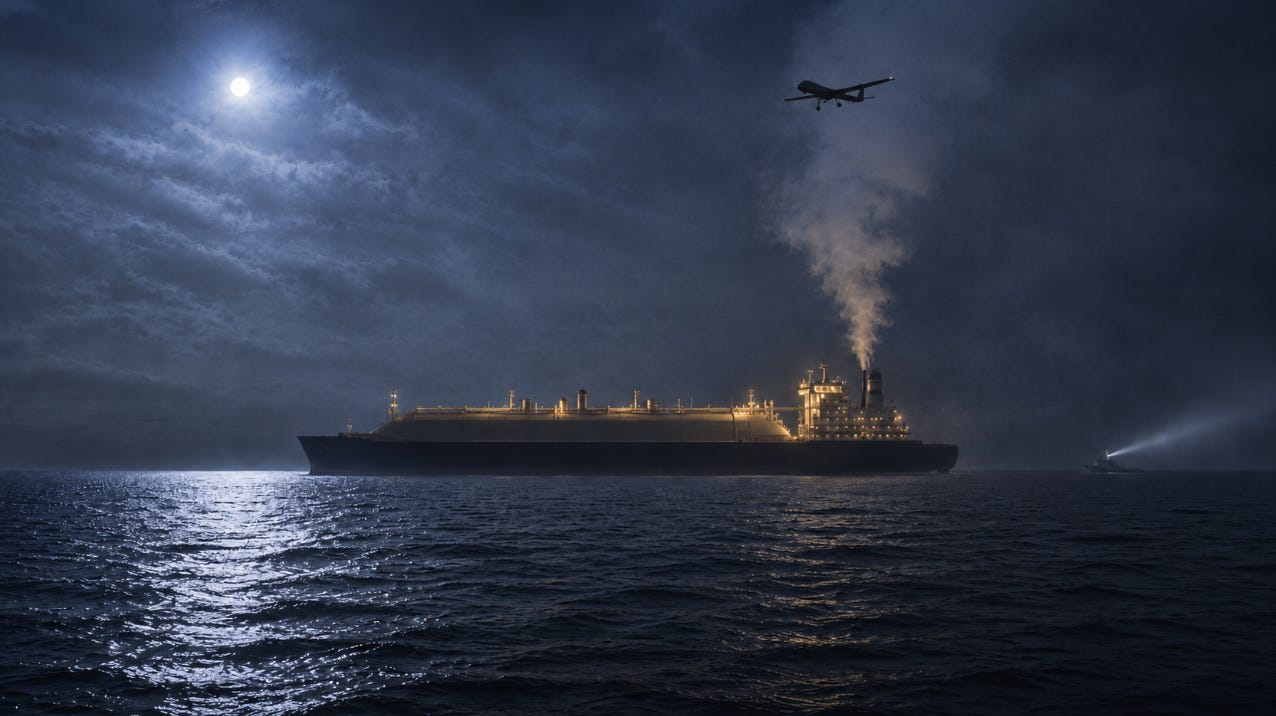
In the early hours of Tuesday 7 July, about eight nautical miles off Limah, Oman, the master of the LNG carrier Al Rekayyat (IMO 9397339) got a distress call out of a ship whose engine room was filling with smoke. United Kingdom Maritime Trade Operations logged his report at 01:19 local time. In a recording of the radio call later reviewed by Reuters, he declared mayday three times, identified his vessel twice by name, and reported a drone hit on the port side, at the top of the engine room. Then the status report: “Status: engine room fire and full of smoke. Unable to assess further damage.”
What followed, based on available reporting, was as disciplined as the call. The crew was evacuated safely, with no injuries reported. The liquefied natural gas in the cargo tanks stayed where it was: industry sources told Reuters there was no breach of the tanks, and that breaching a main tank would have been an event of a different order entirely. By Wednesday the vessel sat stationary near the entrance of the strait with a tugboat and a service ship standing by, awaiting salvage once the fire was fully extinguished. That was the last reported status at the time of writing.
The context is what makes the outcome worth studying. The International Maritime Organization had confirmed at least 46 attacks on shipping in and around the Strait of Hormuz and 14 seafarers lost since 28 February, and that tally dates to 11 June; the attacks have continued since. The same night the Al Rekayyat was hit, the Saudi supertanker Wedyan was damaged and a third tanker took a drone hit, the most strikes in a single day since late April, according to the IMO via the Associated Press. So the question this article is actually about is the one every designated person ashore and superintendent should be asking: when the projectile arrives at one in the morning, what determines whether the night ends with a full muster, or with a casualty entry on the IMO’s incident list?
📻 The Mayday 📊 By The Numbers 🔁 The Pattern 🎓 What Should Be Happening (+ Study Guide) 👀 What to Watch 📡 SwiftAction Signal
📬 SwiftAction Intelligence lands daily. Deficiency intelligence, casualty analysis, and the training gaps behind both.
📻 The Mayday
UKMTO’s advisory was clinical: a tanker travelling southbound was struck on its port side by an unknown projectile about eight nautical miles off Limah, Oman, causing a fire, with no casualties and no environmental impact reported, and authorities investigating. The master’s own transmission, as recorded, was more specific than the advisory. He believed a drone had hit the top of his engine room. Whether drone, missile, or other projectile is still not officially settled: UKMTO said unknown projectile, Axios cited US officials describing missile fire at two commercial ships that night, and the master said drone. What is not in dispute is where it hit and what it started.
The Al Rekayyat is owned and managed by Nakilat, the Qatar Gas Transport Company, operator of one of the world’s largest LNG shipping fleets. She was built in 2009, according to VesselFinder. She was loaded with LNG at the time of the strike, and, like much of the tonnage that has moved through the Gulf since February, she was transiting dark: LSEG shipping data cited by Reuters showed her last AIS transmission on 18 June.
This was the first Qatari LNG ship struck since the war began on 28 February, and Qatar is not a bystander in this war. It is the mediator in the talks between Washington and Tehran. Its foreign ministry said Iran bore full legal responsibility for the attack and summoned the deputy Iranian ambassador in protest. Iranian state television said the tanker was attacked after ignoring warnings to stay off the Omani-coast route, but Tehran made no direct claim, and a US official said initial indications were that Iran had fired on two commercial vessels. Attribution, in other words, remains formally contested, and this article treats it that way.
The escalation that followed moved fast. The US Navy-led Joint Maritime Information Center raised the threat level for the strait to severe from substantial, the first time it had sat at severe since 15 June. Washington revoked the 60-day Treasury license that had allowed Iranian oil sales under the interim arrangement, and President Trump declared the interim agreement finished, comments Reuters reported alongside a five percent jump in oil prices.
None of that reached the Al Rekayyat’s crew in time to matter. Their part of the story was over in the first hours: the call, the fire response, the evacuation, and a burning gas carrier left safely behind them with her cargo contained.
📊 By The Numbers
01:19 : local time UKMTO logged the master’s report on 7 July. (UKMTO)
~8 nautical miles : distance off Limah, Oman, where the vessel was struck on her port side while southbound. (UKMTO)
0 : injuries reported. The full crew was evacuated safely. (UKMTO; Reuters)
0 : reported breaches of the LNG cargo tanks. (Industry source via Reuters)
3 : tankers struck in and around the strait that day, the most in a single day since late April. (IMO via Associated Press)
46 and 14 : attacks on shipping confirmed by the IMO, and seafarers lost, since 28 February. Tally as of 11 June; attacks have continued since. (IMO)
120 to 140 : ships that transited the strait each day before the war. Weekend crossings had recovered to 43, 34, and 31 on 3, 4, and 5 July; at the height of the fighting, traffic fell to as few as 2 a day. (Kpler and Al Jazeera)
~14 : LNG carriers anchored off Qatar’s Ras Laffan terminal on 8 July. (Kpler)
~20,000 : seafarers impacted in the region, per the IMO, which paused its plan to evacuate around 6,000 of them in late June after an earlier attack. (IMO)
Severe : JMIC threat level for Hormuz transit from 7 July, the first time at that level since 15 June. (JMIC via Reuters and Al Jazeera)
🔁 The Pattern
Look at where these strikes land. The Al Rekayyat’s master reported the hit at the top of his engine room. The Settebello (IMO 9162916), the Palau-flagged tanker struck on 9 June with three seafarers lost, was reportedly hit in the engine room as well, according to casualty reporting; Seatrade Maritime News reported that strike came from US blockade enforcement. The IMO’s highlighted incident list for this war reads like a machinery-space casualty file: Mayuree Naree, 11 March, three seafarers lost. Volans and the barge Badr, 2 May, one seafarer lost. HMM Namu, 4 May, one injured. CMA CGM San Antonio, 5 May, eight injured.
A machinery space hit at night is close to the worst-case drill scenario. Fire and dense smoke at the source of the ship’s power, blackout risk, and a response window measured in minutes, on a vessel whose cargo, in the Al Rekayyat’s case, does not forgive containment failure.
Here is what this article will not claim: that training is why the Al Rekayyat’s crew came off and others did not. No investigation report has been published for any of the 2026 Hormuz strikes we could locate, and the casualties are not comparable on paper. Weapon, hit location, sea state, time to assistance: all of it differs, and causation talk before the reports exist is guesswork.
Here is what the record does show, based on available reporting. A distress transmission structured exactly the way the procedures teach it, sent while the compartment filled with smoke. A full-crew night evacuation off a burning, loaded gas carrier without a single reported injury. Cargo containment that held. Every one of those is a drilled behavior. Every one of them has a home in SOLAS, the GMDSS procedures, and the ISM Code, and a Port State Control deficiency code that exists specifically to test whether a crew can actually do it.
And the industry’s paper trail on those exact behaviors is not reassuring. Fire safety led the US Coast Guard’s deficiency categories in its 2025 Port State Control Annual Report, and fire safety and ISM failures sat among the leading categories in the 2025 Paris MOU and Tokyo MOU results we broke down last month. Most of those findings were closed out within weeks. The findings were rectified on paper. The competency gap persisted at sea. The Strait of Hormuz is now grading that difference in real time, and so will every PSC officer who boards the trapped Gulf tonnage when it finally releases: rotations frozen since February, drill schedules degraded, rest-hour records compromised. The IMO Secretary-General put the stakes plainly in his 8 July statement: “No seafarer should have to risk their life simply for doing their job.”
🎓 What Should Be Happening
Strip the war out of the Al Rekayyat record and what remains is a checklist of competencies that every crew is supposed to hold, war zone or not, and that PSC officers test for on ordinary Tuesdays in ordinary ports. SwiftAction Academy builds micro-training modules against the same PSC deficiency codes those officers cite. Eight of them map directly onto what happened off Limah.
📚 Study Guide: The Al Rekayyat Eight
All course codes live-verified against the SwiftAction Academy platform on 13 July 2026.
Study Guide: The Al Rekayyat Eight
All course codes live-verified on 13 July 2026.
05101 Distress Messages Obligations and Procedures
The mayday followed the taught structure: identification twice, nature of distress, location of damage, status. That structure is why the message worked under stress.
https://academy.swiftaction.ai/courses/05101
05118 Operation of GMDSS Equipment
The transmission got out of a smoke-filled casualty and a recording later reached Reuters. Equipment competency is tested in the moment nobody schedules.
https://academy.swiftaction.ai/courses/05118
04109 Fire Drills
A machinery space fire at night is the standard drill scenario, and evaluating crew performance in that drill is a standard PSC inspection item.
https://academy.swiftaction.ai/courses/04109
04108 Muster List
A full-crew evacuation in the dark starts with every person already knowing their station and duty before anything happens.
https://academy.swiftaction.ai/courses/04108
04110 Abandon Ship Drills
The crew left a burning, loaded gas carrier at night with zero reported injuries. That outcome is what the drill exists to produce.
https://academy.swiftaction.ai/courses/04110
11129 Operational Readiness of Life-Saving Appliances
Appliances that launch on demand, at night, in a war zone. Readiness is a finding when it fails and invisible when it works.
https://academy.swiftaction.ai/courses/11129
07110 Firefighting Equipment & Appliances
First response in the engine room comes before any evacuation decision. Appliance readiness and fixed-system competency buy the time.
https://academy.swiftaction.ai/courses/07110
15150 ISM Code Compliance
Section 8 of the ISM Code is emergency preparedness. The safety management system is where drill schedules either live or quietly lapse.
https://academy.swiftaction.ai/courses/15150
One honest caveat, and it belongs in print: nothing public confirms which systems the Al Rekayyat’s crew used or how the evacuation ran minute by minute. The mapping above runs from the observable outcomes to the competencies PSC tests, not from an investigation report, because none exists yet.
👀 What to Watch
The salvage. As of 8 July the vessel was stationary with a tug and service ship standing by, awaiting salvage once the fire was out. Who takes the job, and when, under a severe threat rating will say a great deal about war-zone salvage appetite, and every operator with tonnage in the Gulf should watch it.
The investigation. Oman as the coastal State, the flag Administration, and Qatar as the owner’s State all have standing. No report yet exists for this or any 2026 Hormuz strike we could locate. When the first one lands, the emergency-response findings will be the ones that matter for training departments.
The evacuation initiative. The IMO paused its plan to move roughly 6,000 seafarers out of the Gulf in late June after an earlier attack, and its Secretary-General urged the parties on 8 July to allow the evacuation of stranded ships. Resumption is the single biggest welfare item in world shipping right now.
The trapped-fleet PSC wave. When the confined tonnage releases, drill records, rest-hour records, and muster documentation will be the first ask in every port. The war will not be accepted as an exemption, and the COVID precedent suggests grace periods will be short and uneven.
The naval picture. The UK and France were reported in early July to be preparing a mission to help secure the strait. Escort frameworks change transit risk, and transit risk changes everything above.
📡 SwiftAction Signal
Five sentences of mayday, as published. Every one of them was a trained behavior: the triple call, the double identification, the located hit, the status, the honest unknown. Nobody improvises that at 01:19 with smoke coming up the companionway. It is either drilled into a crew before the night it is needed, or it is absent on the night it is needed.
The competencies inside those five sentences, and inside the evacuation that followed, are exactly what SwiftAction Academy trains: 45-minute micro-modules mapped to the PSC deficiency codes inspectors actually cite, $17 per module, built for crews who do not have spare weeks, including crews sitting at anchor right now with time they never asked for.
Browse the catalog and start with the Al Rekayyat Eight above.
SwiftAction Intelligence is produced by the SwiftAction Intelligence team. Questions, corrections, tips: admin@swiftaction.ai
CIC Bundle: 2026 Cargo Securing CIC (Tokyo & Paris MOUs)