

|⚓ About Us | 📋 Training Catalog | 🎯 CIC 2026 Bundle |
🏅 Free Course Access (No Credit Card)

America’s seven maritime academies sent more than 1,250 new graduates into the industry this graduation season. At Kings Point, the US Merchant Marine Academy graduated 188 merchant marine and military officers at its 90th commencement on 22 June, each carrying a degree, a Coast Guard license earned through more than 300 days at sea, and a commission. From Castine to Galveston, Buzzards Bay to Vallejo, the Class of 2026 is the largest single injection of licensed talent the American fleet will receive this year.
They are arriving at a moment their country says it needs them. America’s Maritime Action Plan, published by the White House in February 2026, calls for a coordinated national push to recruit, train, and keep substantially more qualified mariners. A 2017 MARAD study, still cited in testimony to Congress, estimated the nation is roughly 1,800 mariners short of what a full mobilization lasting more than four to six months would demand. The demand side of this market has rarely looked stronger.
Here is what the commencement speeches did not cover. The license a new officer carries certifies one thing: that they passed an examination. The regime they now sail into runs a different kind of exam: 52,020 port State control inspections across the Tokyo and Paris MOU regions in 2025 alone, graded against the same deficiency codes, boarding after boarding, for the length of a career. That exam has a published answer key, and the industry’s most experienced crews keep missing the same questions. This issue is about how the Class of 2026 can study for it.
📋 In this issue:
⚓ The Class of 2026
📊 By The Numbers
🔍 The Pattern
🎓 What Should Be Happening
👀 What to Watch
🚨 SwiftAction Signal
🔔 Not yet subscribed? SwiftAction Intelligence Covers Maritime Accidents, Detentions, and the Training Failures Behind Them. Subscribe For Free!
⚓ The Class of 2026
The American Maritime Partnership counted more than 1,250 graduates across the seven academies this year: the US Merchant Marine Academy at Kings Point, SUNY Maritime College at Fort Schuyler, Cal Poly Maritime Academy at Vallejo, Great Lakes Maritime Academy at Traverse City, Maine Maritime Academy at Castine, Massachusetts Maritime Academy at Buzzards Bay, and Texas A&M Maritime Academy at Galveston.
The credentials they carry are not ceremonial. License-track graduates leave with a Coast Guard license as Third Mate or Third Assistant Engineer, backed by STCW certification and hundreds of days of cadet sea time. At Kings Point, this year’s valedictorian, a Maritime Logistics and Security major, will sail on his license with the Masters, Mates & Pilots. The salutatorian, a Marine Engineering Systems major, is heading to sea as a Third Assistant Engineer with Military Sealift Command. Both cleared their Coast Guard license examinations in the same month they graduated.
The industry waiting for them is enormous and, on paper, hungry. The domestic fleet numbers more than 45,000 vessels, from container ships and tankers to dredges and towboats, inside an American maritime workforce the American Maritime Partnership puts at roughly 650,000. Washington has spent 2026 telling that industry to grow. The Maritime Action Plan directs agencies to expand mariner training and education, to invest in the state maritime academies, and to modernize Coast Guard credentialing so the pipeline moves faster. MARAD’s five new State-class training ships, the National Security Multi-mission Vessels, are re-equipping the state academies with purpose-built platforms designed to carry hundreds of cadets each.
So the Class of 2026 graduates into a rare alignment: a national policy demanding more officers, a documented shortfall of roughly 1,800 mariners for sustained sealift, and a fleet that needs watchkeepers now. What the alignment does not change is what happens the first time a port State control officer walks up their gangway.
📊 By The Numbers
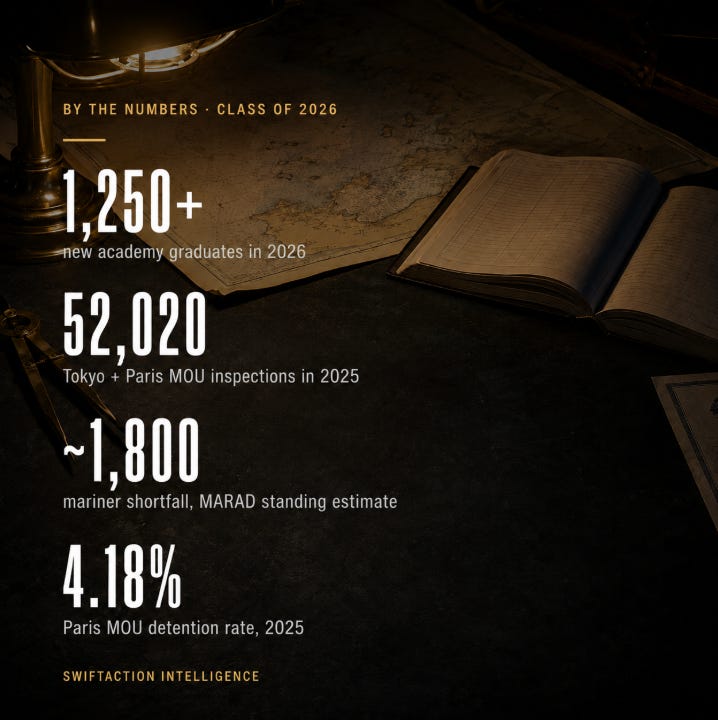
The world the Class of 2026 signed up for, in figures:
1,250+ new academy graduates in 2026 · 188 at Kings Point’s 90th commencement · 300+ cadet days at sea per USMMA graduate
~1,800 mariner shortfall for sustained sealift, per MARAD’s standing estimate · 45,000+ vessels in the domestic fleet
The exam they sail into: 35,546 Tokyo MOU inspections in 2025, a record · 16,474 Paris MOU inspections · 52,020 boardings between them
4.18% Paris MOU detention rate, second-highest in a decade · 3.53% Tokyo MOU rate · 77 US Coast Guard detentions
The inspection numbers are not background noise to a new officer’s career. They are the operating environment. In the Asia-Pacific, Tokyo MOU officers recorded 90,168 deficiencies in 2025, and just four categories produced 53 percent of them: fire safety at 18,020 findings, life-saving appliances at 11,818, working and living conditions at 9,108, and safety of navigation at 8,936. The same four categories led the 2024 table, in the same order.
In Europe, the Paris MOU’s 2025 report shows the identical five findings topping its list for a third consecutive year: ISM, fire doors, seafarers’ employment agreements, cleanliness of the engine room, and electrical installations. ISM alone was cited 2,322 times, the most of any single deficiency in the region. Seafarers’ employment agreements, the document every one of these graduates will sign before their first commercial voyage, drew 664 findings.
And at home, the US Coast Guard detained 77 foreign ships in 2025, down from 82 in 2024 and 101 in 2023, a decline its own report attributes, most importantly, to the effective implementation of a comprehensive Safety Management System. The one regime showing sustained improvement credits the management system, not the metal.
🔍 The Pattern
A Coast Guard license and a diploma certify one thing with precision: that on examination day, the graduate demonstrated the required knowledge. It is a real achievement, earned over four years and hundreds of days at sea, and nothing in the inspection data diminishes it.
But port State control does not grade what an officer knew on examination day. It grades what the crew standing in front of the inspector can demonstrate on boarding day, this boarding, this ship, this system. And on that test, the global fleet’s results are remarkably consistent. Fire safety leads the deficiency tables in both hemispheres. ISM, the code that governs how a ship is actually run, is the single most-cited deficiency in Europe. The categories do not rotate. The answer key does not change. The findings repeat anyway.
The clearest evidence of why came out of the 2025 ballast water inspection campaign. When Paris and Tokyo MOU officers concentrated on one topic for three months, they found, based on available reporting, that documentation compliance was generally high while the paperwork did not always match operational effectiveness on board, including crew familiarity with the procedures. The certificates were in the folder. The demonstration was not on the deck. The findings were rectified on paper. The competency gap persisted at sea.
For a newly licensed third mate or third assistant engineer, this pattern is not an abstraction. Within weeks of reporting aboard, many of the Class of 2026 will stand their first inspection boarding, a Coast Guard exam at home or a port State control visit abroad. The inspector will not ask where they went to school. The inspector will ask them to show the fire detection panel’s zones, produce the rest-hour records they now keep, walk through the passage plan they now monitor on watch, and explain their duties under the Safety Management System they have held for days. A license opens the gangway. What happens on deck is a demonstration, and demonstrations are built through training that continues after the diploma, not through the diploma alone.
🎓 What Should Be Happening
The deficiency tables are, in effect, a published syllabus for a new officer’s first year at sea. Fire safety will be examined. The SMS will be examined. The logbooks, the rest-hour records, the employment agreement, the passage plan: examined, on a schedule no one shares in advance, by an inspector who has seen every version of unprepared.
Graduation should therefore be treated as the start of an officer’s documented training record, not its completion. The academies build the foundation; no four-year program can pre-load familiarity with the specific ship, the specific SMS, and the specific deficiency codes an inspector will probe. That layer is built module by module, in service, and the smart move is to build it before the first boarding rather than after the first finding.
This is where mapped training earns its place in a young officer’s file. SwiftAction Academy structures its modules one-to-one against the PSC deficiency codes that Paris MOU, Tokyo MOU and USCG inspectors actually cite, and each completed module produces a record documenting completion and a passed assessment against that specific code. For a junior officer, that record does two jobs at once: it closes a knowledge gap before an inspector finds it, and it shows any master, DPA or vetting reviewer a training file that speaks the same code language as the inspection sheet.
🎓 The Study Guide: First Watch Edition
Seven courses mapped to what a new officer will be asked to demonstrate first:
⚠️ Course 15150 – ISM Code Compliance The most-cited single deficiency in Europe, 2,322 findings in 2025, and the system every new officer operates inside from day one.
🧭 Course 10127 – Voyage or Passage Planning Every new watchkeeper executes and monitors it from the first watch. Safety of navigation drew 8,936 Tokyo MOU findings in 2025.
🖥️ Course 10112 – Electronic Charts (ECDIS) The bridge tool a PSCO will ask a junior watchkeeper to demonstrate, alarms, updates and all.
📄 Course 01220 – Seafarers’ Employment Agreement (SEA) The first document a graduate signs, and a Paris MOU top-five finding three years running: 664 findings in 2025.
🧯 Course 04121 – Crew Familiarization with Emergency Systems The day-one requirement on every new ship. Crew familiarity is the gap inspectors keep finding behind the paperwork.
📖 Course 01305 – Log Books and Compulsory Entries The records a junior officer keeps are the first thing an inspector reads.
🚨 Course 07106 – Fire Detection & Alarm System Training Fire safety led both regions’ deficiency tables in 2025. This module is free, no credit card required.
👀 What to Watch
1 September to 30 November 2026: the Class of 2026’s first CIC. The joint Paris and Tokyo MOU Concentrated Inspection Campaign on cargo securing opens roughly ten weeks after commencement season. Many of these graduates will face a concentrated campaign questionnaire during their very first months aboard. The 30-course 2026 Cargo Securing CIC bundle exists for exactly this window.
The new performance lists are already grading their ships. The Paris MOU White, Grey and Black Lists and RO rankings published with the 2025 report took effect on 1 July 2026. Every vessel these officers join carries a risk profile calculated against them.
The Maritime Action Plan moves from paper to program. Watch for the mariner mobilization planning, the expanded academy funding, and the Coast Guard’s credentialing modernization the February plan directs. A faster credential pipeline means more new officers reaching ships sooner, with the same first-boarding gap to close.
The Jones Act waiver dispute. The American Maritime Partnership, congratulating the Class of 2026 on 24 June, noted the Jones Act had been waived for almost 150 days and argued the waiver threatens opportunities for newly credentialed mariners even as national policy calls for growing the pipeline. However that debate resolves, it is the market these graduates are entering.
2027 brings the Enclosed Space Entry CIC. The two regimes have already named the campaign that follows cargo securing. For the Class of 2026, the exam calendar for their second year at sea is already published. There is no excuse for arriving unprepared.
🚨 SwiftAction Signal
America just graduated more than 1,250 new mariners into a fleet its own government says is short roughly 1,800. Every new officer among them earned a license that certifies what they knew on examination day. Starting now, they will be graded on what they can demonstrate on boarding day, by regimes that ran 52,020 inspections last year and publish the same failing answers annually: fire safety, ISM, the records, the familiarization. A first finding follows the ship for years in its risk profile; a detention follows the ship, and the people running it, far longer. A SwiftAction module mapped to the exact deficiency code costs $17 and produces a completion record documenting a passed assessment before the first inspector ever walks the gangway. To the Class of 2026: the syllabus is published, and the first class is on us. Start with Course 07106. It is free.
⚓ The SwiftAction Team
SwiftAction Intelligence Is Published Daily.
For partnership inquiries contact admin@swiftaction.ai
📋 Full Training Catalog: academy.swiftaction.ai
🎯 Prepare for the 2026 Cargo Securing CIC: academy.swiftaction.ai/bundles/2026-cargo-securing-cic-tokyo-paris-mous