

|⚓ About Us | 📋 Training Catalog | 🎯 CIC 2026 Bundle |
🏅 Free Course Access (No Credit Card)
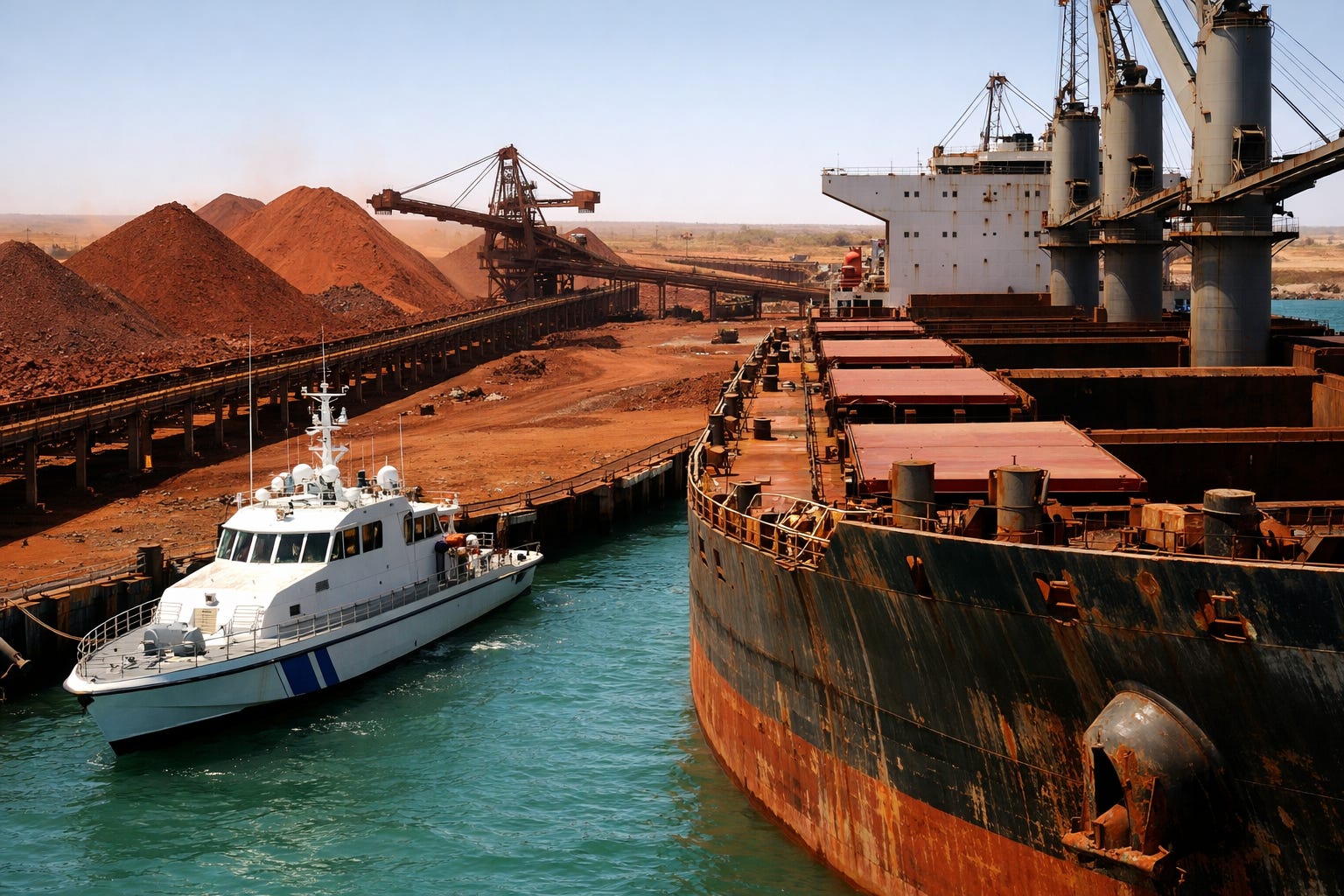
Australia detained 237 ships in 2025 and the number one reason was the same as it has been for over a decade: ISM Code failures. The Australian Maritime Safety Authority’s 2025 annual PSC report reveals a detention rate of 4.8%, a deficiency rate of 2.73 per inspection, and a system where ships keep arriving with the same problems year after year. Australia exports roughly 900 million tonnes of iron ore alone each year. Every detained bulker at Newcastle or Hay Point delays the raw materials that end up in the steel in your car, the concrete in your building, and the electricity in your home. Behind every ISM deficiency that triggers a detention is a crew member who could not demonstrate a competency that a properly structured training system would have given them.
📋 In this issue:
🔥 The Incident
📊 By The Numbers
🔍 The Training Failure
✅ What Should Have Happened
👀 What to Watch
🚨 SwiftAction Signal
🔔 Not yet subscribed? SwiftAction Intelligence Covers Maritime Accidents, Detentions, and the Training Failures Behind Them. Subscribe For Free!
📋 Competency-Based Maritime Training Mapped to Every PSC Deficiency Code
→ Academy.SwiftAction.AI
🎯 AMSA Repeat Deficiency Elimination System: 24 Courses, $199
→ Academy.SwiftAction.ai/bundles/amsa-repeat-deficiency-elimination-system#see-more
📌 SwiftAction Data Card
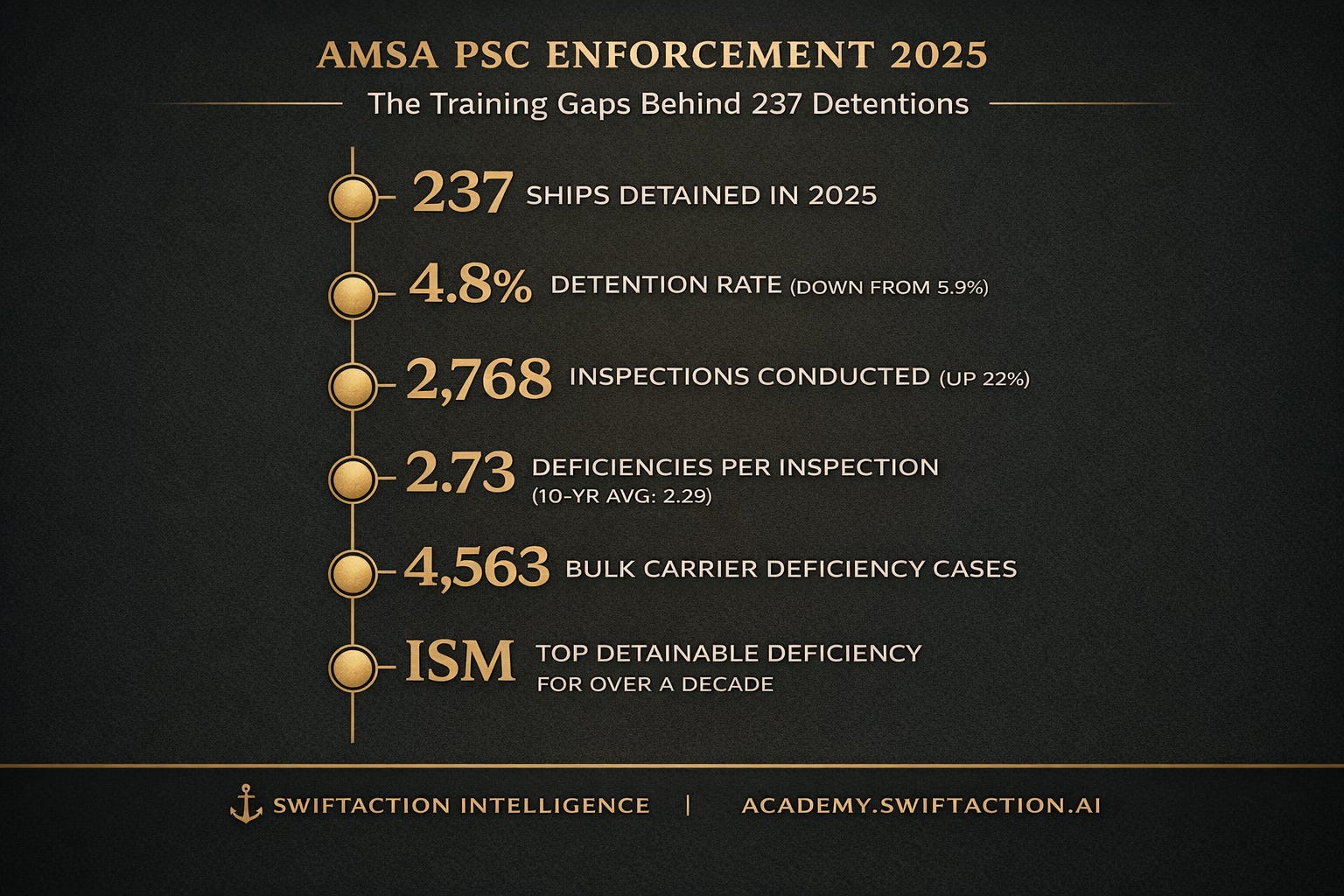
→ 237 Ships Detained Across Australian Ports in 2025
→ Detention Rate Fell to 4.8%, Below 10-Year Average of 5.7%
→ 2,768 PSC Inspections Conducted, Up 22.26% From 2024
→ Deficiency Rate of 2.73 Per Inspection, Still Above 10-Year Average of 2.29
→ Bulk Carriers Accounted for 4,563 Deficiency Cases
→ ISM Was the Top Detainable Deficiency Category, Consistent With Every Year Since at Least 2010
Source: AMSA Annual PSC Report 2025
🔥 The Incident
AMSA released its 2025 annual port state control report in March 2026, and the numbers reveal a pattern that the maritime training industry cannot ignore, according to SAFETY4SEA.
AMSA conducted 2,768 initial PSC inspections in 2025, a 22.26% increase from 2,264 in 2024. The 237 total detentions span PSC inspections of foreign-flagged vessels, domestic commercial vessel (DCV) inspections, and flag state inspections. The 4.8% detention rate and 2.73 deficiency rate apply to PSC inspections of foreign-flagged vessels specifically. The PSC detention rate fell from 5.9% the previous year and dropped below the 10-year rolling average of 5.7%. But deficiencies per inspection rose to 2.73, up from 2.63 in 2024, and well above the 10-year rolling average of 2.29, according to AMSA’s report via SAFETY4SEA. Ships are arriving at Australian ports with more problems. AMSA is finding them. And the same categories of failure that have dominated for over a decade are still at the top of the list.
ISM Code deficiencies were once again the most prevalent category in the 2025 report. In 2024, ISM accounted for 27.57% of all detainable deficiencies, up from 27.0% in 2023, 29.1% in 2022, and 24% in 2021, according to AMSA reports via MaritimeCyprus and AMSA’s 2022 inspection report. Fire safety was the second-highest category at 15.14%. Water and weathertight conditions came in at 12.97%, a figure that had itself doubled from 6.4% in 2022. Lifesaving appliances rounded out the top four at 11.35%.
MARPOL Annex I detainable deficiencies nearly doubled, rising from 4.9% in 2023 to 8.11% in 2024, according to AMSA data reported by MaritimeCyprus. The Bahamas Maritime Authority’s October 2025 information notice on recurring PSC deficiencies identifies the six most common MARPOL Annex I failures: crew unable to demonstrate correct operation of the oily water separator, crew unable to conduct the 15ppm oil content monitor function test, previous oil record books not available for the required three-year retention period, oil record books missing entries for weekly soundings of oil residues in tanks, incinerator refractory deterioration, and unauthorized modifications to the OWS and OCM. Every one of these is a crew competence or record-keeping failure, not an equipment malfunction.
Bulk carriers accounted for 4,563 deficiency cases in 2025, substantially higher than any other ship type, according to SAFETY4SEA. Bulk carriers represented 51.8% of ship arrivals and 58% of all inspections in Australia.
For Australian-flagged domestic commercial vessels (DCVs), detainable deficiencies surged from 140 in 2024 to 198 in 2025, a 41.4% increase, according to SAFETY4SEA. In 2023, the top three detainable deficiency categories for DCVs were structural conditions at 22.3% (49 cases), safety management system failures at 19.6% (43 cases), and fire safety at 18.2% (40 cases), according to AMSA’s 2023 PSC report via MaritimeCyprus.
AMSA Is Banning Ships, Not Just Detaining Them.
AMSA has used its powers under the Navigation Act 2012 aggressively. Under Australian law, AMSA can ban vessels for up to 24 months, according to legal analysis by Holding Redlich.
In March 2026, the Liberian-flagged bulk carrier Ocean Bright was detained in Newcastle after eight crew members had not been paid for two months. Inspectors found US$46,334 in unpaid wages, 18 deficiencies, and four detainable deficiencies, according to Marine Insight and MarineLink. The vessel was banned from Australian waters until September 4, 2026.
In May 2024, AMSA issued a 180-day ban to the Indian-flagged bulk carrier Darya Shaan after inspectors found 19 deficiencies at Port of Melbourne, including defective main engine control and monitoring systems, faulty engine room alarms, and defective starting arrangements for two generators, according to MarineLink. AMSA Executive Director of Operations Michael Drake said the operator, Anglo-Eastern Ship Management (India), had been notified of “serious safety concerns” before the vessel arrived in Australia.
In August 2023, AMSA banned the Liberian-flagged bulk carrier MSXT Emily for one year after discovering US$77,000 in unpaid wages at the Port of Hay Point. Inspectors found forged employment agreement signatures and evidence that seafarers had been coerced into signing new contracts with lower salaries, according to MarineLink. AMSA’s 2018 report referenced a similar case with the Thorco Luna, which was banned after AMSA found that “the master and crew were not familiar with essential shipboard procedures relating to the safety of the ship over three separate inspections,” according to IMEC Technologies.
In March 2025, Universal Shipping Alliance, owner of the Liberian-flagged bulk carrier KMAX Leader, was fined A$63,000 by Gladstone Magistrates Court for failing to comply with an AMSA written direction after the vessel was disabled at the Port of Gladstone during an approaching cyclone season, according to Offshore Energy.
📊 By The Numbers
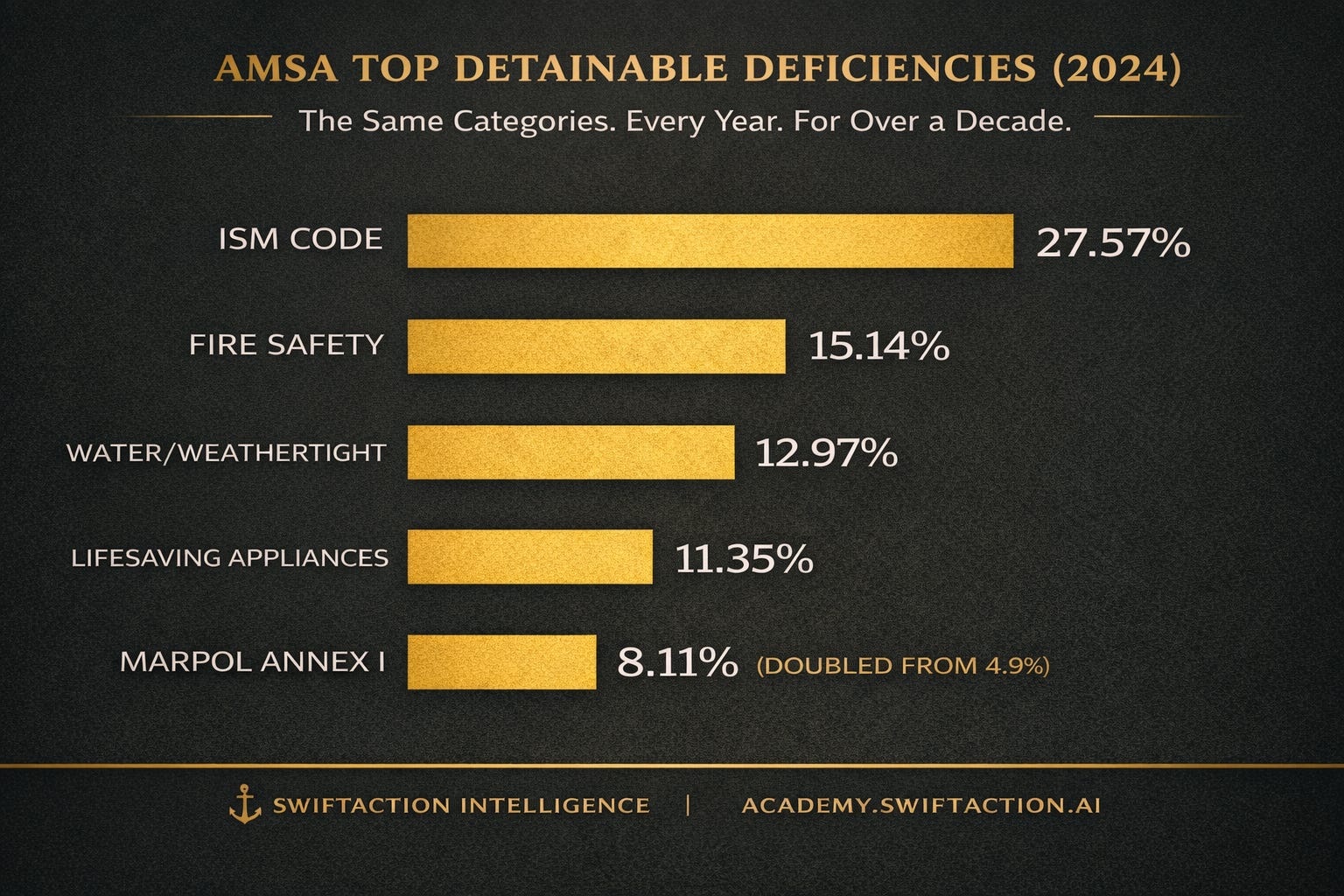
→ ISM Code: 27.57% of All Detainable Deficiencies (Up From 24% in 2021)
→ Fire Safety: 15.14% (Second Highest, Consistent Year Over Year)
→ Water/Weathertight Conditions: 12.97% (Doubled From 6.4% in 2022)
→ Lifesaving Appliances: 11.35%
→ MARPOL Annex I: 8.11% (Nearly Doubled From 4.9% in 2023)
→ AMSA Detention Rate (2025): 4.8% vs. Tokyo MOU Regional Average (2024): 3.71%
→ DCV Detainable Deficiencies Surged 41.4%: 140 → 198 (2024 to 2025)
Sources: AMSA Annual PSC Reports 2024-2025; Tokyo MOU Annual Report 2024
The deficiency categories that drive AMSA detentions have not changed in over a decade. How a single failed fire detector becomes two detainable deficiencies, why the ISM detention can only be closed after a days-long external audit, and which specific deficiency codes every vessel calling on Australian ports should train against before arrival, is below.
🔍 The Training Failure
The data from AMSA’s 2025 report is not telling operators something new. It is telling them the same thing it has told them every year since at least 2010: ISM failures drive detentions in Australian waters, according to IMEC Technologies referencing AMSA’s historical reports. The category has not changed. The percentage has barely moved. The ships keep failing the same inspections.
ISM detainable deficiencies are not hardware problems. They are competency problems. When AMSA issues an ISM-related detention, it means the port state control officer found evidence that the company’s safety management system is not effectively implemented onboard. The most common ISM detention triggers in Australia are shipboard operations and maintenance failures, followed by emergency preparedness gaps, according to AMSA’s published data via SAFETY4SEA. In 2024, AMSA specifically concentrated enforcement on planned maintenance requirements under the ISM Code, “spurred by incidents where a lack of proper maintenance, particularly of main engines and power generation systems, resulted in unsafe conditions or operational failures,” according to AMSA’s 2024 annual report.
Here is how ISM detentions actually happen in practice, according to PSC deficiency analysis by Capt. Rajeev Jassal of MySeaTime and DNV’s Q2 2025 PSC summary:
A single fire detector in accommodation is found not working during inspection. One detector is a Code 17 deficiency under deficiency code 07106 (Fire Detection and Alarm System), which must be corrected before departure. Two or more detectors not working can become a detainable deficiency at the professional judgment of the PSCO. But it does not stop there. Multiple non-functional fire detectors indicate that the weekly testing required under the SMS has not been performed. The PSCO then issues a second detainable deficiency, this one under the ISM Code, because the failed weekly tests prove the safety management system is not being followed onboard. One observation. Two detainable deficiencies. And the ISM detention can only be cleared after an external ISM audit conducted by the flag state or classification society on behalf of the flag. That audit can take days to arrange. The ship does not sail until it is complete.
This cascade is the mechanism behind the 27.57% ISM share. It is not one catastrophic failure per ship. It is dozens of small competency gaps across the fleet. A crew member who cannot demonstrate a procedure. A test log that shows no record of the weekly test being conducted. A maintenance record that does not match what the equipment shows. Each gap, individually, might be a minor deficiency. Combined, they tell the PSCO that the safety management system exists on paper but is not being lived onboard. That conclusion triggers the ISM detention.
The MARPOL Annex I doubling follows the same pattern. The Bahamas Maritime Authority’s six most common MARPOL Annex I deficiencies are all competency or record-keeping failures. Crew who cannot operate the oily water separator were never trained on its specific make and model. Crew who cannot conduct the 15ppm oil content monitor function test have never been walked through the procedure. Oil record books with missing entries reflect a crew that does not understand what entries are required or when. Unauthorized modifications to the OWS and OCM suggest a crew that does not understand the regulatory implications of what they are changing. None of these require new equipment. They require trained operators.
Australia’s 4.8% detention rate is 29% higher than the Tokyo MOU regional average of 3.71% in 2024, according to the Tokyo MOU Annual Report via MaritimeCyprus. Ships that pass inspection in other Tokyo MOU member states are being detained in Australia because AMSA tests crew competence, not just equipment condition. The under-performing ships in the Tokyo MOU region nearly doubled in 2024, according to IIMS, and AMSA feeds into that same regional risk profiling system. Vessels with detention histories anywhere in the region face higher scrutiny when they arrive in Australian waters.
✅ What Should Have Happened
No training program can guarantee that an individual will follow procedures they choose to ignore. But the AMSA data is not describing willful non-compliance. It is describing crews who were never given the competency in the first place.
The top five AMSA detainable deficiency categories, ISM, fire safety, water/weathertight, lifesaving appliances, and MARPOL Annex I, have not changed in over a decade. Each one maps to specific competency requirements under STCW and the ISM Code. Each one has corresponding PSC deficiency codes. And each one is addressable through targeted, competency-based training completed and documented before the vessel enters Australian waters.
The crew member who could not demonstrate oily water separator operation needed Code 14104 (Oil Filtering Equipment) training covering OWS and OCM operation, alarms, maintenance, and testing. The crew member who could not conduct the oil content monitor function test needed Code 14101 (Control of Discharge) training covering operational limits, monitoring, and record-keeping. The fire detection system that had not been tested needed a crew trained under Code 07106 (Fire Detection and Alarm System) to understand the weekly testing protocol and record it correctly. The engine room alarms that were defective on the Darya Shaan needed engineers trained under Code 13101 (Propulsion Main Engine) and Code 13102 (Auxiliary Engine) to identify and report critical failures before they accumulated to 19 deficiencies in a single inspection.
SwiftAction built the AMSA Repeat Deficiency Elimination System specifically for vessels calling on Australian ports. The bundle contains 24 courses mapped directly to the deficiency codes that drive AMSA detentions. Here is how it maps to the data in this article:
ISM Code (27.57% of AMSA detainable deficiencies): Code 15106 (ISM Code Shipboard Operations) and Code 15150 (ISM Code Compliance) address the two most common ISM detention triggers: shipboard operations and maintenance failures, and safety management system implementation gaps.
Fire Safety (15.14% of AMSA detainable deficiencies): Eight courses cover the fire safety deficiency spectrum: Code 07105 (Fire Doors), Code 07106 (Fire Detection and Alarm System), Code 07108 (Ready Availability of Fire Fighting Equipment), Code 07110 (Fire Fighting Equipment and Appliances), Code 07113 (Fire Pumps), Code 07115 (Fire Dampers), Code 07123 (Operation of Fire Protection Systems), and Code 07124 (Maintenance of Fire Protection Systems). Code 07106, the exact deficiency code in the ISM cascade example above, is included free.
MARPOL Annex I (8.11% of AMSA detainable deficiencies, doubled in one year): Code 14104 (Oil Filtering Equipment) directly addresses the top MARPOL Annex I failure: crew unable to demonstrate OWS and OCM operation. Code 14101 (Control of Discharge) covers the record-keeping and operational limits behind the remaining MARPOL Annex I deficiency findings.
Structural Conditions (top DCV detainable deficiency category at 22.3%): Code 02106 (Hull Damage Impairing Seaworthiness), Code 02108 (Electrical Installations), Code 02112 (Hull Corrosion), and Code 02117 (Decks Corrosion) address the structural deficiency categories that accounted for 49 detainable deficiency cases on DCVs in 2023.
Propulsion and Auxiliary Machinery (Darya Shaan’s 19 deficiencies): Code 13101 (Propulsion Main Engine), Code 13102 (Auxiliary Engine), Code 13104 (Bilge Pumping Arrangements), Code 13108 (Operation of Machinery), and Code 13110 (Precautions Against Electrical Hazards) cover the engine room deficiency categories consistent with the findings reported on the Darya Shaan.
The bundle costs $199 for all 24 courses. Individual courses are $17 each, and Code 07106 is included free. A single day of detention at an Australian commodity port costs the shipowner more than the entire bundle by an order of magnitude.
Every course produces a completion record referenced to the specific PSC deficiency code. That record is the documented evidence that the crew was trained on the exact procedure the AMSA inspector will test. It sits in the ship’s training files at the time of inspection. It is the difference between a clean walkthrough and a detention that triggers an emergency external ISM audit, days of lost revenue, and potentially a ban from Australian waters for up to 24 months.
Start with Code 07106 (Fire Detection and Alarm System). It is free. No credit card required. It covers the exact deficiency described in the ISM cascade example in this article. Complete it, and see what documented competency evidence looks like before buying the full bundle at academy.swiftaction.ai.
👀 What to Watch
AMSA’s enforcement trajectory. The detention rate fell to 4.8%, but deficiencies per inspection rose. AMSA is getting more selective about which ships to detain, not more lenient. The 41.4% surge in DCV detainable deficiencies shows the regulator is intensifying focus on serious findings. Operators should expect the 2026 inspection cycle to continue this trend.
MARPOL Annex I enforcement escalation. The near-doubling from 4.9% to 8.11% signals a specific enforcement shift. If this trend continues into the 2025 data, MARPOL Annex I will join ISM and fire safety as a top-three detention driver in Australian waters. OWS operation (Code 14104), OCM function tests, and oil record book accuracy will be tested.
Tokyo MOU under-performing ships. The 2024 Tokyo MOU report found under-performing ships nearly doubled year-over-year. AMSA is a Tokyo MOU member state. Ships with detention histories in other Tokyo MOU ports face higher scrutiny on arrival in Australia.
AMSA vessel bans. The pattern from Ocean Bright (March 2026), Darya Shaan (May 2024), and MSXT Emily (August 2023) shows AMSA escalating from detention to bans of 90 days to one year. Operators with outstanding deficiency close-out items should treat their next Australian port call as high-risk. Pre-arrival crew training mapped to the specific outstanding deficiency codes is the most direct way to reduce inspection risk.
🚨 SwiftAction Signal
AMSA detained 237 ships in 2025 and ISM topped the list for over a decade running. The detention rate went down. The deficiency rate went up. MARPOL Annex I detainable deficiencies doubled in a single year. Crew members could not operate the oily water separator. Fire detection weekly tests were not recorded. Oil record books had gaps. Engine defects were not reported. Australia is banning ships that would sail freely in other Asia-Pacific ports, and the iron ore, coal, and LNG that move through these ports build the infrastructure every person depends on. The industry does not have a knowledge problem. It knows exactly which deficiency codes drive detentions. It knows exactly which competencies PSCOs test.
Twenty-four training modules mapped to those exact codes cost $199. A single day of detention costs more. The free Code 07106 module takes less time than reading this article. The gap is not money. The gap is action.
⚓ The SwiftAction Team
SwiftAction Intelligence Is Published Daily.
For Partnership Inquiries Contact admin@swiftaction.ai
📋 Full Training Catalog: academy.swiftaction.ai
📋 Resources
📋 Full Training Catalog: academy.swiftaction.ai/collections
🎯 AMSA Repeat Deficiency Elimination System (24 Courses, $199): academy.swiftaction.ai/bundles/amsa-repeat-deficiency-elimination-system#see-more
🆓 Code 07106: Fire Detection and Alarm System (Free, No Credit Card): academy.swiftaction.ai/courses/07106
🏅 Try Any Free Course: academy.swiftaction.ai/enroll