

About Us · Training Catalog · CIC Bundle
Start free. One PSC-aligned micro-module, no charge, so you can see how a single finding maps to a competency before the campaign starts. Take the free course.
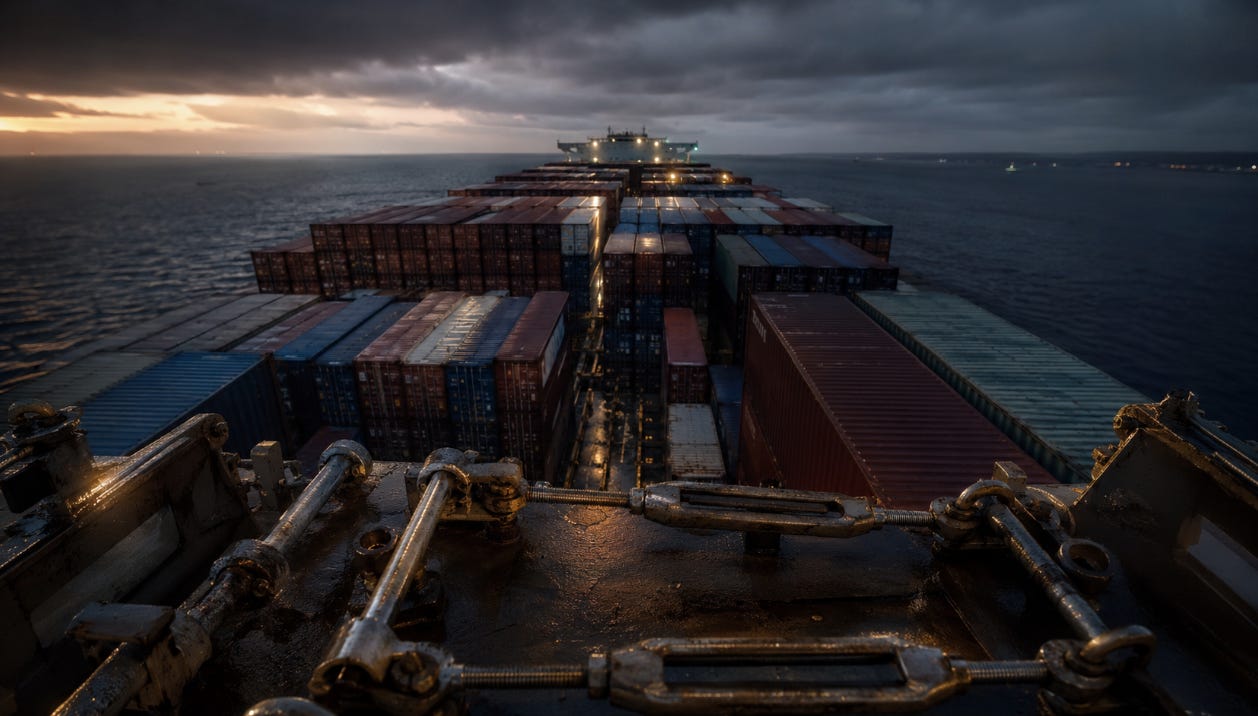
On 1 September 2026, Port State Control officers across the Tokyo and Paris MoU regions begin a coordinated three month check on one subject: cargo securing. It runs to 30 November, it applies to every ship that is inspected in either region during the window regardless of risk profile, and the trade press is already describing it as the most consequential PSC event on this year’s calendar. Operators do not have to guess what is coming. The topic is published, the regulatory basis is fixed, and the last campaign left a very clear signal about how these blitzes now behave.
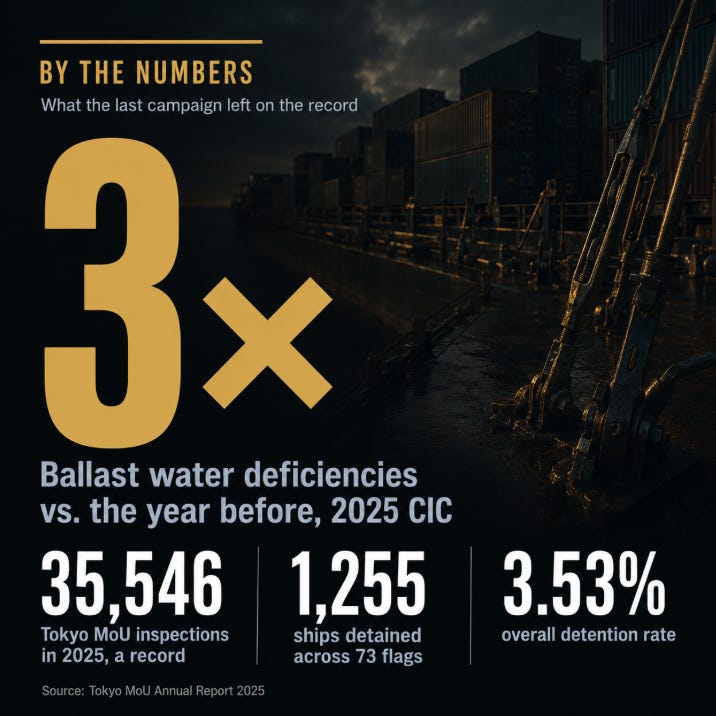
That signal is worth reading closely. The 2025 joint campaign covered Ballast Water Management, and when the Tokyo MoU published its annual results, the number of deficiencies tied to the campaign topic came in at three times the level of the previous year. The detentions did not cluster around missing certificates. Based on the published reporting, they clustered around whether the system was actually being operated and maintained correctly on board. In other words, the paperwork was not the exposure. The practice was.
Cargo securing sits on exactly that fault line. A vessel can carry a current, flag approved, vessel specific Cargo Securing Manual and still fail, because the 2026 questionnaire is expected to go past the manual and into the condition of the lashing gear, the discard criteria for worn equipment, and whether the deck crew can explain the securing arrangements when an officer asks. This piece lays out what the record shows, what a fleet should have in place before September, and what it costs to answer a finding by hand when the findings start arriving faster than a superintendent can draft responses.
In this issue
🚢 The Campaign: what is confirmed for September, and the regulatory basis
📊 By The Numbers: the 2025 result, the 2025 record year, and Q1 2026
🔍 The Pattern: why a compliant manual is no longer a compliant ship
🛠️ What Should Be Happening: a competency map, with the modules that address it
🔭 What To Watch: the questionnaire, 2027, and the risk profile mechanics
📡 The SwiftAction Signal: closing the practice gap, and answering the finding
Subscribe to SwiftAction Intelligence. Daily maritime regulatory intelligence for designated persons ashore, superintendents, masters, and compliance teams. The findings, read the way an inspector reads them.
🚢 The Campaign
Both the Tokyo MoU and the Paris MoU have confirmed a joint Concentrated Inspection Campaign on cargo securing, running from 1 September to 30 November 2026. A Concentrated Inspection Campaign is a coordinated period in which port State authorities across one or more regions apply a single, pre announced questionnaire on top of the standard inspection. The mechanics matter: the questionnaire is not reserved for ships already flagged for a detailed inspection. Any vessel that is inspected for any reason during the window is assessed against it, and inspection probability rises across the board while a campaign is live.
The regulatory framework behind the 2026 campaign is settled. It rests primarily on the Code of Safe Practice for Cargo Stowage and Securing, on SOLAS Chapter VI and Chapter VII, and on each vessel’s own flag approved, vessel specific Cargo Securing Manual. Guidance published ahead of the campaign points to five areas that officers are expected to concentrate on: the Cargo Securing Manual itself, the physical condition of lashing and securing equipment against discard criteria, how cargo is secured in practice, the procedure for withdrawing damaged equipment from service, and crew familiarity with the securing arrangements. The official questionnaire is expected to be published during the summer, ahead of the September start.
The point that operators tend to underweight is the last one. A campaign questionnaire converts a general obligation into a specific, answerable checklist, and every negative answer becomes a formal deficiency that attaches to the vessel’s record. A ship that would pass a routine inspection can pick up deficiencies, and in serious cases a detention, purely because the campaign questionnaire exposes a gap that a normal inspection would not have probed.
📊 By The Numbers
The case for taking this campaign seriously is not rhetorical. It is in the last three published data sets.
The 2025 campaign. During the Ballast Water Management CIC, member authorities of the Tokyo MoU conducted 9,244 PSC inspections, of which 6,930 carried the CIC questionnaire. 184 ships inspected during the period were detained, a 2.66 percent detention rate, and 30 of those were detained as a direct result of the campaign deficiencies. According to the Tokyo MoU’s published results, deficiencies tied to the campaign topic ran at three times the level of the prior year, and the most common ones, including those that led to detention, were associated with the proper operation of the ballast water management system on board.
The 2025 record year. In the same annual report, the Tokyo MoU recorded 35,546 inspections, the highest number in its history, covering 19,980 individual ships. 23,230 of those inspections found deficiencies. 1,255 ships registered under 73 flags were detained on serious deficiencies, a 3.53 percent detention rate across ships inspected. The scale is the point: a campaign layered on top of that inspection volume touches a very large number of hulls.
Q1 2026. The direction of travel into this year is consistent. In its Q1 2026 detention review, DNV recorded 64 detentions across its fleet, compared with 52 in the same quarter of 2025. Container, bulk carrier and general cargo vessels accounted for 83 percent of those detentions, and roughly 84 percent were recorded in the Paris and Tokyo MoU regions. Detainable deficiencies continued to be dominated by shortcomings in ISM implementation, with the most frequently cited sub categories being 15150, ISM, and 15109, Maintenance of the ship and equipment.
None of this forecasts how many cargo securing deficiencies September will produce. It establishes how a modern campaign behaves. Read together, these numbers describe a system that is inspecting more, detaining on operational failures, and about to point a dedicated questionnaire at a subject where the gap between the manual and the deck is already on the record.
🔍 The Pattern
There is a consistent theme running through the recent cargo securing guidance from the marine insurance market, and it is the same theme the 2025 campaign surfaced. PSC inspection has moved beyond paperwork. Officers are increasingly likely to question the crew and test their understanding of the securing arrangements in practice, and a compliant manual on its own is not treated as sufficient if it is not effectively implemented on board.
The loss prevention record makes the same point from the other direction. When the Australian Maritime Safety Authority ran a focused inspection campaign that examined cargo securing, the recurring finding was not that procedures were absent. It was that procedures were typically in place but not always applied correctly. That gap, between the documented requirement and the onboard practice, appears to be where both the PSC deficiency and, further downstream, the P&I claim tend to originate. Damaged or incorrectly engaged twistlocks, lashing gear that is past its discard criteria but still in service, a manual that no longer matches the vessel’s actual configuration: these are practice failures wearing the costume of a documentation subject.
This is the structural problem with treating a Concentrated Inspection Campaign as a paperwork exercise. A binder can be assembled in a week. Competency cannot. The finding can be closed on paper the same afternoon it is raised, and the same gap can still be sitting on the deck the next time the vessel is inspected.
The findings were rectified on paper. The competency gap persisted at sea.
🛠️ What Should Be Happening
Preparation for a cargo securing campaign has two halves that operators frequently collapse into one. The first is the documentation and equipment half: confirm the Cargo Securing Manual is on board, current, flag approved and vessel specific for the cargo actually carried; inventory every securing device and remove anything that meets the discard criteria; and stand up a documented, signed pre departure securing check for every voyage. That half is necessary and it is auditable.
The second half is the one the questionnaire is built to expose: whether the people on deck can demonstrate the competency the manual assumes. A training record showing that officers and crew were briefed on the Cargo Securing Manual, the securing procedures for the cargo types carried, and the equipment discard criteria, in the weeks before the campaign, is exactly the kind of timestamped evidence that carries weight when a PSC officer questions crew knowledge. The record is the difference between an officer’s doubt and a closed line item.
Study Guide: competency areas mapped to PSC deficiency categories
The modules below are mapped to the PSC deficiency categories that inspectors cite, and each corresponds to a live SwiftAction micro-module. Codes verified against the 2026 catalog.
Cargo operations and securing in practice: 06107 Cargo Operations
Residual cargo requirements and edge cases: 06199 Other Cargo Requirements
Hatch openings and access integrity: 03104 Cargo and Other Hatchways
Hatch covers, tarpaulins and weathertight closure: 03105 Hatchway Covers and Tarpaulins
Loading instrument and stowage planning: 06109 Loading Instrument
Cargo density declaration and stability inputs: 06108 Cargo Density Declaration
ISM shipboard operations discipline: 15106 ISM Code: Shipboard Operations
Maintenance of ship and equipment, the top detainable sub category: 15109 ISM Code: Maintenance of the Ship and Equipment
Operational Standard. The half that is hardest to hold together across a fleet is consistency: the same competency, evidenced the same way, on every vessel calling every port. That is the problem class Nautilux AI is built for, with real time vessel scoring and human in the loop oversight, so a superintendent sees where the practice gap actually sits before an inspector does.
The full cargo securing preparation set is packaged for the campaign here: 2026 Cargo Securing CIC Training.
🔭 What To Watch
The questionnaire. The official 2026 questionnaire is expected to be published on the Paris MoU and Tokyo MoU websites during the summer, ahead of the September start. When it lands, it should be worked through question by question against each vessel’s current state, with any gap closed immediately rather than noted for later.
The risk profile. Under the New Inspection Regime, a ship’s inspection window is driven by its Ship Risk Profile, which folds in ship type, age, flag performance, class record, company ISM performance, and deficiency and detention history. Analysis of the Tokyo MoU inspection record indicates that older ships and vessels carrying five or more deficiencies face a materially higher probability of detention. A deficiency is not a single bad afternoon. It follows the vessel’s record and feeds the calculation that decides how often it gets stopped.
2027. The rotation is already set. The joint campaign planned for 2027 focuses on enclosed space entry, a higher stakes subject where the practice gap has consequences that are harder to walk back. A fleet that builds securing discipline into standing procedure now is also building the muscle it will need for that campaign.
📡 The SwiftAction Signal
Everything above is the problem. This is the part where a compliance team decides what to actually put in place, and it splits cleanly along the two halves of the gap.
Closing the competency side. The practice gap that the campaign is designed to expose is closed with training that produces evidence, not slideware. SwiftAction Academy runs a library of more than 600 PSC-aligned micro-modules, each mapped to a deficiency category an inspector actually cites, each priced at $17 per module, and each producing a completion record with a date on it. The 2026 Cargo Securing bundle assembles the modules in the Study Guide above into a single campaign set, so a fleet can brief officers and deck crew on the manual, the securing procedures, and the discard criteria, and hold the timestamped record that answers an officer’s question before it becomes a deficiency.
Answering the finding. Training reduces the number of findings. It does not eliminate them, and during a three month campaign the findings that do land arrive in a compressed window, across a fleet, all needing a corrective-action response that is fast, consistent, and cited to the exact regulation behind the deficiency. Drafting that by hand is where the response quality falls apart under volume.
That second half, a fast and consistent corrective-action response across a fleet, is a different problem from training, and it is the one the company featured below was built to solve.
A company built for the finding itself: SolarisTech

Most compliance tools stop at the checklist. SolarisTech starts where the checklist fails: the Port State Control deficiency, and the detention that can follow it.
SolarisTech is the maritime compliance company that created FRPC, the Fleet Risk and Predictive Compliance engine inside the Nautilux AI suite, for one job that no binder does well. FRPC turns any deficiency into a complete, regulation cited corrective-action response. From a single submission it produces the internal report for the company and the DPA, the cascaded external report for the attending officer, and the Code 10 close-out once the finding is rectified, every line cited to the exact regulation behind it, with named owners and due dates attached. SolarisTech reports the engine reduces the manual effort per finding by roughly 87 percent, from about 4.5 hours to about 0.6, and returns a first response in about 20 minutes rather than hours.
FRPC was built around a harder truth: most deficiencies are not really paperwork problems. They come from three pressures no manual fixes, and SolarisTech built its approach to relieve all three.
Superintendent overload. Superintendents are carrying more vessels than the day has hours for. FRPC takes the response off their desk, so a finding in a distant port does not become another late night drafting the same letters by hand.
Crew experience. Crews turn over faster than sea experience can be rebuilt, and the questionnaire now tests the competency the manual assumes. The Nautilux AI scoring behind FRPC shows a superintendent exactly where a competency gap is turning into findings, so attention lands on the vessels and crews that need it before the next inspection, not after.
Work and rest hours. When hours of rest are squeezed, supervision and the routine checks a ship depends on are the first things to slip, and the record and the reality drift apart. SolarisTech is built to surface that gap before an officer does.
The finding stays Port State Control’s call. Everything after it, the speed, the consistency, and the evidence quality of the response, is where SolarisTech comes in.
See it on your own fleet. SolarisTech runs a live pilot measured against your own Port State Control record. Start one at admin@solaristechinc.com.
SwiftAction Intelligence is produced by the SwiftAction Intelligence team. Questions, corrections, and story tips: admin@swiftaction.ai. Campaign training set: 2026 Cargo Securing CIC Bundle.