

|⚓ About Us | 📋 Training Catalog | 🎯 CIC 2026 Bundle |
🏅 Free Course Access (No Credit Card)
The Paris MOU has published its 2025 Annual Report, and the headline number moved in the wrong direction for the second year running. The detention rate across Europe’s port State control region reached 4.18 percent, up from 4.03 percent in 2024 and 3.81 percent in 2023. Only 2022 recorded a higher rate in the past ten years. Refusals of access, the bans that shut a ship out of an entire region, jumped to 19, the highest total since 2019.
The report’s most important sentence is not a number. It is a conclusion. The Paris MOU states that its analysis of recorded deficiencies did not identify any single convention or regulatory area as the primary cause of the rise. The regime’s Chairman and Secretary-General instead urge every stakeholder to re-evaluate operational practices, warning that the elevated rate may signal a broader reduction in shipping standards.
Read the deficiency tables, though, and the picture sharpens. The same five findings that led the list in 2023 and 2024 led it again in 2025: ISM, fire doors, seafarers’ employment agreements, cleanliness of the engine room, and electrical installations. The rate is rising, and the reasons are not new. They are the same reasons, uncorrected, for a third consecutive year.
📋 In this issue:
🧾 The Report
📊 By The Numbers
🔍 The Pattern
🎓 What Should Be Happening
👀 What to Watch
🚨 SwiftAction Signal
🔔 Not yet subscribed? SwiftAction Intelligence Covers Maritime Accidents, Detentions, and the Training Failures Behind Them. Subscribe For Free!
🧾 The Report
The Paris Memorandum of Understanding spans maritime Authorities across Europe and the North Atlantic, from Canada to Croatia. Its Port State Control Officers boarded ships at an average of roughly 45 inspections per day through 2025, producing 16,474 inspections for the year.
Six of every ten inspections found something. A total of 9,879 inspections recorded at least one deficiency, and 51,797 deficiencies were logged in total, up 4.6 percent from 49,510 in 2024. Of those, 4,744 were serious enough to be marked detainable. The result: 688 ships detained, and a detention rate of 4.18 percent.
For context, the pre-pandemic rate in 2019 was 2.99 percent. The region has now spent four consecutive years well above that level, and the Paris MOU’s leadership frames that gap as a trend demanding sustained attention in the period ahead.
The banning figures moved sharply. Nineteen ships were refused access to the entire region in 2025, up from 15 in 2024 and 11 in 2023, a jump the report frames as the end of a quiet stretch in banning activity. Across 2023 to 2025, repeated detentions were the trigger in 33 of 45 refusals of access, with another 11 ships banned for failing to proceed to their designated repair yard.
The report also names the threat it cannot inspect its way out of. Ships operating outside legitimate oversight are transiting the coastal waters of Paris MOU members without making port calls, which places them beyond the reach of a risk-based inspection system built around port arrivals. The leadership pairs that concern with the rise of false flags and fraudulent certification, an issue it says is best addressed through global cooperation between PSC regimes. According to PortNews’ report on the regime’s 59th Committee meeting, held in Glasgow in May 2026, the Paris MOU has now agreed to develop practical guidance for handling suspected fraudulent registrations and certificates.
📊 By The Numbers
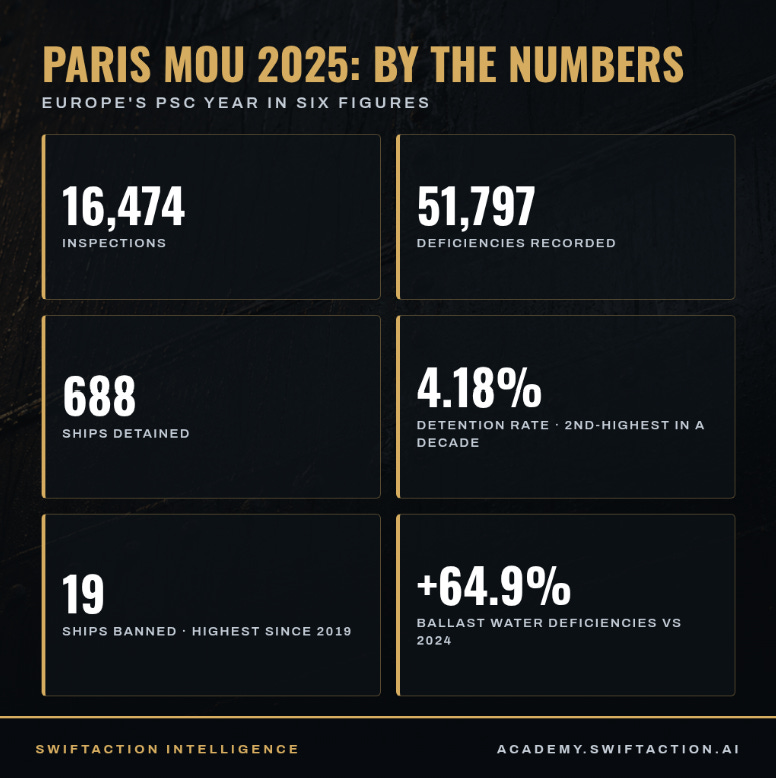
The 2025 inspection year, in the figures that matter:
16,474 inspections · 9,879 with deficiencies · 688 detentions · 4.18% detention rate
51,797 deficiencies recorded · 4,744 detainable · 3.14 deficiencies per inspection
19 ships banned from the region · highest total since 2019
Five main deficiency groups produced more than 55 percent of everything PSCOs wrote up in 2025. Fire safety under SOLAS Chapter II-2 led again at 16.8 percent of all deficiencies, with 8,713 findings. Structure, machinery and electrical requirements under SOLAS Chapter II-1 followed at 11.6 percent. Health protection, medical care and welfare under MLC 2006 Title 4 came third at 10.1 percent. Life-saving appliances under SOLAS Chapter III and safety of navigation under SOLAS Chapter V rounded out the five. The top three groups alone account for 38.5 percent of all findings, nearly two of every five.
At the individual deficiency level, the 2025 top five reads like a photocopy of 2024 and 2023: ISM at 4.48 percent of all deficiencies, fire doors and openings in fire-resisting divisions at 3.11 percent, seafarers’ employment agreements at 1.28 percent, cleanliness of the engine room at 1.26 percent, and electrical installations in general at 1.25 percent.
One category broke the pattern, and it broke it upward. Ballast water management deficiencies rose from 965 in 2024 to 1,591 in 2025, an increase of 64.9 percent, the sharpest rise of any category in the report.
By ship type, general cargo and multipurpose vessels were detained at 6.78 percent, the worst rate of any major segment, with 283 detentions from 4,173 inspections. Bulk carriers recorded a 5.38 percent detention rate, and that number has climbed each year, from 3.61 percent in 2023 to 4.71 percent in 2024 to 5.38 percent now. Container ships, by contrast, sat at 1.98 percent.
By flag, the two most-inspected flags in the region both finished above the average. Liberia recorded 105 detentions from 2,221 inspections, a 4.7 percent rate, and Panama 103 detentions from 1,891 inspections, 5.4 percent. At the extreme end, among flags with at least 20 inspections, Cameroon was detained on 34.3 percent of boardings, Tanzania on 28.2 percent, and Comoros on 23.6 percent. The Black List holds ten flags, with Cameroon, Tanzania and Comoros carrying the highest excess factors in the region. The distribution across the White, Grey and Black Lists, the report notes, remains largely stable despite the rising rate.
One quieter finding deserves attention. While the Recognized Organization performance categories themselves hold steady year over year, the report states that the number of detainable deficiencies attributable to RO responsibility remains elevated, and characterises the trend as evidence that the quality of certain ROs is measurably slipping.
🔍 The Pattern
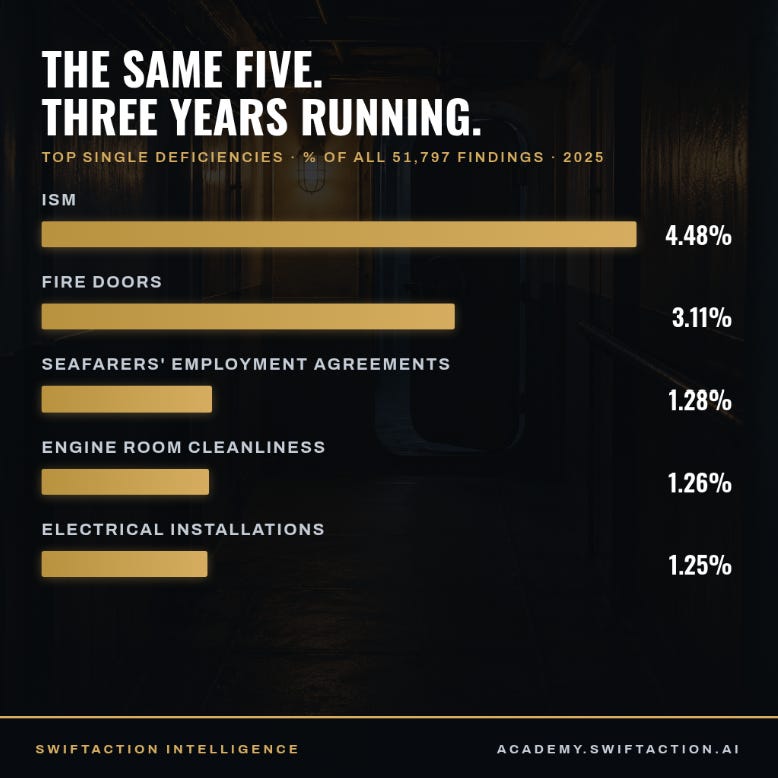
Put the three annual reports side by side and the pattern is unmistakable. Fire safety has led the deficiency table in 2023, 2024 and 2025, at 17.3 percent, 17.3 percent and 16.8 percent. Fire doors specifically have held between 3.1 and 3.3 percent of all findings for three straight years. ISM has topped the single-deficiency table in all three years, easing only from 4.79 percent of everything recorded in 2023 to 4.48 percent in 2025. Seafarers’ employment agreements have not left the top five once.
This is what makes the Paris MOU’s “no single cause” conclusion so pointed. The rise is not coming from a new regulation catching the industry off guard. It is coming from the oldest items on the inspection sheet. When the single most-cited deficiency in Europe is ISM itself, the finding is not that one piece of equipment failed. It is that the management system responsible for preventing every other finding on the sheet is not producing the outcomes the Code demands.
The ballast water surge tells the same story from a different angle. The Paris MOU and Tokyo MOU ran their joint Concentrated Inspection Campaign on ballast water management from 1 September to 30 November 2025, and the 64.9 percent jump in BWM deficiencies is consistent with the concentrated scrutiny of that campaign window: inspectors looked harder at one topic, and found more. What they found is the instructive part. According to PortNews’ account of the Committee’s review, documentation compliance was generally high, but the paperwork did not always match operational effectiveness on board, including the readiness of the ballast water management systems themselves and crew familiarity with the procedures.
The certificates were in the folder. The plan was on the shelf. The competency was not on the deck. Based on available reporting, that gap between documented compliance and demonstrated capability is the closest thing this report offers to the single explanation its authors say they could not find. Every repeat appearance of fire doors, ISM, engine room cleanliness and electrical installations on the annual top five is the same gap, measured a different way. The findings were rectified on paper. The competency gap persisted at sea.
🎓 What Should Be Happening
The Paris MOU publishes the exam syllabus every summer. The top five deficiencies are not a surprise quiz; they are the same five questions, asked 16,474 times a year. An operator who treats the annual report as a study guide knows exactly what a PSCO in Rotterdam, Gdynia or Genoa will test: the fire doors, the SMS, the employment agreements, the engine room, the wiring, and, through 2026, the cargo lashings.
Closing a finding is not the same as closing the gap. A rectified deficiency proves the item was fixed once. It does not prove the crew that sails tomorrow can operate the system, maintain it, and demonstrate it under a PSCO’s eyes. That demonstration is a competency, and competency is built before the boarding, not during it.
This is where documented training earns its place in the inspection file. SwiftAction Academy maps its modules one-to-one to the PSC deficiency codes that Paris MOU, Tokyo MOU and USCG inspectors cite, and each completed module produces a record documenting completion and a passed assessment against that specific code. When the inspection sheet and the training file speak the same code language, the conversation on board changes.
🎓 The Study Guide
Seven courses mapped to the deficiencies that led Europe’s 2025 table:
⚠️ Course 15150 – ISM Code Compliance The single most-cited deficiency in the Paris MOU region: 2,322 findings in 2025.
🔥 Course 07105 – Fire Doors/Openings in Fire-Resisting Divisions The most-cited hardware deficiency: 1,609 findings, three straight years in the top five.
📄 Course 01220 – Seafarers’ Employment Agreement (SEA) The MLC finding that has not left the top five: 664 findings in 2025.
⚙️ Course 07126 – Oil Accumulation in Engine Room The failure behind the engine room cleanliness deficiency: 654 findings in 2025.
⚡ Course 02108 – Electrical Installations The wiring, insulation and protection failures PSCOs classify as unsafe: 646 findings.
🌊 Course 14811 – Ballast Water Management System (BWMS) Training The sharpest-rising category in the report: BWM deficiencies up 64.9 percent in one year.
🚨 Course 07106 – Fire Detection & Alarm System Training Fire safety led the deficiency table again at 16.8 percent. This module is free, no credit card required.
👀 What to Watch
1 September to 30 November 2026: the Cargo Securing CIC. The Paris MOU and Tokyo MOU reconfirmed their joint Concentrated Inspection Campaign on cargo securing at the May 2026 Committee meeting. It begins in under nine weeks. The segments it will fall hardest on, bulk carriers and general cargo vessels, are precisely the segments whose detention rates are already at or climbing toward the top of the 2025 table. The 30-course 2026 Cargo Securing CIC bundle exists for exactly this window.
The new performance lists are already live. The White, Grey and Black Lists and RO performance rankings published with this report apply from 1 July 2026. Every ship’s risk profile, and therefore its inspection priority, is now being calculated against them.
Fraudulent certificates move up the agenda. Following the Glasgow Committee meeting, the Paris MOU is developing practical guidance for suspected fraudulent registrations and certificates, per PortNews. Expect PSCOs to probe certificate provenance more aggressively.
The methodology changes land in July 2027. Revised flag and RO performance calculation methodologies are scheduled for implementation in July 2027, and reporting on the Committee outcomes indicates new environmental parameters are entering the ship risk profile. The rules for who gets boarded are being rewritten.
2027 brings the Enclosed Space Entry CIC. The two regimes have already confirmed the topic that follows cargo securing. The exam calendar is published two years out. There is no excuse for arriving unprepared.
🚨 SwiftAction Signal
Europe just told the industry, in its own annual report, that it cannot find a single regulatory cause for a detention rate at its second-highest level in a decade. It does not need to. The cause is printed in its own tables: the same five deficiencies, led by the ISM Code itself, topping the list for a third consecutive year, and a ballast water campaign that found the paperwork compliant while the competency behind it was not. A detention in the Paris MOU region costs days off-hire, a damaged risk profile that follows the ship for three years, and, 19 times in 2025, the entire regional trade. A SwiftAction module mapped to the exact deficiency code costs $17 and produces a completion record documenting a passed assessment before the PSCO ever walks the gangway. The 2026 CIC window opens 1 September. Start with Course 07106. It is free.
⚓ The SwiftAction Team
SwiftAction Intelligence Is Published Daily.
For partnership inquiries contact admin@swiftaction.ai
📋 Full Training Catalog: academy.swiftaction.ai
🎯 Prepare for the 2026 Cargo Securing CIC: academy.swiftaction.ai/bundles/2026-cargo-securing-cic-tokyo-paris-mous