

|⚓ About Us | 📋 Training Catalog | 🎯 CIC 2026 Bundle |
🏅 Free Course Access (No Credit Card)
🔔 Not yet subscribed? SwiftAction Intelligence Covers Maritime Accidents, Detentions, and the Training Failures Behind Them. Subscribe For Free!
📋 Data Card
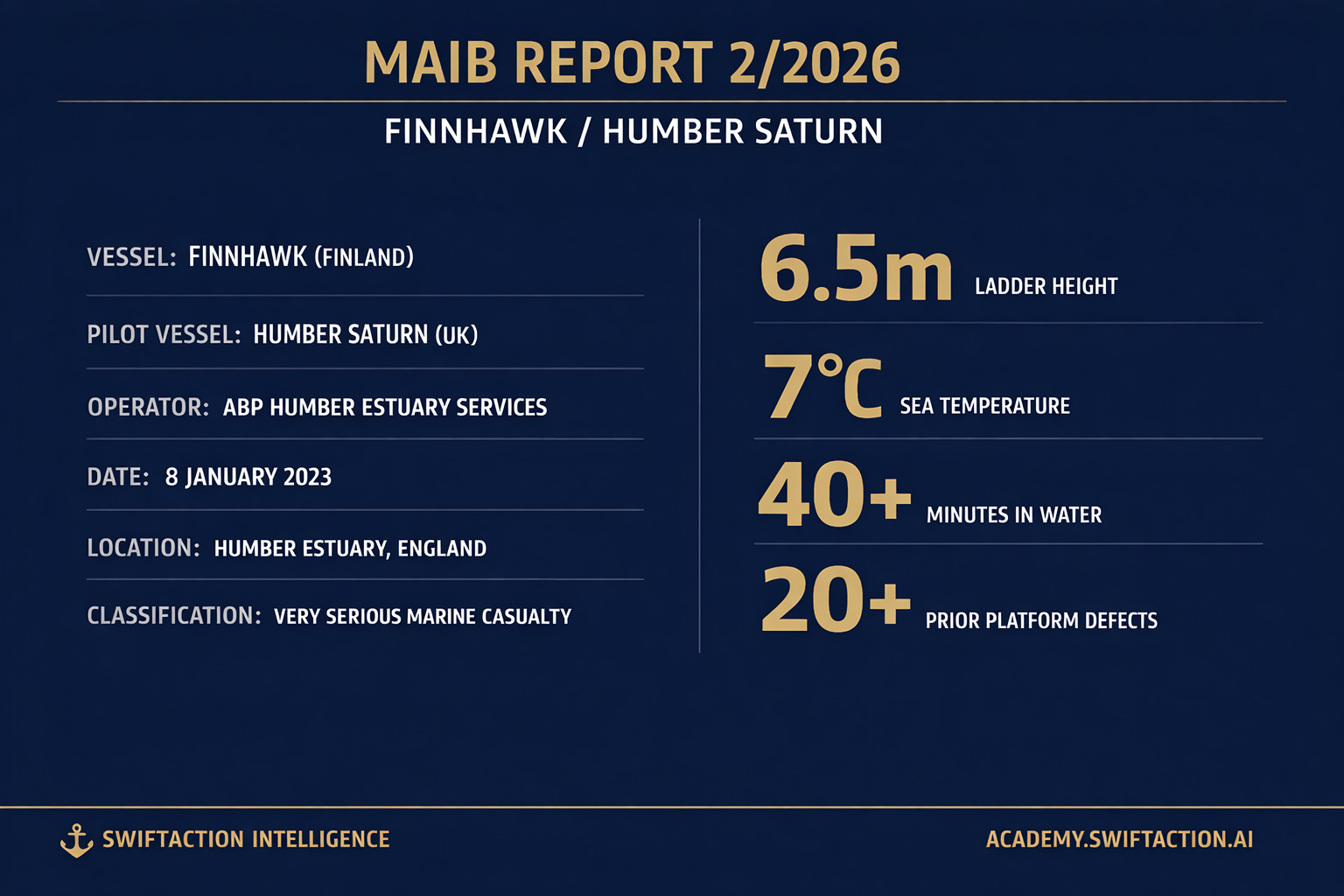
Report: MAIB Investigation Report 2/2026 — Very Serious Marine Casualty Date of Accident: 8 January 2023 Report Published: 22 January 2026 Location: Approaches to the Humber Estuary, England — west of No.3 Chequer Buoy
Vessel: Finnhawk — Finland-flagged ro-ro cargo vessel, 11,671 GT, built 2001 Owner/Manager: Finnlines Plc Classification: RINA S.p.A
Pilot Vessel: Humber Saturn — UK-registered pilot vessel, GRP, built 2006 Operator: Associated British Ports Humber Estuary Services (ABP Humber)
Casualty: A 67-year-old Humber Class-2 pilot. He did not survive. Pronounced at Hull Royal Infirmary.
Conditions: Wind westerly 19kts, wave height 1–1.5m, sea temperature 7°C, air temperature 8°C.
Pilot Ladder: Approved design, good condition, correctly secured. Retrieval line rigged leading aft — contrary to IMO Resolution A.1045(27), which states retrieval lines should lead forward. The MAIB concluded this did not affect the outcome of this accident.
Source: MAIB Investigation Report 2/2026, Sections 1.1, 1.4, and 2.3
🔎 The Incident
At about 1300 on 8 January 2023, a 67-year-old Humber Class-2 pilot began climbing a 6.5-metre pilot ladder on the starboard side of the ro-ro cargo vessel Finnhawk in the approaches to the Humber Estuary. He was boarding the vessel from the pilot vessel Humber Saturn. He was wearing his issued PPE — including a high-visibility waterproof coat with integrated lifejacket, safety helmet, harness, personal locator beacon, and gloves — as well as a rucksack on his back. The Boarding and Landing Code advises against wearing rucksacks while climbing pilot ladders unless risk-assessed and part of approved PPE.
Before the transfer, multiple colleagues had attempted to dissuade him from working. The trainee pilot accompanying him had noticed him walking slowly and learned he had lower back pain, sciatica, and had not rested well. The trainee pilot suggested swapping assignments. The pilot refused. The trainee pilot then informed MCC staff, who in turn informed VTS staff. VTS staff, concerned by the pilot’s slow, laboured walk along the jetty observed on CCTV, asked the pilot vessel coxswain to check on him. The pilot said he wanted to proceed. The coxswain asked again immediately before the transfer. The pilot firmly replied that he did. In total, the trainee pilot proposed alternative assignments (the tanker pilot agreed to swap), informed MCC staff — who in turn alerted VTS staff — and the pilot vessel coxswain asked the pilot twice whether he wanted to proceed. At every stage, the pilot refused the alternatives and insisted on climbing.
The pilot inspected the ladder, tested it by putting his weight on it and pulling it away from the hull, and began climbing. Finnhawk’s second officer and an able seaman were monitoring the embarkation at the top of the pilot ladder. The pilot’s upper body was further from the ladder than his lower limbs and his progress was very slow. At approximately 2 to 2.5 metres above the pilot vessel’s deck, he stopped, looked up at Finnhawk’s crew above him, then suddenly leaned back, released both hands simultaneously, and fell backwards without making a sound.
He landed on his back on Humber Saturn’s deckhouse and port safety rail. The pilot vessel was positioned beneath the ladder at the time of the fall. His safety helmet broke on impact. The MAIB found it was highly likely that his thoracic spine fractures occurred at this point. He then slipped off the pilot vessel and fell into the sea between the two vessels. His integrated lifejacket inflated and his personal locator beacon activated. He was floating with his head above water.
The pilot vessel crew responded immediately. Within approximately two minutes, the deckhand used a MateSaver MOB rescue pole to catch the pilot and manoeuvre him to the stern. The crew then attempted to deploy Humber Saturn’s man overboard recovery platform — the vessel’s only means of lifting an unconscious person from the water.
The platform lowered. It would not raise.
The crew tried the mobile control box, the manual solenoid valve, and the secondary hand pump in the aft void space. Nothing worked. An MCA inspection the following morning found the platform operated under light load (approximately 100kg). An independent contractor inspection on 11 January — three days after the accident — found a defective solenoid valve and a loose limit switch fixing bolt. When the platform was loaded to 160.8kg — just over its safe working load of 160kg — it could not lift until those defects were rectified.
The pilot remained partially immersed on the lowered recovery platform for over 40 minutes. The trainee pilot jumped onto the platform to lift the pilot’s head clear of the water. Waves intermittently washed over both of them. The trainee pilot was occasionally chest-deep in cold water and unable to determine whether the pilot was still breathing.
The RNLI all-weather lifeboat arrived 26 minutes after the fall. Its rigid inflatable boat transferred the pilot to the lifeboat, where CPR was started. A coastguard helicopter winched the pilot and transferred him to Hull Royal Infirmary. He did not survive. He was pronounced at Hull Royal Infirmary at 1452 — nearly two hours after the fall.
The trainee pilot was treated for hypothermia. The deckhand was treated for a hand injury sustained during the rescue.
Source: MAIB Investigation Report 2/2026, Sections 1.2, 1.3, 1.8.6, and 2.9
📊 By The Numbers
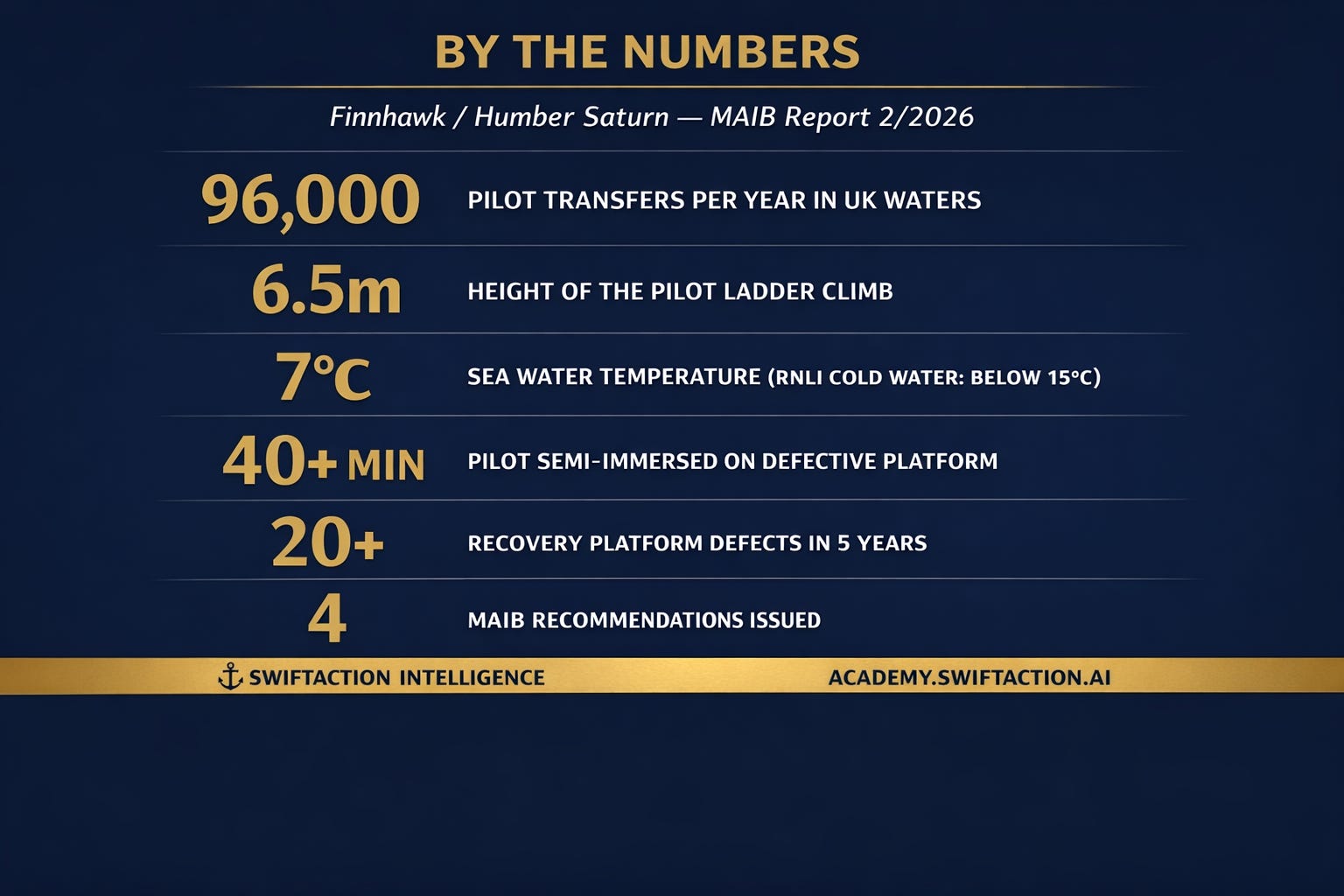
→ 6.5 metres — the height of the pilot ladder climb from Humber Saturn to Finnhawk’s upper deck. (Source: MAIB Report 2/2026, Section 1.2.2)
→ 7°C — sea water temperature at the time of the accident. The RNLI defines cold water as anything below 15°C. (Source: MAIB Report 2/2026, Section 1.1; RNLI definition cited in Section 1.9.4)
→ 40+ minutes — the time the pilot remained partially immersed on the defective recovery platform before being transferred to the RNLI RIB. (Source: MAIB Report 2/2026, Synopsis)
→ 20+ defects — the number of defects reported for Humber Saturn’s recovery platform in the five years before the accident, including lifting wires, limit switches, and sticking solenoid valves. ABP Humber’s maintenance system did not classify these as safety-significant. (Source: MAIB Report 2/2026, Section 1.7.3)
→ 130 kg — the pilot’s recorded weight at his last medical examination. The recovery platform’s safe working load was 160 kg. The MAIB assessed that it was possible that the defective solenoid valve, combined with the pilot’s weight plus wet clothing, rendered the platform incapable of lifting at the time of the accident. (Source: MAIB Report 2/2026, Sections 1.6.4, 1.7.2, and 2.6)
→ 67 years old — the pilot’s age. He had suffered a heart attack in 2011, a stroke in 2018, and had chronic kidney disease, high blood pressure, and obesity (BMI 40.1). Six months before the accident, he was issued a Category 1 ENG1 declaring him fit with no limitations. (Source: MAIB Report 2/2026, Sections 1.3 and 1.6)
→ 96,000 — the number of pilot transfers conducted underway using pilot ladders in the UK each year, by approximately 700 pilots. (Source: MAIB Report 2/2026, Section 1.10.1, citing MAIB 2022 CHA survey)
→ 4 MAIB recommendations issued to the MCA, ABP, and UK port industry bodies. (Source: MAIB Report 2/2026, Section 5)
🚨 The Systemic Failures
The MAIB identified multiple systemic failures that combined to significantly reduce the pilot’s chance of survival after the fall. These are not the usual crew competency gaps SwiftAction covers — they are organisational and regulatory failures. But every one of them has a training dimension that fleet operators and port authorities can address.
Failure 1: Medical fitness assessment was incomplete.
The pilot had a documented history of heart attack (2011), stroke (2018), chronic kidney disease, high blood pressure, and obesity (BMI 40.1 — severely obese). Despite this history, six months before the accident an MCA Approved Doctor issued a Category 1 ENG1 — fit for sea service with no restrictions. The MAIB found that the examination did not follow MCA guidance. The pilot’s BMI alone required a physical capabilities assessment under the Approved Doctor’s Guidance. That assessment was not performed. Additionally, the pilot did not declare his heart conditions to the examining doctor, and the doctor did not have digital access to the pilot’s previous ENG1 records to cross-check.
The MAIB concluded that correct assessment would probably have led to the pilot being declared either temporarily unfit or only fit for restricted service.
Failure 2: Stop-work procedures could not stop the pilot from working.
ABP Humber’s “Beyond Zero” safety culture empowered employees to stop unsafe work. On the day of the accident, multiple interventions were made — the trainee pilot proposed alternative assignments (the tanker pilot agreed to swap), the trainee pilot informed MCC staff who alerted VTS staff, and the pilot vessel coxswain asked the pilot twice whether he wanted to proceed. The pilot overrode every intervention.
The MAIB observed that employees are more likely to report a technical fault than challenge a colleague’s fitness for duty. The pilot’s age, experience, and long service may have made it difficult for his colleagues to exercise stop-work authority, despite their clear concerns. The MAIB characterised stop-work systems as “a supportive safeguard rather than an effective barrier.”
Failure 3: The only means of recovering an unconscious person from the water did not work.
Humber Saturn’s electro-hydraulic recovery platform was the vessel’s sole method of lifting a person in the water. It had accumulated over 20 reported defects in five years. ABP Humber’s maintenance system did not classify the recovery platform as safety-critical equipment. The MAIB assessed that it was possible that the defective solenoid valve, combined with the pilot’s weight plus wet clothing, rendered the platform incapable of lifting at the time of the accident. There was no backup — no davit, no harness arrangement, no independent recovery system.
This was not the first time inadequate pilot vessel recovery equipment contributed to a pilot being lost. In February 2018, a pilot fell from the container ship Singapore Express off Lisbon and could not be recovered for over 100 minutes because the pilot vessel’s recovery davit was unfit for purpose. That pilot did not survive. The investigation found no emergency procedure for recovering an unconscious person from the water.
Failure 4: The pilot’s clothing did not protect against cold water immersion.
The pilot wore an approved high-visibility waterproof coat with integrated lifejacket, safety boots, gloves, and a safety helmet. His trousers were thin suit-type trousers. This clothing kept his head above water but provided no thermal protection. The trainee pilot, who spent approximately 40 minutes on the platform with the pilot, was treated for hypothermia. The MAIB noted that immersion in cold water can provoke a cardiac event in individuals with pre-existing heart disease.
Failure 5: Pilots had received no sea survival, first aid, or CPR training.
None of the three ABP Humber pilots on board Humber Saturn at the time of the accident had received sea survival or first aid training, including defibrillator use, since joining the company. Only the pilot vessel crew held first aid certificates — and the coxswain was conning the vessel while the deckhand had injured his hand during the rescue. Had the pilot been recovered to the deck, the available first aid capability would have been severely compromised. IMO Resolution A.960(23) and the Boarding and Landing Code both recommend that pilots receive this training.
Failure 6: The pilot vessel was positioned beneath the ladder.
Humber Saturn was positioned beneath Finnhawk’s pilot ladder when the pilot fell. He landed on the pilot vessel’s deckhouse and safety rail, fracturing his thoracic vertebrae, before falling into the sea. The Fédération Française des Pilotes Maritimes reviewed French pilot accidents over 20 years and found that a 3-metre fall onto a pilot vessel could result in serious injury, while a fall from 8 metres could be unsurvivable. The pilot in this case fell approximately 2 to 2.5 metres onto a hard surface.
The updated Boarding and Landing Code now includes guidance on “Climb Zones” — the positioning of the pilot vessel relative to the ladder during the pilot’s climb. This is actionable for both pilot vessel coxswains and vessel masters receiving pilots: the positioning of the pilot vessel during transfer should be discussed and agreed before the pilot begins climbing.
Source: MAIB Investigation Report 2/2026, Sections 2.4–2.10, 1.9.5, and 1.10.3
🛡️ What Vessel Crews Should Learn — SwiftAction Courses
Finnhawk’s pilot ladder was in good condition and correctly secured. The vessel’s crew monitored the embarkation correctly. The failures in this case were on the port authority and pilot vessel side. But every pilot transfer involves two parties, and the MAIB’s findings contain direct lessons for vessel operators about their own pilot boarding arrangements, emergency preparedness, and equipment maintenance.
Pilot Ladders & Hoist/Pilot Transfer Arrangements (Code 10101) Code 10101 is the PSC deficiency code for pilot transfer arrangements. PSCOs routinely inspect pilot ladder rigging, securing, condition, and compliance with SOLAS V/23 and IMO Resolution A.1045(27). Finnhawk’s ladder was in good condition and correctly secured — but its retrieval line was rigged leading aft, contrary to IMO Resolution A.1045(27), which states that retrieval lines should lead forward. The MAIB concluded this did not affect the outcome, but it illustrates how a vessel that meets the physical standard can still have compliance gaps that a PSCO will identify. SwiftAction’s Code 10101 module covers SOLAS requirements for pilot boarding arrangements, the correct rigging of pilot ladders and combination arrangements, retrieval line positioning, lighting requirements, and the specific items PSCOs check during inspection.
Emergency Preparedness (Code 15107) The recovery of a person from the water is an emergency procedure that every vessel must be prepared to execute. The Humber Saturn case demonstrates what happens when the emergency equipment fails and no backup exists — a scenario that also occurred in the 2018 Singapore Express pilot loss off Lisbon. SwiftAction’s Code 15107 module covers the ISM Code requirements for emergency preparedness, including drills, procedures, and the identification of potential shipboard emergencies. For vessel crews, the question is not whether a pilot will fall — it is whether the crew can respond effectively if one does.
Maintenance of the Ship and Equipment (Code 15109) Humber Saturn’s recovery platform accumulated over 20 defects in five years. The maintenance system did not classify it as safety-critical. The platform passed its routine daily check on the morning of the accident — but could not lift a loaded person when it mattered. SwiftAction’s Code 15109 module covers the ISM Code requirements for planned maintenance, the identification and reporting of safety-critical equipment defects, and the distinction between routine maintenance and safety-significant defect management. The lesson for vessel operators: if a piece of equipment exists to save a life, it must be maintained to save a life.
Masters Responsibility and Authority (Code 15104) Multiple colleagues tried to stop the pilot from climbing the ladder. None succeeded. The MAIB found that the port’s stop-work system was ineffective because colleagues could not override the pilot’s decision. SwiftAction’s Code 15104 module covers the master’s overriding authority under the ISM Code to make safety decisions, including the authority to refuse to proceed with an operation the master considers unsafe. For vessel masters receiving a pilot, the question is: if you observe a pilot who appears unfit to make the transfer, do you have the procedures and the confidence to refuse the boarding?
Resources and Personnel (Code 15105) The pilot climbed a 6.5-metre ladder despite visible signs of impairment that prompted multiple interventions from colleagues. On the pilot vessel side, only two crew members were available for MOB recovery, and none of the three pilots onboard had received sea survival or first aid training. SwiftAction’s Code 15105 module covers the ISM Code requirements for adequate resources and personnel, including manning levels, training, and the competency of personnel assigned to safety-critical operations.
Crew Familiarization with Emergency Systems (Code 04121) When the recovery platform failed, Humber Saturn’s crew and the pilots onboard had no alternative recovery plan and limited first aid capability. SwiftAction’s Code 04121 module covers SOLAS requirements for crew familiarization with emergency systems and the STCW onboard training obligations. The module addresses the scenario where primary emergency equipment fails and the crew must improvise — the exact scenario that played out on Humber Saturn.
👉 Browse all Safety of Navigation courses: academy.swiftaction.ai/collections/10-safety-of-navigation
👉 Browse all ISM courses: academy.swiftaction.ai/collections/15-ism
👉 Browse all Emergency Systems courses: academy.swiftaction.ai/collections/04-emergency-systems
👉 Try a free course: https://academy.swiftaction.ai/courses/07106
👀 What to Watch
The MAIB issued four recommendations. Two target the regulatory framework:
Recommendation 2026/103 asks the MCA to amend MGN 544 to require non-SOLAS vessels to carry an alternative means of recovering an unconscious person that does not rely on shipboard systems or power. This directly addresses the single point of failure that prevented Humber Saturn’s crew from recovering the pilot.
Recommendation 2026/106 asks UK port industry bodies to update the Boarding and Landing Code to include guidance on occupational health standards for marine pilots and cold water survival PPE.
ABP Humber has already taken action: introducing an improved medical standard for its pilots, equipping all pilot vessels with manually operated recovery cradles as backup, upgrading defibrillators and stretchers, and strengthening its Stop-Work Authority programme. The MCA has introduced the Approved Doctors Information System, which allows Approved Doctors to access seafarer medical examination records digitally — addressing the records access gap that contributed to the pilot’s incomplete medical assessment.
For vessel operators, the immediate question is not whether your pilot ladder is compliant — it is whether your crew knows what to do if a pilot falls during the transfer. Does the vessel have MOB recovery equipment that works? Has the crew drilled the scenario? Can the crew provide first aid? Does the master know the authority exists to refuse a transfer if conditions are unsafe? These are the competencies PSCOs check under Codes 10101, 15107, and 04121. They are also the competencies that save lives.
Pilot transfers are among the most dangerous routine operations in maritime. The MAIB’s 2022 survey found that UK pilots alone conduct 96,000 underway pilot ladder transfers every year. Most are completed without incident. This one was not.
⚡ SwiftAction Signal
The Pattern: A pilot with a documented history of cardiac disease, stroke, obesity, and chronic pain was declared fully fit for unrestricted sea service by an Approved Doctor who did not follow the MCA’s own guidance. When he suffered a probable cardiac event on the ladder, the only equipment that could have recovered him had a known pattern of defects and failed under load. His colleagues tried to stop him. The system let him through.
The Gap: Medical fitness certification that does not match the physical demands of the role. Maintenance systems that do not distinguish between routine defects and safety-critical failures. Stop-work cultures that empower employees in theory but cannot override individual determination in practice. PPE that keeps your head above water but does not keep you alive in 7°C seas.
The Question for Fleet Operators: Your vessel receives pilots. Is your pilot ladder rigged correctly — including the retrieval line? If a pilot falls during transfer, can your crew recover them? Has the MOB recovery equipment been tested under load — not just lowered and raised empty? Does your master know the authority exists to refuse a transfer if conditions are unsafe? Have you discussed pilot vessel positioning during the climb?
One course. One drill. One maintenance check. That is the difference between a routine transfer and a pilot who never comes home.
→ Start here: academy.swiftaction.ai