

|⚓ About Us | 📋 Training Catalog | 🎯 CIC 2026 Bundle |
🏅 Free Course Access (No Credit Card)
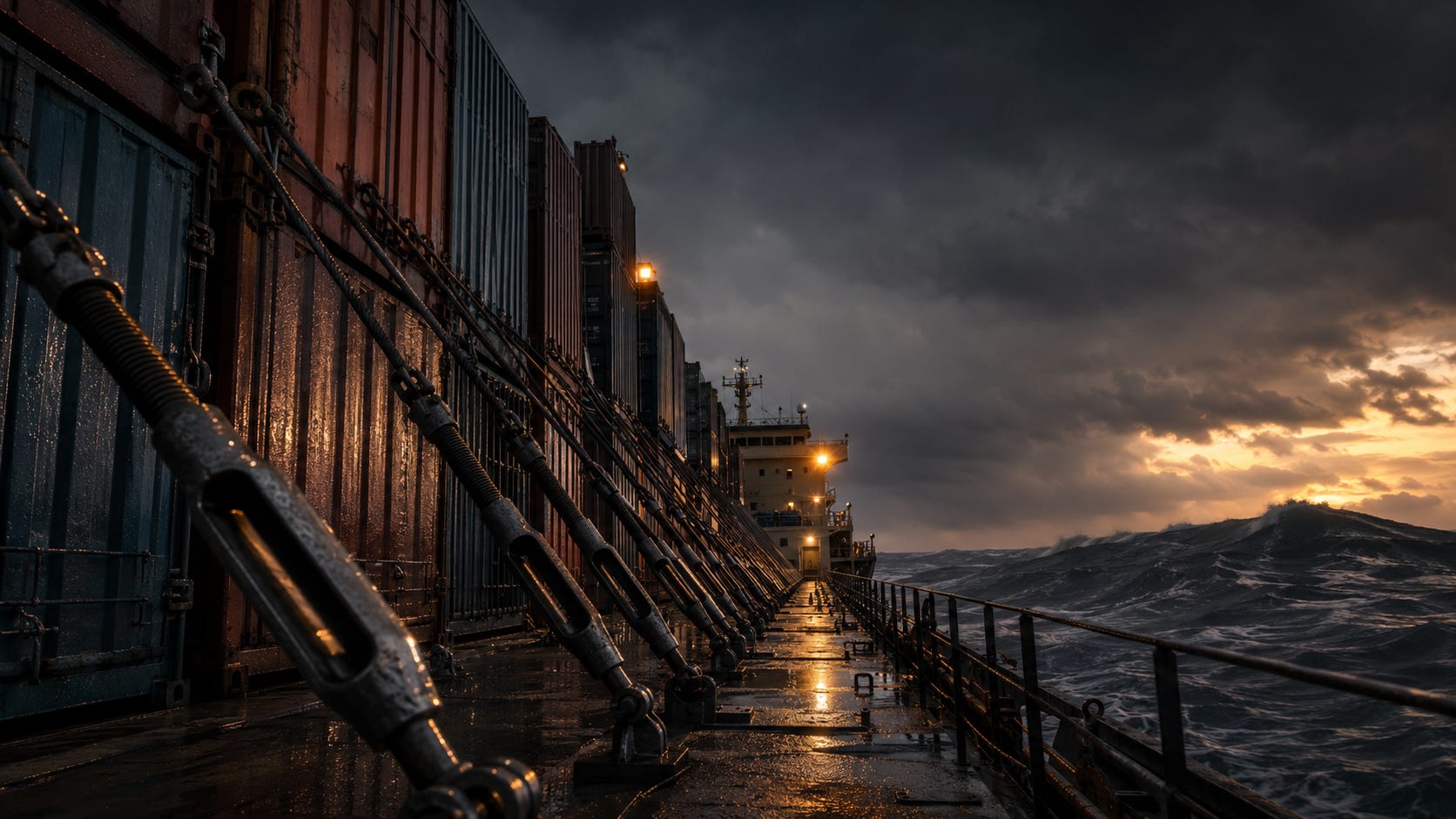
In 2025, the Paris MOU and Tokyo MOU ran their joint Concentrated Inspection Campaign on ballast water management. Before that campaign had even closed, both regimes had named the 2026 topic: cargo securing. The campaign runs from 1 September to 30 November 2026, and for those three months every vessel inspected in either region, from the Atlantic and North Sea ports of the Paris MOU to the Asia-Pacific ports of the Tokyo MOU, is assessed against the cargo securing questionnaire on top of the standard inspection.
A Concentrated Inspection Campaign is the closest thing port State control has to a published exam. The topic is announced in advance, the window is fixed, and the questionnaire is released before it begins. What separates cargo securing from a simple documentation check is that, at its core, it is a competency. A Cargo Securing Manual sitting in the wheelhouse is a document. Knowing which lashings to apply for the cargo and the sea state, inspecting the securing gear against its discard criteria, and recording all of it, is a skill the crew either has or does not. A skill cannot be retrofitted the week before a boarding.
Thanks for reading SwiftAction Intelligence! Subscribe for free to receive new posts and support my work.
The findings were rectified on paper. The competency gap persisted at sea.
📋 In this issue:
📋 The Campaign
📊 By The Numbers
🚨 The Pattern
🧭 What Should Be Happening
👀 What to Watch
🎯 SwiftAction Signal
🔔 Not yet subscribed? SwiftAction Intelligence covers maritime accidents, detentions, and the training failures behind them. Subscribe For Free!
📋 Competency-Based Maritime Training Mapped to Every PSC Deficiency Code → academy.swiftaction.ai
🎯 2026 CIC Cargo Securing Bundle: 30 Courses, Tokyo & Paris MOU Aligned → academy.swiftaction.ai/bundles/2026-cargo-securing-cic-tokyo-paris-mous
📋 The Campaign
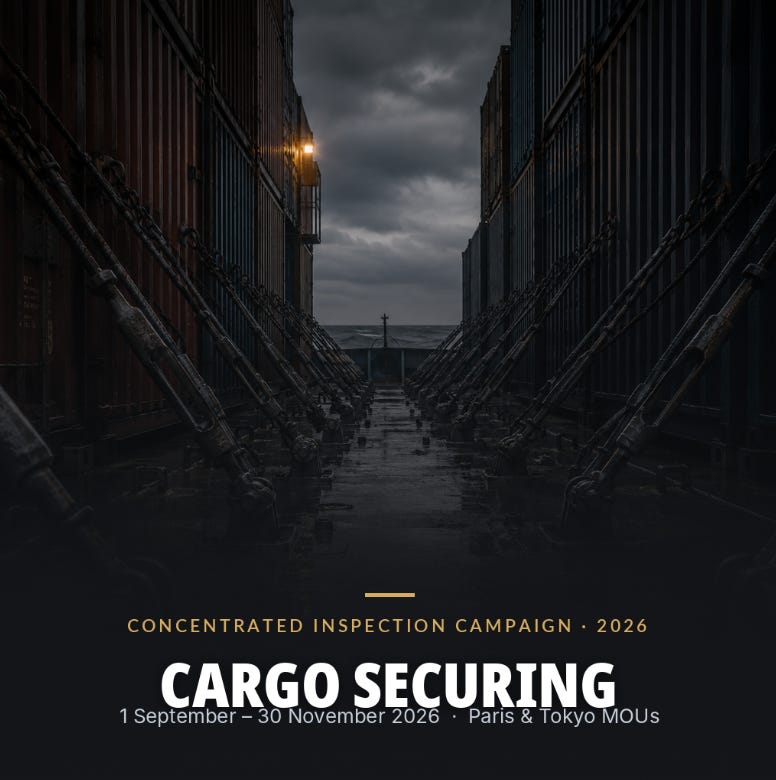
Every year the Paris MOU and Tokyo MOU select a single compliance area and run a coordinated campaign on it, jointly, across both regions. For the period from 1 September to 30 November 2026, that area is cargo securing. The two regimes agreed the topic in principle alongside the 2025 ballast water campaign, and have also already agreed the 2027 campaign on enclosed space entry. The schedule is not a forecast. It is published policy.
How a campaign changes the inspection. During a Concentrated Inspection Campaign, a port State control officer applies the campaign questionnaire on top of the standard inspection. This matters because it changes the odds. A vessel that would pass a routine check on its general condition can pick up deficiencies, and in a serious case a detention, on the campaign topic alone. The questionnaire is not optional and it is not selective. If a ship is inspected for any reason during the window, the cargo securing questions are worked through as part of that inspection.
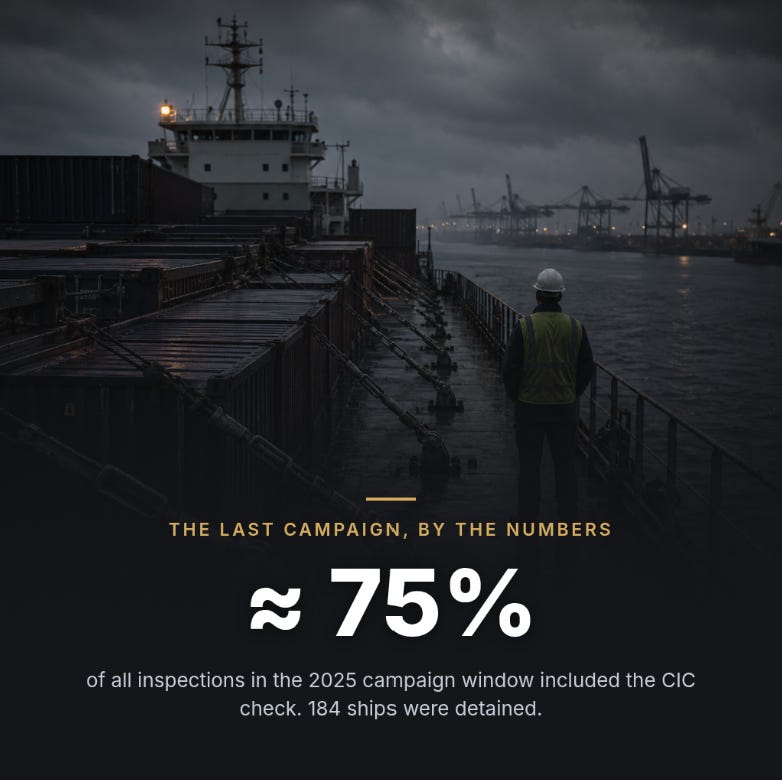
The reach is near total. The campaign applies to every inspected vessel, not only those pre-selected for a routine inspection. The scale of the last campaign shows what that means in practice. During the 2025 ballast water campaign, member authorities of the Tokyo MOU carried out 9,244 inspections in the three-month window, and 6,930 of them, close to 75%, included the campaign check. A campaign is not a possibility to monitor from a distance. It is a scheduled examination, with the syllabus released ahead of time, applied to almost everyone who is boarded.
Cargo securing is a competency topic. The questionnaire will work through the Cargo Securing Manual, the condition of lashing and securing equipment, stowage and stability, and the crew’s knowledge of securing procedures. Each of those has a paper element and a practical element, and the practical element is where findings are raised. An inspector can read a manual in a minute. Establishing whether the crew can actually apply it, whether the lashing gear on deck matches what the manual requires, and whether discard criteria are understood and acted on, is the part that separates a clean inspection from a finding. That assessment lands on the crew, in real time, with no opportunity to prepare once the officer is aboard.
So the situation is unusually clear. The topic is fixed. The dates are fixed. The questionnaire publishes before the window opens. The only variable a fleet actually controls is whether its crews have trained against the competency before September. The next section maps that competency to the specific deficiency codes a cargo securing inspection is built around.
📊 By The Numbers
1 September to 30 November 2026, the fixed window of the joint Paris MOU and Tokyo MOU Concentrated Inspection Campaign on cargo securing
2 port State control regimes running the campaign jointly, covering the Atlantic, North Sea, and Asia-Pacific basins
Every inspected vessel in either region is assessed against the cargo securing questionnaire during the window, not only ships pre-selected for inspection
9,244 inspections carried out by the Tokyo MOU during the three-month 2025 campaign window
6,930, close to 75%, of those inspections included the campaign check
184 ships detained during the 2025 campaign, a 2.66% detention rate over the window
Summer 2026, when the official cargo securing questionnaire is expected to be published, ahead of the September start
6 deficiency categories the cargo securing competency spans: cargo operations, structural conditions, water and weathertight conditions, safety of navigation, emergency systems, and ISM
2027 is already set for a joint campaign on enclosed space entry, giving operators more than a year of notice
Campaign topic and dates: Paris MOU and Tokyo MOU 2026 Concentrated Inspection Campaign announcements. 2025 campaign results: Tokyo MOU Annual Report on Port State Control in the Asia-Pacific Region 2025 (ballast water management CIC), published May 2026.
🚨 The Pattern
Cargo securing reads like a single line item. It is not. A securing failure is rarely one missing turnbuckle. It is a chain of competencies that runs from the manual, through the gear, into stowage and stability, and out to the bridge that has to route the ship through the weather the cargo was secured for. The 2026 questionnaire reaches into all of it, and each link maps to a specific deficiency code an officer can cite.
The manual and the gear. The starting point of any cargo securing inspection is whether the Cargo Securing Manual is current and understood, and whether the lashing material on deck matches it and is fit for service. Those are code 06101 (Cargo Securing Manual) and 06104 (Lashing Material), sitting directly on the broader handling competency in 06107 (Cargo Operation). A manual nobody applies and gear nobody inspects against discard criteria are the two most predictable findings of the entire campaign.
Stowage, stability, and loading. Securing does not exist in isolation from how the ship is loaded. The questionnaire connects to stability information and loading instruments, cargo density, and the loading and ballast condition the securing arrangement assumes. That is code 02103 (Stability, Strength, Loading Information and Instruments), 06108 (Cargo Density Declaration), 06109 (Loading Instrument), and 02134 (Loading and Ballast Condition). A correctly lashed cargo on an incorrectly loaded ship is still a deficiency.
The integrity securing depends on. Cargo stays put because the structures and closures around it hold. The campaign touches hatchways and their covers, weathertight doors and machinery space openings, and, for timber, the uprights and lashings that secure a deck load. That is code 03104 (Cargo and Other Hatchways), 03105 (Covers), 03107 (Doors), 03109 (Machinery Space Openings), and 03114 (Stowage incl. Uprights, Lashing, etc., Timber), alongside the overloading and freeboard checks in 03101 (Overloading) and 03102 (Freeboard Marks), and the structural condition codes that decide whether decks and frames can carry the load at all, 02106, 02110, 02111, 02117 and 02118.
The bridge that has to deliver it. Cargo is secured for an expected sea state. Whether the ship is routed and handled to stay within that envelope is a navigation competency. That is code 10127 (Voyage or Passage Plan) and the discipline of keeping the record straight in 10129 (Navigation Records).
What happens when securing fails. If a load shifts, the response is an emergency competency: the muster, the damage control plan, and the crew’s familiarity with the systems they will reach for. That is code 04108 (Muster List), 04111 (Damage Control Plan), and 04121 (Crew Familiarization with Emergency Systems), with the wider emergency readiness checks in 04101, 04102 and 04109.
The root that ties it together. Every one of these sits inside the Safety Management System. Whether securing procedures are planned, carried out, maintained, and reported is the ISM Code in practice, and the responsibility for it sits with the company and the master, not the classification society. That is code 15106 (Shipboard Operations), 15108 (Reporting Non-Conformities, Accidents and Hazardous Occurrences), and 15109 (Maintenance of the Ship and Equipment). An SMS is not the binder. It is whether the crew runs the procedures the binder contains.
None of these are equipment line items. They are competency line items. The hardware behind almost every one of them can be repaired in a single port call. The competency that operates and maintains it cannot be installed overnight, and it does not show up in a certificate that only says a deficiency was rectified.
🧭 What Should Be Happening
The campaign telegraphs the test. That makes the response specific rather than general. For every deficiency code the 2026 cargo securing questionnaire is built around, there is a defined competency a crew member can be trained on and assessed against before a port State control officer ever steps aboard. SwiftAction Academy’s 2026 Cargo Securing CIC bundle maps thirty modules, one to one, to the codes across all six categories the campaign reaches.
Cargo operations
06101 – Cargo Securing Manual
06104 – Lashing Material
06107 – Cargo Operation
06108 – Cargo Density Declaration
06109 – Loading Instrument
Structural conditions
02103 – Stability, Strength, Loading Information and Instruments
02106 – Hull Damage Impairing Seaworthiness
02110 – Beams, Frames, Floors, Operational Damage
02111 – Beams, Frames, Floors, Corrosion
02117 – Decks, Corrosion
02118 – Decks, Cracking
02134 – Loading and Ballast Condition
Water and weathertight conditions
03101 – Overloading
03102 – Freeboard Marks
03104 – Cargo and Other Hatchways
03105 – Covers (Hatchway, Portable, Tarpaulins)
03107 – Doors
03109 – Machinery Space Openings
03114 – Stowage incl. Uprights, Lashing (Timber)
Safety of navigation
Emergency systems
04101 – Public Address System
04102 – Emergency Fire Pump and Its Pipes
04108 – Muster List
04109 – Fire Drills
04111 – Damage Control Plan
04121 – Crew Familiarization with Emergency Systems
ISM, the root
15106 – Shipboard Operations
15108 – Reporting Non-Conformities, Accidents and Hazardous Occurrences
15109 – Maintenance of the Ship and Equipment
Each module carries the Tokyo MOU and Paris MOU deficiency code on its face. A completion record shows that a named crew member completed the code-specific module and passed its assessment, which creates a documented, auditable link between the question a port State control officer will ask, the training that addresses it, and the person who was trained. The completion record does not claim to make anyone competent at sea, and it is not a substitute for statutory, flag-approved training. What it does is point at the exact code the campaign is built on, and prove that the gap behind it was actually worked. With more than 600 modules mapped one to one to the deficiency codes inspectors cite, the catalogue covers every area the 2026 questionnaire reaches, and the thirty-course bundle covers the campaign at a 60% discount on individual pricing.
👀 What to Watch
The official questionnaire, expected summer 2026. The Paris MOU and Tokyo MOU publish the cargo securing questionnaire several weeks before the campaign opens. It tells you, item by item, what officers will check. Monitor parismou.org and tokyo-mou.org for the release, and treat the gap between publication and 1 September as the last clear window to train against it.
The campaign window, 1 September to 30 November 2026. Any vessel inspected in either region during these three months is assessed against the questionnaire. High risk-score vessels are more likely to be inspected and should prepare accordingly, but no inspected ship is exempt.
The Paris MOU 2025 annual report and refreshed flag lists, due around 30 June 2026. The third major regime completes the 2025 picture at the end of June, when the Paris MOU is due to publish its annual report and reset its White, Grey and Black lists for the year. Those flag movements reset every vessel’s targeting exposure heading into the campaign.
Tokyo MOU company performance lists. From the start of 2026 the Tokyo MOU publishes performance lists for companies, not only flags. Operators now sit on the public record alongside the registries they choose, and charterers and insurers will read those lists.
The 2027 enclosed space entry campaign. The two regimes have already agreed a joint campaign on enclosed space entry for 2027. Enclosed space entry remains one of the most dangerous recurring competency failures at sea, and operators have more than a year to get ahead of it rather than meet it cold.
🎯 SwiftAction Signal
The inspectors have published the 2026 exam. The subject is cargo securing, the window is 1 September to 30 November, and the questionnaire lands before it opens. None of that is a surprise, which is exactly the point. A Cargo Securing Manual proves a document exists. It does not prove the crew can read the cargo, the gear, and the sea state and secure the load correctly under way. That is the gap a $17 SwiftAction Academy module is built to close, mapped to the precise code an officer will cite, because the campaign has already moved the question from “is it in the manual?” to “can your crew prove they can do it?”
⚓ The SwiftAction Team
SwiftAction Intelligence is published weekly.
For partnership inquiries contact admin@swiftaction.ai
📋 Full Training Catalog: academy.swiftaction.ai
🎯 Prepare for the 2026 Cargo Securing CIC: academy.swiftaction.ai/bundles/2026-cargo-securing-cic-tokyo-paris-mous