

📋 In this issue:
🔍 The Incident — What happened at Deurganck Dock
📊 By The Numbers — The scale of disruption and contamination
🔥 The Training Failure — Twelve competency gaps behind the spill
🛡️ SwiftAction Courses — The 12 courses mapped to the exact PSC deficiency codes exposed by this incident
👁️ What to Watch — The investigation, the environmental fallout, and the ageing fleet question
🚨 SwiftAction Signal
🔔 Not yet subscribed? SwiftAction Intelligence covers maritime accidents, detentions, and the training failures behind them. Subscribe for free!
📋 Competency-Based Maritime Training Mapped to Every PSC Deficiency Code → academy.swiftaction.ai
🎯 2026 CIC Cargo Securing Bundle: 30 Courses, 60% Off → academy.swiftaction.ai/bundles/2026-cargo-securing-cic-tokyo-paris-mous
DATA CARD
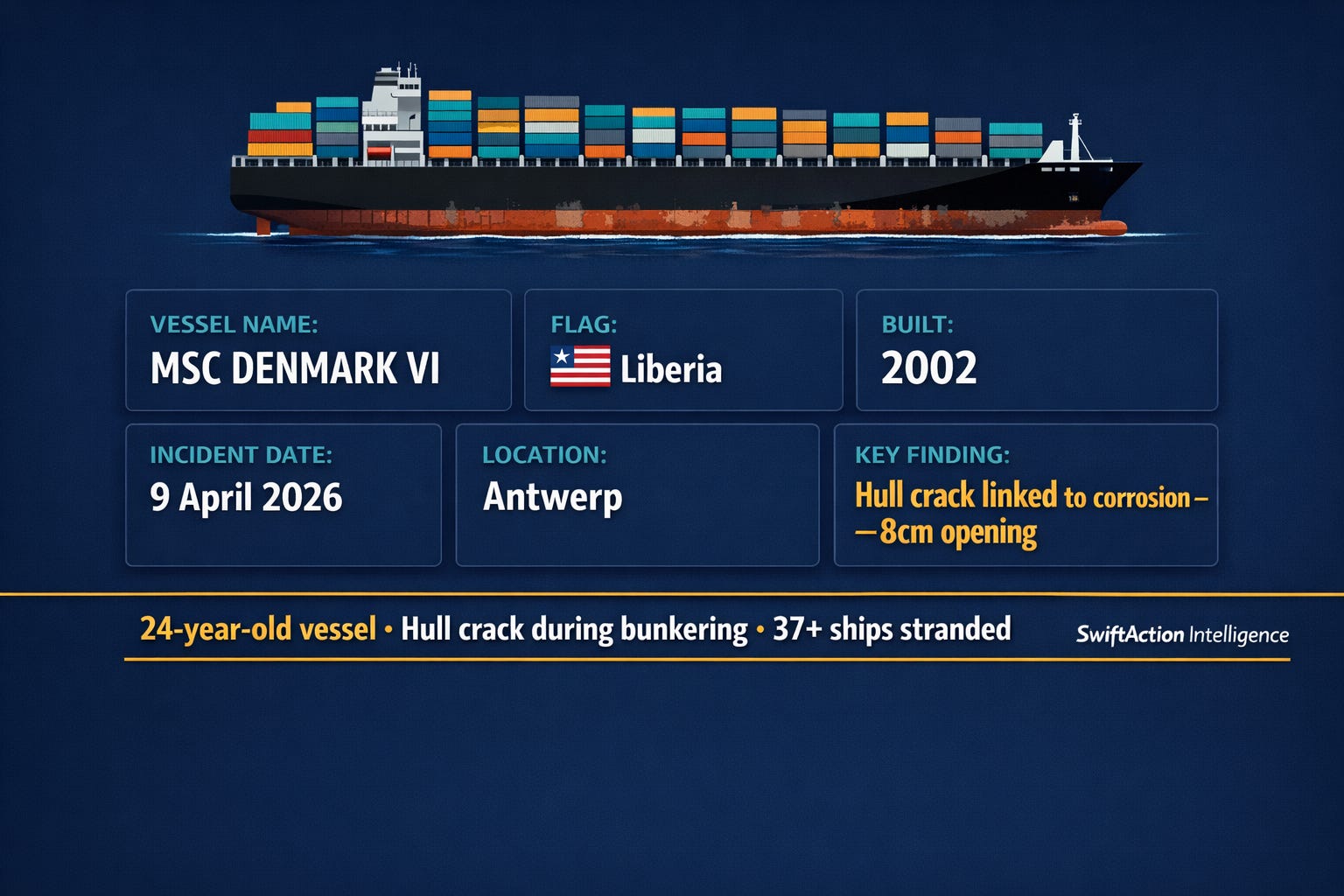
Vessel: MSC Denmark VI IMO: 9231250 Type: Container Ship (Post-Panamax), 5,762 TEU Flag: Liberia
Built: 2002 (24 years old) LOA / Beam: 278m / 40m
Former Name: E.R. Denmark
Incident Date: Night of April 9, 2026 Location: Deurganck Dock, Port of Antwerp-Bruges, Belgium
Hull Opening: Approximately 8cm, per the mayor of Beveren-Kruibeke-Zwijndrecht as reported by VRT NWS (not independently confirmed by marine surveyors or port authority technical report)
What Happened: Hull crack linked to corrosion opened during bunkering. Heavy fuel oil leaked into the dock, spread into the Scheldt River, shut Europe’s second-largest port, contaminated nature reserves, and left at least 37 vessels waiting to enter or leave the port, with reports of up to 50 ships stopped or delayed at peak disruption. Cleanup entered its sixth day with the full environmental impact still unknown.
Casualties: None reported Pollution: Significant — oil spread 3+ km, reached the Doelpolder wetlands, Verdronken Land van Saeftinghe, Hedwigepolder, and Bath in the Netherlands
Competency Areas Exposed: Hull corrosion detection, pre-bunkering structural assessment, SOPEP activation, pollution emergency response, ISM planned maintenance for ageing tonnage
(Note: WorldCargo News identified the vessel as MSC Monterey 5; all other major outlets including Maritime Executive, VRT NWS, Marine Insight, Safety4Sea, and Brussels Times identify it as MSC Denmark VI. This article follows the majority identification.)
THE INCIDENT
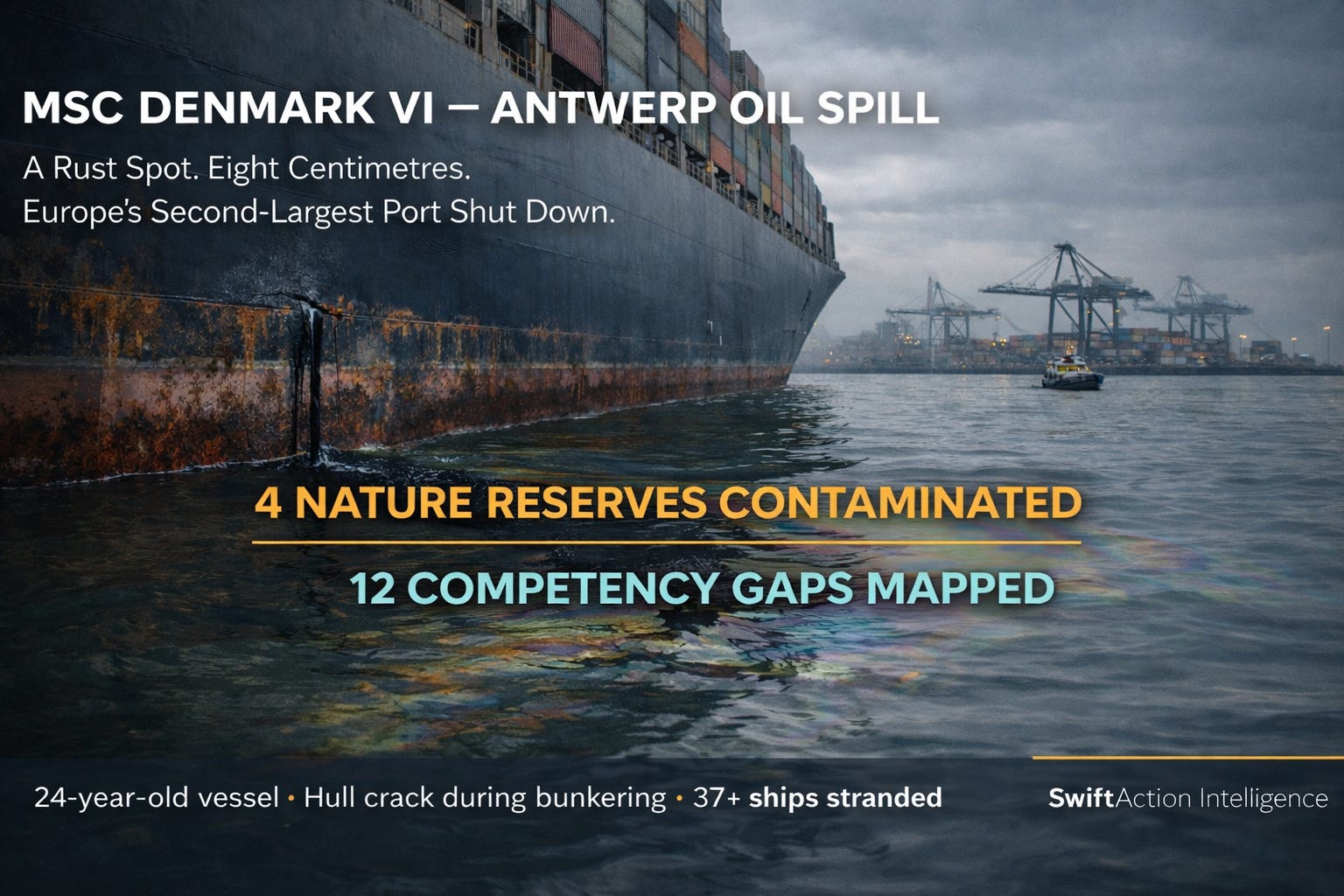
On the night of April 9, 2026, the Liberian-flagged container ship MSC Denmark VI was bunkering at Deurganck Dock in the Port of Antwerp-Bruges when heavy fuel oil began leaking from a crack in the vessel’s hull. The opening — approximately eight centimetres, according to the mayor of Beveren-Kruibeke-Zwijndrecht — was linked to a rust spot that gave way under the pressure of the refuelling operation.
The leak was not detected immediately. It continued through the night and was only discovered the following morning, when port authorities activated emergency response operations at approximately 07:30 local time on April 10.
As of publication, no official estimate of the volume of oil discharged has been released.
By then, oil had spread from the dock into the tidal Scheldt River — the main maritime access route to one of Europe’s busiest ports. Authorities closed the river to navigation between buoy 80 and the entrance to Deurganck Dock. The Zandvliet and Berendrecht locks — critical deep-sea shipping access points — were shut. Europe’s single largest container terminal, the PSA-MSC TIL facility at Deurganck with nine berths and over 12,000 feet of quay, was suspended.
At least 37 vessels were waiting to enter or leave the port as of the morning of April 11, with reports of up to 50 ships stopped or delayed at peak disruption. Multiple container ships and inland barges were contaminated, including vessels at the Noordzee Terminal and Europaterminal. The economic impact was immediate: normally, around 50 large ocean-going vessels and up to 200 ships pass through the port daily.
The oil — heavy fuel oil with a density close to brackish water — partly formed a visible film on the surface, but much of it sank below the waterline, making it difficult to detect from the air or track by surface observation. It spread at least three kilometres downstream.
Within days, the contamination had reached several protected nature reserves: the Doelpolder wetlands, a key bird breeding ground; the Verdronken Land van Saeftinghe; the Hedwigepolder; and as far as Bath in the Netherlands. The Dutch water authority Rijkswaterstaat deployed the oil spill response vessel Arca, buoy tenders, and patrol vessels — but the oil layer was too thin for mechanical skimming, and much of the pollution had moved below the water surface.
By April 15 — six days after the incident — cleanup operations were still ongoing. The conservation group Natuurpunt stated that the full extent of environmental damage would only become visible after the spring tide.
Belgian authorities and the terminal operators MSC and PSA launched a joint investigation. The vessel remains at the MSC-PSA terminal.
The Maritime Executive reported that a similar oil spill incident occurred in the same dock in June 2024, though details of that event’s cause, scale, and the vessel involved have not been independently confirmed.
Every element of this incident traces back to a measurable competency: the ability to detect corrosion before it fails, the ability to assess hull condition before pressurised bunkering, the ability to recognise and respond to an active pollution event. These are not specialist skills. They are foundational competencies that every officer on every vessel is expected to hold — and that PSC inspectors are trained to test.
BY THE NUMBERS
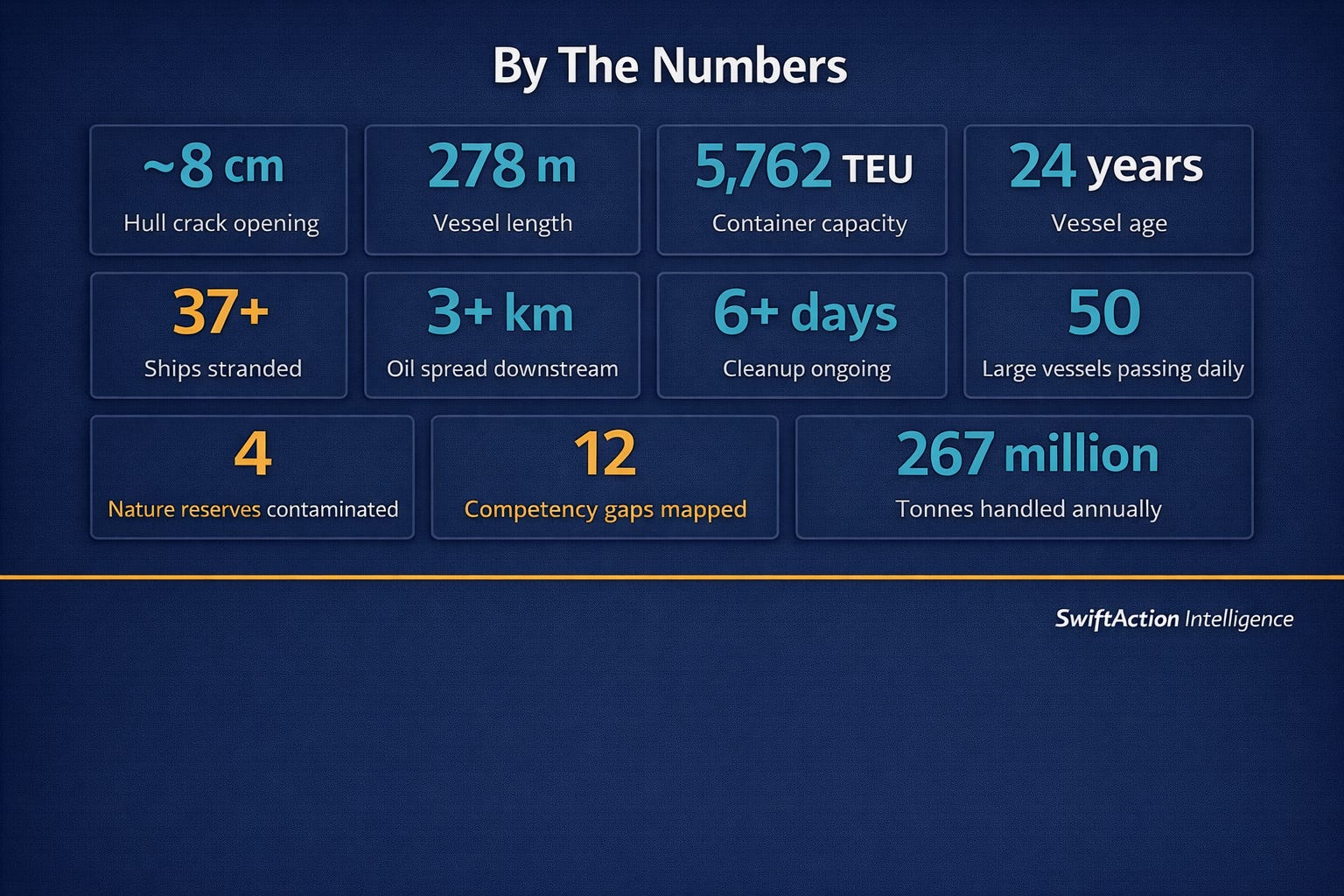
~8 cm — approximate size of the hull opening, per local official reporting (not independently surveyed), linked to a rust spot that cracked under bunkering pressure
37+ — vessels waiting to enter or leave the port as of 08:30 on April 11 (Brussels Times, citing port authority), with VRT NWS reporting up to 50 ships stopped or delayed
3+ km — minimum distance the oil spill spread downstream
6+ days — cleanup duration as of April 15, with full environmental assessment still pending
50 — large ocean-going vessels that typically pass through the port daily
13.6 million — TEUs handled by the Port of Antwerp-Bruges in 2025
267 million — tonnes of goods handled annually
24 years — age of MSC Denmark VI at time of incident
2nd reported incident — the Maritime Executive noted a similar oil spill occurred in the same dock in June 2024 (cause and scale unconfirmed)
4 — protected nature reserves reached by the pollution (Doelpolder, Saeftinghe, Hedwigepolder, Bath)
12 — distinct competency gaps mapped to PSC deficiency codes, spanning structural integrity, pollution prevention, and safety management
THE TRAINING FAILURE
A crack reportedly measuring approximately eight centimetres should never shut Europe’s second-largest port. Based on available reporting, it did because the corrosion behind it appears to have gone unidentified before the bunkering operation began.
Hull structural integrity is not an abstract regulatory concept. It is a foundational competency for every officer involved in vessel maintenance and pre-bunkering inspection. The chain of failures that led to this incident maps to a set of competency gaps that are visible long before a rust spot gives way under fuel pressure. Each gap corresponds to a specific, testable, trainable skill — and each one is something a PSC inspector can identify in under ten minutes during an expanded inspection.
Corrosion detection and hull survey awareness. Every vessel undergoes periodic structural surveys, but between those surveys, the ship’s crew is the first line of defence against progressive corrosion. The ability to identify wastage, pitting, and stress points — especially in areas subject to ballast water exposure, splash zones, and structural transitions — is a core competency under SOLAS Chapter II-1. A 24-year-old vessel operating in demanding trade routes should have heightened awareness of age-related structural degradation. Based on the reporting available, the rust spot that cracked does not appear to have been identified prior to the bunkering operation.
Pre-bunkering preparation and risk assessment. Bunkering operations subject hull structures to internal pressures that dormant corrosion points may not withstand. A structured pre-bunkering checklist that includes hull condition awareness — particularly for ageing vessels — is consistent with ISM Code requirements for operational risk management. The fact that fuel began leaking during bunkering and went undetected until the following morning raises questions about both the quality of the pre-operation assessment and the monitoring regime during the operation itself.
SOPEP awareness and response readiness. Every vessel is required to carry a Shipboard Oil Pollution Emergency Plan under MARPOL Annex I. The delayed detection of the leak — overnight, with oil spreading uncontrolled into the Scheldt — raises questions about how effectively the SOPEP framework was understood and activated by the crew. The plan exists for exactly this scenario. The gap is not in the plan’s existence, but in the competency to recognise a developing pollution event and activate a response before a dock becomes a disaster.
ISM Code — planned maintenance and continuous improvement. The ISM Code requires companies to establish procedures for maintenance that ensure the vessel is maintained in conformity with regulations and with additional standards established by the company. For a 24-year-old vessel, that maintenance regime must account for the accelerated degradation profile of ageing steel. The reporting of a similar incident at the same dock in June 2024 raises questions about whether lessons from that event were absorbed into the maintenance and inspection regime for vessels operating on the same route.
None of these competency gaps are invisible. Corrosion detection is trainable. Pre-bunkering risk assessment is trainable. SOPEP activation is trainable. ISM maintenance awareness for ageing tonnage is trainable. The question facing every fleet operator reading this is not whether these gaps exist on their vessels — but whether they have been identified, measured, and closed before the next PSC inspector walks aboard.
The procedures existed on paper. The competency gap persisted at sea.
SWIFTACTION COURSES
No PSC inspection report for this incident has been published. The following deficiency codes are editorially mapped based on the incident’s reported characteristics and available source material, consistent with standard PSC deficiency categorization. They do not represent confirmed inspection findings against this vessel.
The deficiency categories consistent with the findings of the MSC Denmark VI incident map to twelve SwiftAction Academy competency modules — every one verified against active PSC deficiency codes. Each link below takes you directly to the targeted training that closes the specific competency gap.
Structural Integrity Competencies
02112 — Hull — Corrosion. The primary reported failure. Can your crew identify wastage, pitting, and progressive corrosion before it becomes a structural failure? → Start this course
02113 — Hull Cracking. The ~8cm crack that released heavy fuel oil. Corrosion-driven cracking in a 24-year-old hull is a predictable degradation mode — if you know what to look for. → Start this course
02119 — Enhanced Survey Programme (ESP). Ageing tonnage demands a survey regime that matches the vessel’s actual degradation profile, not just the minimum interval. → Start this course
01312 — Thickness Measurement Report. Hull wastage tracking is the early warning system for exactly this failure mode. Do your officers understand how to interpret and act on thickness measurement data? → Start this course
Pollution Prevention & Emergency Response Competencies
01314 — SOPEP. The Shipboard Oil Pollution Emergency Plan exists for exactly this scenario. The overnight delay in detection raises questions about crew competency in recognising activation triggers. → Start this course
04112 — Shipboard Marine Pollution Emergency Operations. When oil hits the water, response time is everything. This competency is the difference between a contained spill and a port shutdown. → Start this course
14101 — Control of Discharge (MARPOL Annex I). Uncontrolled discharge of heavy fuel oil into the Scheldt — understanding discharge control obligations is not optional, it’s a core officer competency. → Start this course
14123 — Accidental Oil Outflow Performance. Where structural condition meets environmental compliance. This competency bridges hull integrity awareness and pollution prevention. → Start this course
14116 — Pollution Report — MARPOL Annex I. Reporting obligations are triggered the moment oil enters the water. Delays compound both the environmental and regulatory consequences. → Start this course
01117 — International Oil Pollution Prevention Certificate (IOPP). IOPP compliance is not a certificate on a wall — it’s a competency that must be understood and maintained operationally. → Start this course
Safety Management Competencies
15109 — ISM Code: Maintenance of the Ship and Equipment. The ISM Code requires maintenance procedures that match reality, not just paperwork. A corrosion-linked hull crack on a 24-year-old vessel is consistent with a gap between planned maintenance and actual structural condition. → Start this course
15107 — Emergency Preparedness (ISM). The overnight delay between the leak starting and its detection the following morning raises questions about emergency detection and response competency across the watch team. → Start this course
WHAT TO WATCH
The investigation. Belgian authorities and the MSC-PSA joint inquiry will determine the exact cause and timeline of the corrosion development. If the investigation reveals that the hull deterioration was visible at a prior inspection — or should have been identified during classification society surveys — the implications for the vessel’s maintenance record and ISM compliance will be significant. The vessel’s classification society survey history — including the most recent hull and structural survey — will be a key focus of any investigation into why the corrosion was not identified prior to the failure. The investigation may also examine whether pre-bunkering checks by both the receiving vessel and the fuel supplier met operational requirements.
The environmental outcome. The full impact on the Doelpolder wetlands, Saeftinghe, and the Hedwigepolder will only become clear after the spring tide. This is breeding season. If the contamination has affected nesting sites, the ecological and reputational consequences will extend well beyond the port.
The pattern. The Maritime Executive reported a similar incident in the same dock in June 2024. If the two events share similar causal factors — particularly corrosion-related hull failures during bunkering — the question shifts from “how did this happen” to “why did it happen again.” If they do not share a common cause, the recurrence still raises questions about bunkering risk management at this specific berth.
Ageing fleet exposure. MSC Denmark VI was built in 2002. The global container fleet includes thousands of vessels of similar or greater age still in active service. If corrosion-linked hull failures during routine operations become a recurring theme, PSC authorities — particularly in the Paris MOU region — may sharpen their focus on structural integrity for ageing tonnage. Fleet operators running vessels older than 20 years should be asking a simple question: does every officer on board have demonstrated competency in the specific deficiency categories that PSC inspectors target on ageing hulls?
SWIFTACTION SIGNAL
A crack reportedly measuring approximately eight centimetres shut a port that handles 267 million tonnes of cargo per year. The cleanup is in its sixth day. Oil has reached four protected nature reserves across two countries. And the investigation hasn’t even begun to produce findings.
Twelve competency gaps. Twelve PSC deficiency codes. Twelve targeted training modules — each one designed to close the exact gap that this incident exposed.
The competency gaps behind the Antwerp oil spill — corrosion awareness, pre-bunkering risk assessment, SOPEP activation, ISM maintenance management — are not exotic. They are the kind of gaps that PSC inspectors look for on every expanded inspection. They are the kind of gaps that turn a routine bunkering operation into a headline.
SwiftAction Academy courses are built to close these gaps — for $17 per module, less than the cost of a single hour of port delay. Every course maps directly to a PSC deficiency code. Every module targets a specific, measurable competency. Complete a module, and you have demonstrated competency in the exact area an inspector will test.
Start with the competencies exposed by this incident:
→ Enhanced Survey Programme (02119)
→ Thickness Measurement Report (01312)
→ Shipboard Marine Pollution Emergency Operations (04112)
→ Control of Discharge — MARPOL Annex I (14101)
→ Accidental Oil Outflow Performance (14123)
→ Pollution Report — MARPOL Annex I (14116)
→ ISM: Maintenance of Ship and Equipment (15109)
→ ISM: Emergency Preparedness (15107)
The question is not whether your fleet has these gaps. The question is whether you’ll find them before the inspector does — or before the rust spot cracks.