

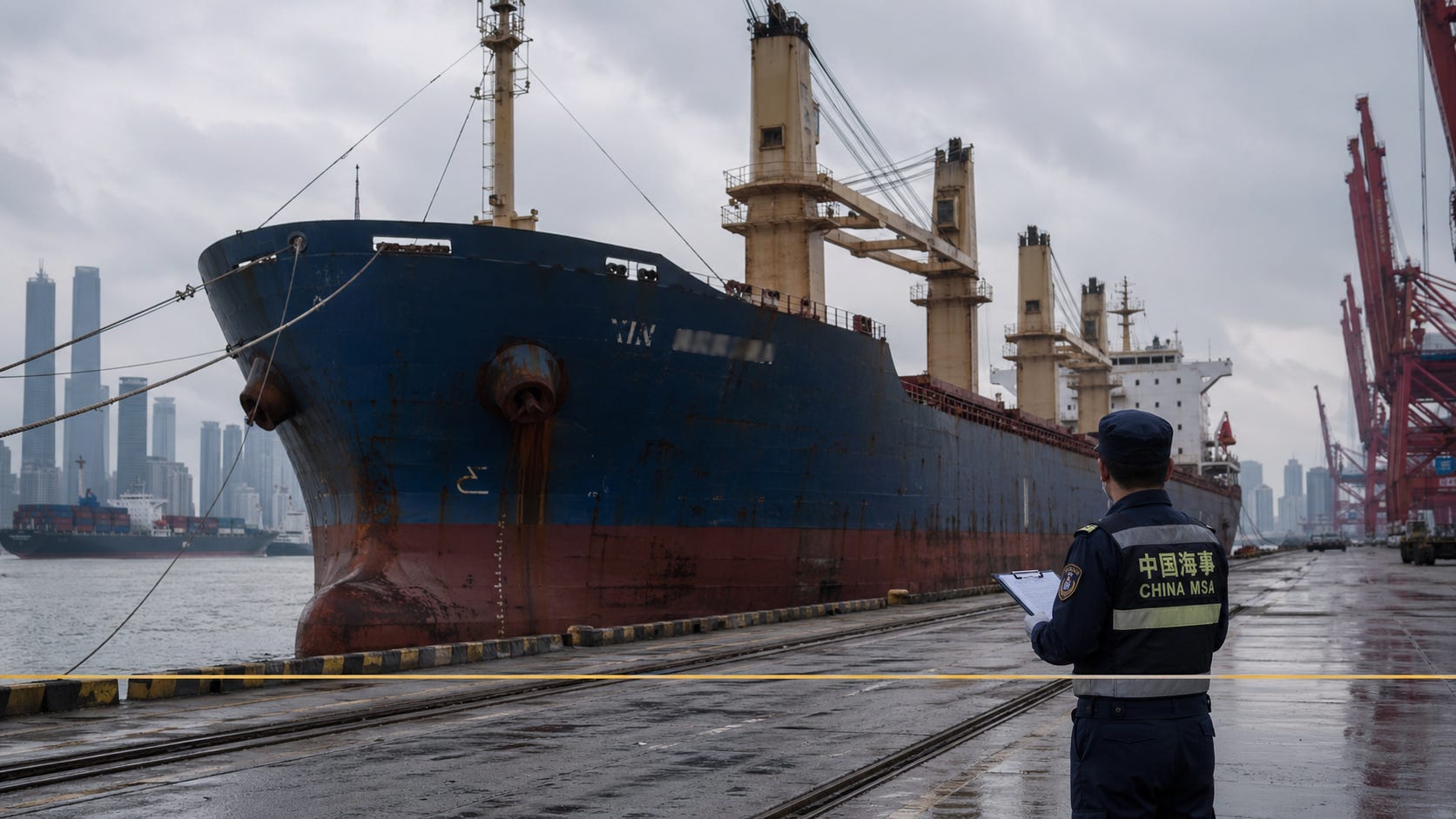
A Panama-flagged, Bureau Veritas-classed, Vietnamese-managed Handysize bulker — keel laid December 2007, sailing under a previous name (CHANG AN) — picked up 5 grounds for detention on an initial PSC inspection at Shanghai on 26 April 2026. The vessel’s Safety Management Certificate had been issued by class on 17 March 2026 — 40 days before the inspectors boarded.
📌 DATA CARD
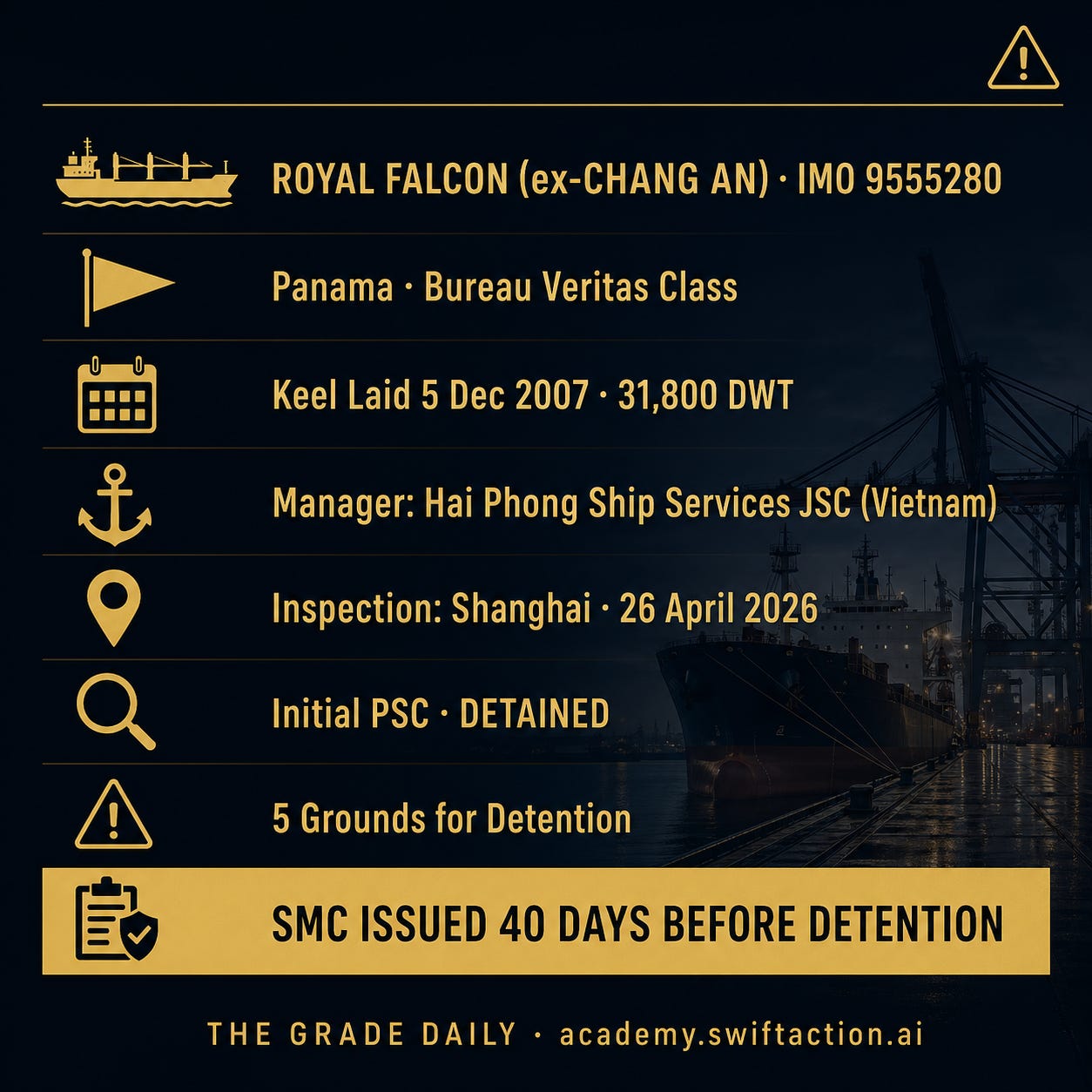
Vessel: ROYAL FALCON (ex-CHANG AN)
IMO: 9555280
MMSI / Callsign: 371661000 / 3FNE2
Type: Bulk carrier (Handysize)
Flag: 🇵🇦 Panama
Class: Bureau Veritas (BV)
Keel Laid: 5 December 2007
DWT / GT: 31,800 / 20,748
Manager: Hai Phong Ship Services Joint Stock Company (Vietnam)
Inspection Authority: China MSA
Inspection Port: Shanghai
Inspection Date: 26 April 2026
Inspection Type: Initial
Outcome: DETAINED — 5 grounds for detention
Latest SMC issued: 17 March 2026 (Bureau Veritas)
Latest DOC issued: 4 September 2025 (Bureau Veritas)
Source: China MSA inspection record (initial PSC, 26.04.2026)
📝 THE TEST
The deficiency. What inspectors found.
ROYAL FALCON arrived at Shanghai under a Panama flag, managed by a Vietnamese ship management company, with a Bureau Veritas Safety Management Certificate that had been issued just 40 days earlier. Across the prior nine months the vessel had cycled through what looked, on paper, like a complete recertification window: Cargo Ship Safety Construction renewed 7 November 2025; Cargo Ship Safety Equipment 20 October 2025; Safety Radio, IOPP, IAPP, ISPP, Load Line, and IEE all dated 23 September 2025; Document of Compliance 4 September 2025; Ballast Water Management Certificate 19 December 2025; SMC and MLC both 17 March 2026.
Then China MSA boarded.
Five grounds for detention:
Code 07109 — Fire Safety: Fixed Fire Extinguishing Installation
Code 07115 — Fire Safety: Fire-Dampers
Code 07117 — Fire Safety: Jacketed High Pressure Lines & Oil Leakage Alarm
Code 08110 — Alarms: Closing Watertight Doors Alarm
Code 11113 — Life-Saving Appliances: Launching Arrangements for Rescue Boats
Three of the five detainable findings sit in fire safety (07-series). One is a watertight integrity alarm under SOLAS Chapter II-1. One is the equipment that gets the rescue boat off the ship in an emergency.
📊 BY THE NUMBERS
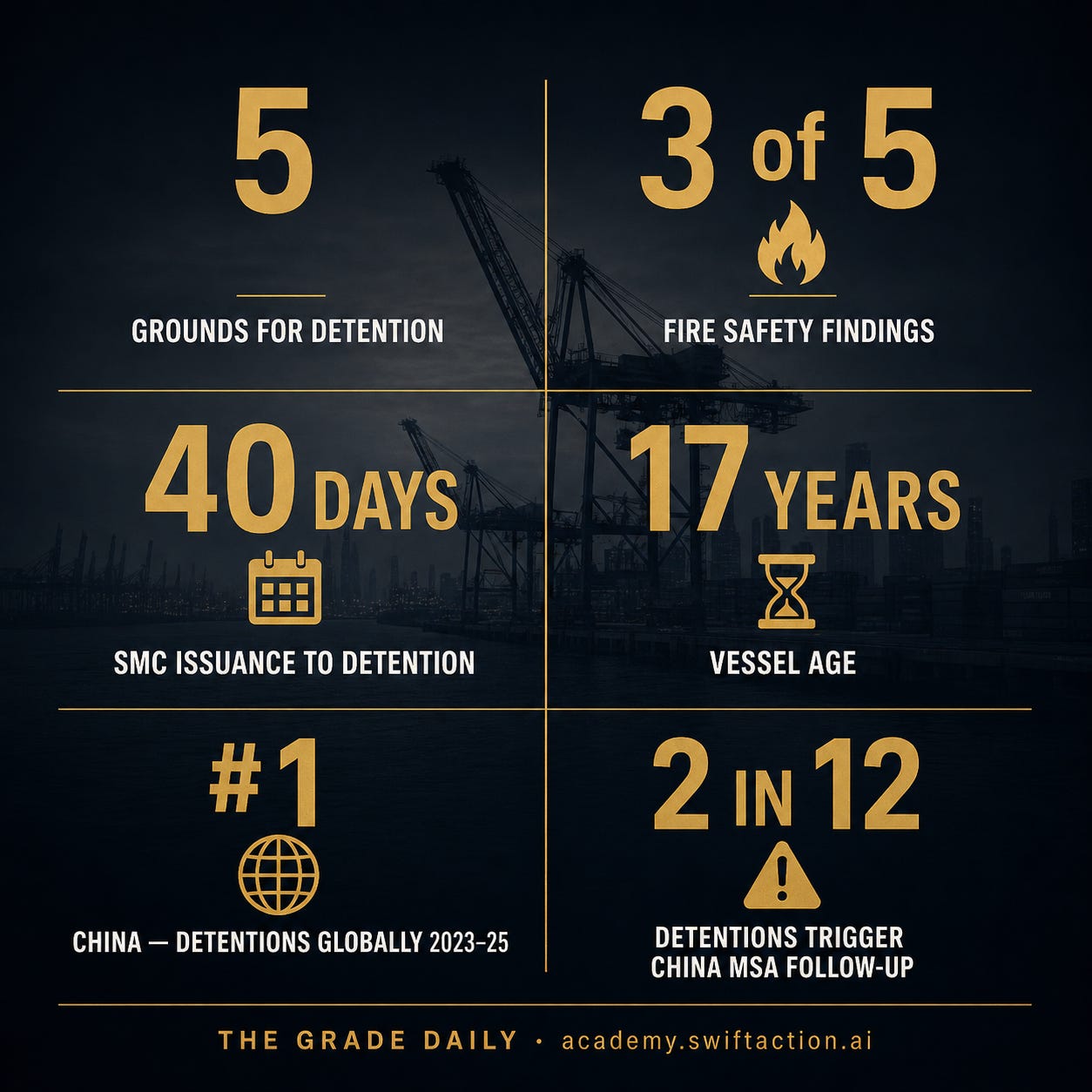
5 — Grounds for detention on a single initial inspection
3 of 5 — Findings in fire safety alone (60%)
40 — Days between SMC issuance and detention
17 — Years since build (delivered 2009; keel laid 5 December 2007)
#1 — China’s global rank for PSC detentions (Cyprus SDM PSC Performance Report 2023–2025)
2 — Detentions anywhere in the world within 12 months that trigger China MSA’s mandatory follow-up scheme
✅ THE ANSWER
What should have happened.
Under the ISM Code, the Safety Management Certificate attests that a company’s Safety Management System has been verified and is operational at the date of survey. Class verification is bounded by what is testable on survey day. Day-to-day implementation between surveys — drills, equipment readiness, crew competency — sits with the company and the master, not the certifying class society. That distinction is the editorial story of every gap between an SMC date and a detention date.
A Safety Management Certificate is not a souvenir of a class survey. It is a working attestation that the SMS on board is operating — that the master can call for a fire drill, that the crew can launch a rescue boat, that the ship’s emergency systems function on inspection day, not only on survey day.
Forty days before China MSA inspectors boarded ROYAL FALCON at Shanghai, Bureau Veritas signed an SMC saying exactly that. Five separate detainable items disagreed.
A fixed fire extinguishing installation that does not pass inspection (Code 07109) means an inspector asked the second engineer to demonstrate the system and the demonstration did not satisfy the standard. A fire-damper finding (Code 07115) means dampers either did not close on demand, did not close fully, or could not be operated from the required control position. A jacketed high-pressure fuel line and oil leakage alarm finding (Code 07117) is the SOLAS II-2/4.2.2.5 protection against engine room fuel oil fires — the system designed to prevent the very category of casualty that destroys engine rooms. A watertight door closing alarm finding (Code 08110) means the alarm that warns crew that a door is about to close did not perform. A rescue boat launching arrangement finding (Code 11113) means the equipment that lowers a crewed boat to the water was found wanting.
These are not paperwork defects. These are operational competencies. The crew either can demonstrate them or cannot. China MSA inspectors are not asking to see the manual — they are asking the crew to show them.
The ISM Code (Resolution A.741(18), as amended) places SMS implementation, equipment maintenance (Element 10), and crew familiarisation (Element 6) squarely on the company. The SMC is verification of the system. The crew demonstrates the competency.
🎯 THE PASS MARK
What compliant looks like.
A vessel that passes a China MSA initial inspection at Shanghai, Ningbo, Shenzhen, or Guangzhou clears every line of the following bar:
The chief engineer or second engineer can manually trigger the fixed fire extinguishing system release procedure and explain the time delay, the ventilation shutdown sequence, and the personnel evacuation interlocks — from memory, in working English, on the inspector’s first request.
Every fire damper marked on the Fire Control Plan closes fully and can be confirmed closed from its required remote control position. Locally operated dampers operate without seizure or visible deformation.
Jacketed high-pressure fuel lines on main and auxiliary engines are intact across their entire run. Oil leakage alarms test alive on demand. The crew knows the muster point response when an alarm sounds.
Watertight door closing alarms sound for the full SOLAS-required interval before the door begins to close. Bridge indication confirms operation.
Rescue boat launching arrangements lower a fully manned rescue boat to the water within the SOLAS-required time, on the side of intended use, with the davit, falls, hooks, and release gear functioning to standard. The deck crew can rig and launch under inspector observation.
The pass mark is not “the equipment exists.” It is “the crew can operate it on demand.”
🎓 THE STUDY GUIDE
Train your crew to the standard.
Fire Safety — three of five detainable findings:
Alarms:
Life-Saving Appliances:
If your fleet calls Shanghai, Ningbo, Shenzhen, or Guangzhou during the Tokyo MOU 2026 cargo securing CIC, every deck and engine watch should be able to demonstrate every one of the above on first request.
❓ 3 QUESTIONS FOR YOUR DPA
When was your last fleet-wide fixed fire extinguishing system functional test, and was it the crew demonstrating it — or the contractor? A contractor demonstration tells you the system works. A crew demonstration tells you the system will work when it matters.
Can your second engineer explain the CO2 release sequence, time delay, ventilation shutdown, and personnel interlocks, in working English, from memory? Not “find it in the manual.” Explain it. That is what a Chinese PSCO will ask for.
What is the date of the most recent rescue boat launching drill that lowered the boat to the water with crew on board — not paid lip service in the muster list, actually launched? If the answer is “we usually just turn out and recover,” your next initial inspection in China is a 11113 finding waiting to happen.
🔭 WHAT TO WATCH
Tokyo MOU 2026 cargo securing CIC. The 2026 CIC focuses on cargo securing across the Tokyo MOU, including China MSA. Crew competency on lashing, dunnage, and stowage will be tested on every initial inspection during the campaign window. ROYAL FALCON’s findings did not include cargo securing — but a Handysize bulker calling Chinese ports during the CIC will be tested on it.
Bureau Veritas certifying-surveyor verification cycle. The gap between issuance of statutory certificates and operational competency findings is exactly the kind of pattern owners, charterers, and class committees track in their internal performance reviews. Whether BV opens an internal review of this case is the open question for the next reporting cycle.
High-risk profile tonnage. Older bulk carriers operating under flags-of-convenience and managed by smaller management companies consistently feature in Tokyo MOU detention statistics — a profile that ROYAL FALCON fits. Sister tonnage in this profile group should expect heightened inspection priority at Chinese ports through the remainder of 2026.
The vessel name change (ex-CHANG AN) is a recorded element of the IMO history. Name changes themselves are not deficiencies, but the audit trail behind a name change combined with a high-finding initial inspection is a signal for charterers reviewing this vessel for forward fixtures.
🎯 SWIFTACTION SIGNAL
A Safety Management Certificate is a piece of paper. A crew that can launch a rescue boat is not. A surveyor’s signature on an SMC is a piece of paper. A second engineer who can demonstrate the fixed fire-fighting system to a Chinese MSA inspector at 0830 in Shanghai is not.
ROYAL FALCON’s audit cycle was complete on the day she berthed. Five separate detainable items were not. The cost of this detention — vessel out of service in Shanghai, agency fees, charterer claims, off-hire, repair invoices, re-inspection — will run into six figures before she sails. A SwiftAction course mapped to every one of those five PSC codes runs $17.
The findings get rectified on paper. The competency gap persists at sea. The next inspector decides which one matters.