

|⚓ About Us | 📋 Training Catalog | 🎯 CIC 2026 Bundle |
🏅 Free Course Access (No Credit Card)
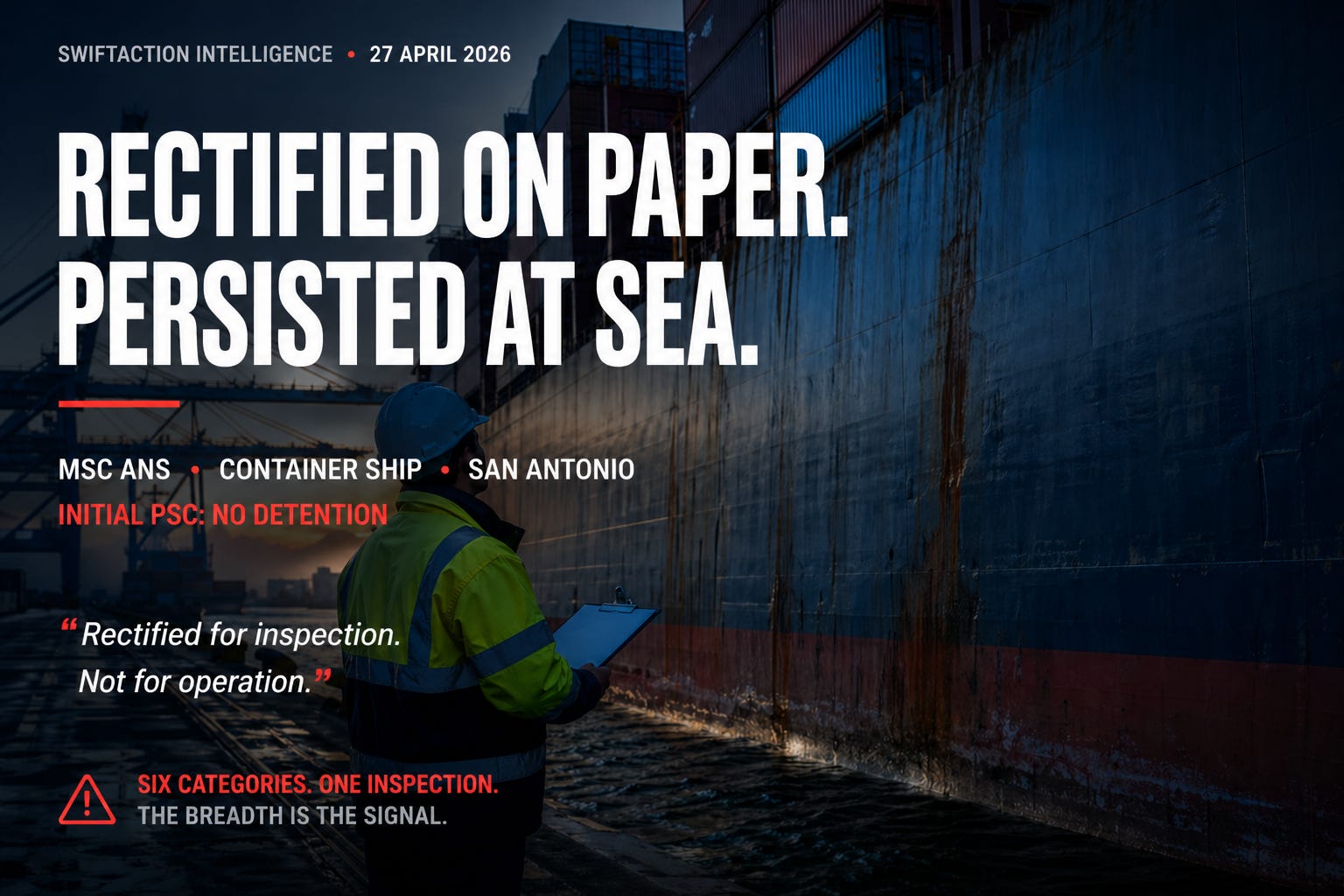
A 22-year-old container ship that passed a Cargo Ship Safety Construction survey at Arica in November 2025 and a Load Line survey at Ningbo a month earlier was inspected on the Chilean coast today and walked into six PSC findings spanning hull, load line, emergency power, engine instrumentation, fire safety, and crew working conditions. None individually crossed the detention threshold. The breadth of the spread — six unrelated PSC deficiency categories on one inspection — is the signal.
🔔 Not yet subscribed? SwiftAction Intelligence Covers Maritime Accidents, Detentions, and the Training Failures Behind Them. Subscribe For Free!
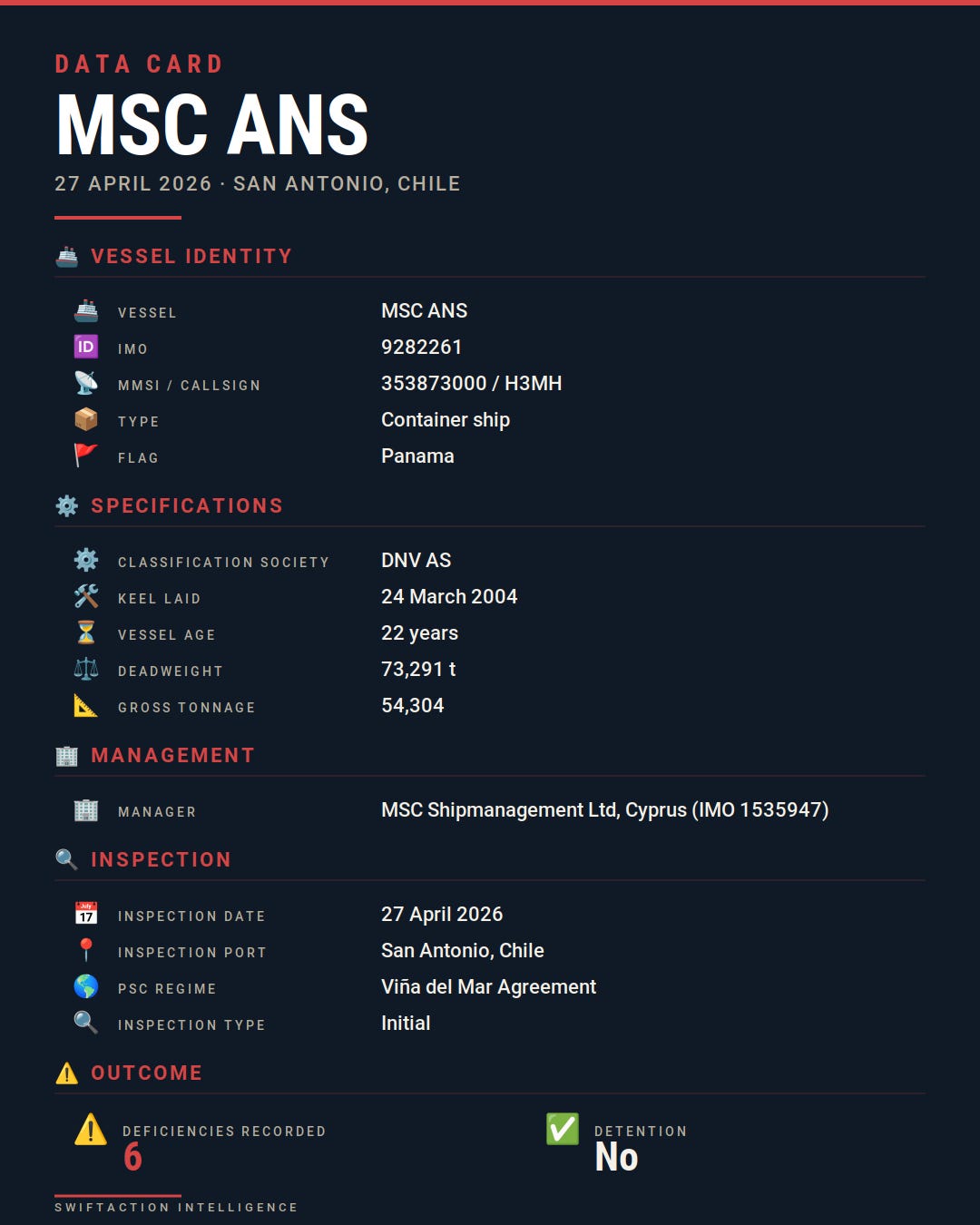
Data Card
Vessel: MSC ANS
IMO: 9282261
MMSI / Callsign: 353873000 / H3MH
Type: Container ship
Flag: Panama
Classification Society: DNV AS
Keel laid: 24 March 2004
Vessel age: 22 years
Deadweight: 73,291 t
Gross Tonnage: 54,304
Manager: MSC Shipmanagement Ltd, Cyprus (IMO 1535947)
Inspection date: 27 April 2026
Inspection port: San Antonio, Chile
PSC regime: Viña del Mar Agreement
Inspection type: Initial
Deficiencies recorded: 6
Detention: No
The Inspection
San Antonio is one of two ports — alongside Valparaíso — that carry the bulk of Chile’s container traffic. Inspectors operating under the Viña del Mar Agreement boarded the MSC ANS for an initial PSC inspection on 27 April 2026 and recorded six deficiencies before standing down. None were classified as grounds for detention, and the vessel was cleared to continue trading.
The findings cluster across six distinct PSC deficiency categories, spanning three international conventions (SOLAS — both Chapter II-1 and Chapter II-2 — ICLL, and MLC 2006):
#1 — PSC 02112 — Structural conditions — Hull – corrosion
#2 — PSC 03102 — Water/weathertight conditions — Freeboard marks
#3 — PSC 18416 — Labour conditions, health protection — Mooring ropes/lines and wires
#4 — PSC 04114 — Emergency systems — Emergency source of power, emergency generator
#5 — PSC 13103 — Propulsion and auxiliary machinery — Gauges, thermometers, etc
#6 — PSC 07106 — Fire safety — Fire detection and alarm system
Six deficiencies on a single initial inspection is not, on its own, a remarkable count for a container vessel of this age in this region. The breadth of the categories — six unrelated areas touched in one initial inspection — is the editorial signal.
What makes the profile worth reading is what it is not. It is not a single-system failure where one neglected piece of kit drives the whole report. It is six separate touchpoints across structure, load line, MLC equipment, emergency power, engine room instrumentation, and fire detection — each consistent with the corresponding PSC Code description, and each suggesting an attention pattern rather than an isolated event.
The vessel’s recent statutory survey timeline is worth setting out separately, because the regulatory scopes do not overlap:
Cargo Ship Safety Construction (Cert 501) — surveyed by DNV at Arica, Chile, on 10 November 2025 (~5.5 months before this inspection). Hull corrosion (PSC 02112) sits within CSC scope.
Load Line (Cert 508) — surveyed by DNV at Ningbo, China, on 2 October 2025 (~6.8 months before this inspection). Freeboard marks (PSC 03102) sit within Load Line Convention scope, not CSC.
Document of Compliance (Cert 509) — surveyed at Limassol, Cyprus, on 5 June 2025.
Safety Management Certificate (Cert 510) — surveyed at Durban, South Africa, on 26 May 2025.
Two separate statutory-attended items — hull corrosion under CSC, freeboard marks under Load Line — both presenting at PSC inside seven months of their respective surveys is the editorial fact this article is built on.
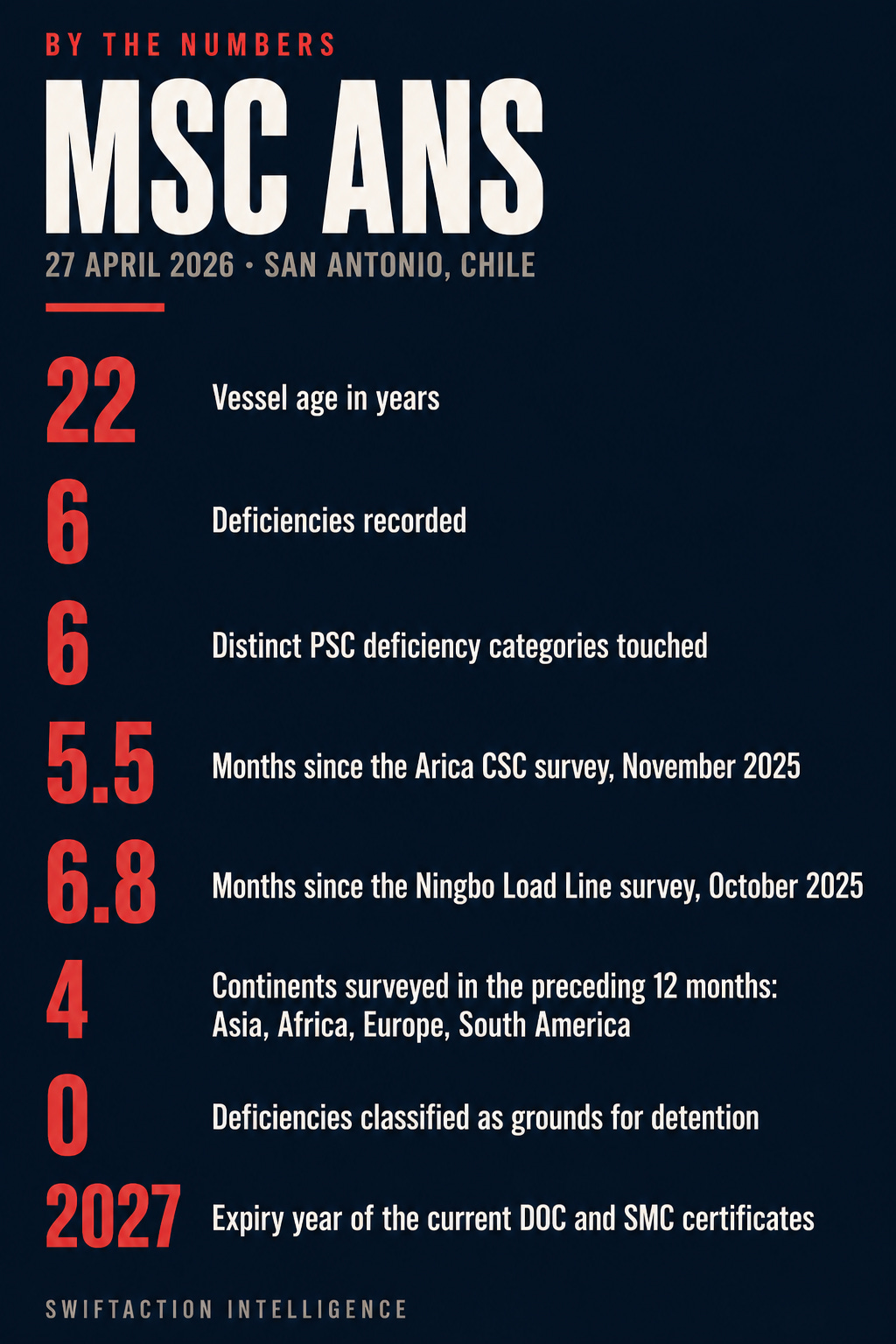
By The Numbers
22 — Vessel age in years
6 — Deficiencies recorded
6 — Distinct PSC deficiency categories touched
5.5 — Months between the November 2025 Arica CSC survey and this inspection
6.8 — Months between the October 2025 Ningbo Load Line survey and this inspection
4 — Continents on which this vessel was surveyed in the preceding 12 months (Asia – Ningbo; Africa – Durban; Europe – Limassol; South America – Arica, San Antonio)
0 — Deficiencies classified as grounds for detention
2027 — Expiry year of the current Document of Compliance and Safety Management Certificate
The Training Failure
The Viña del Mar inspector did not detain the MSC ANS. The findings can each be cleared with a rectification programme and follow-up verification. That is the formal story.
The competency story is different.
A 22-year-old container ship presenting hull corrosion under PSC 02112 and freeboard mark deficiencies under PSC 03102 within seven months of their corresponding statutory surveys is the inspection’s central anomaly. The convention scopes are different, the certificates are different, and the surveying ports are different — but both items rely on a shipboard self-inspection regime that flags emerging conditions before the next external inspector boards. Hull corrosion sufficient to be recorded under PSC 02112 is generally observable during routine self-inspection rounds. Freeboard mark deficiencies under PSC 03102 are observable in the same routine. They are exactly the items a competent self-inspection regime is designed to surface.
Four of the remaining five findings sit inside operational competency:
Emergency generator (04114) — Tested under load against SOLAS II-1/Reg.43 expectations during initial inspection scope. A finding here points to either a defective unit or a defective testing routine.
Gauges and thermometers (13103) — Engine room walk-through item. Consistent with PSC Code descriptions involving illegible, frozen, or out-of-calibration instruments — items that are routinely covered under planned maintenance attention.
Fire detection and alarm system (07106) — A core SOLAS Chapter II-2 item, tested against FSS Code Chapter 9 requirements. Consistent with PSC Code descriptions covering loop integrity, panel response, or sensor population.
Mooring ropes/lines and wires (18416) — Coded under MLC 2006 Regulation 4.3 (health protection and accident prevention). Mooring equipment condition has been progressively re-classified as a labour safety item rather than a deck equipment item, reflecting the casualty data on mooring operations. A finding here suggests the on-board MLC self-inspection regime has not caught up with the equipment’s condition.
The pattern, taken across the full set, is consistent with competency drift in shipboard self-inspection — items inspected on schedule but not inspected with the rigour the regime assumes. The pattern of recent statutory certificate renewals — IOPP renewed 8 December 2025, Bunker certificate renewed 22 January 2026, IAPP renewed 27 May 2025 — shows the survey rhythm is being met. The PSC profile suggests the operational discipline behind the certificates has not kept pace.
The deficiencies will be rectified on paper. The competency gap behind them is harder to close.
SwiftAction Courses
The six deficiencies on the MSC ANS map to six SwiftAction Academy courses:
PSC 02112 — Hull corrosion → Hull – Corrosion
PSC 03102 — Freeboard marks → Freeboard Marks
PSC 18416 — Mooring lines / MLC 4.3 → Mooring Ropes/Lines And Wires
PSC 04114 — Emergency generator → Em’cy Source Of Power – Em’cy Generator
PSC 13103 — Engine room gauges → Gauges, Thermometers, Etc
PSC 07106 — Fire detection / alarm → Fire Detection And Alarm System
Each course addresses the specific competency gap reflected in the corresponding PSC finding category.
What to Watch
Whether MSC Shipmanagement issues a fleet-wide circular addressing the spread of the findings rather than the individual items. The signal of a serious response to a deficiency profile of this kind is system-level, not item-level.
Whether the operator publicly addresses the inspection through any maritime industry channel. Silence is itself a signal.
The next port-state inspection on this vessel — a follow-up inspection within the next 6 months at any Tokyo MOU or Paris MOU port would surface whether the rectifications held.
Whether DNV adjusts the scope of the next class survey attendance to reflect the PSC findings — separate items flagged at PSC across two different statutory regimes (CSC under SOLAS, Load Line under ICLL) within seven months of survey warrants visibility on what was inspected and what was deferred.
The Viña del Mar Agreement’s regional pattern on container vessels of this vintage — whether 20+ year container ships are being landed with comparable deficiency profiles across the Latin American PSC regime.
SwiftAction Signal
Six deficiencies on a 22-year-old container ship at San Antonio is not a detention story. It is a competency-drift story dressed as a routine PSC outcome. The cost of closing each finding individually — paint, wire-rope replacement, generator re-test, instrument calibration, sensor swap — runs into thousands of dollars per item, plus port time.
The cost of closing the competency gap behind them, through structured training that covers the same PSC code categories, runs to $17 per course on the SwiftAction Academy platform.
The findings were rectified on paper. The competency gap persisted at sea.