

|⚓ About Us | 📋 Training Catalog | 🎯 CIC 2026 Bundle |
🏅 Free Course Access (No Credit Card)
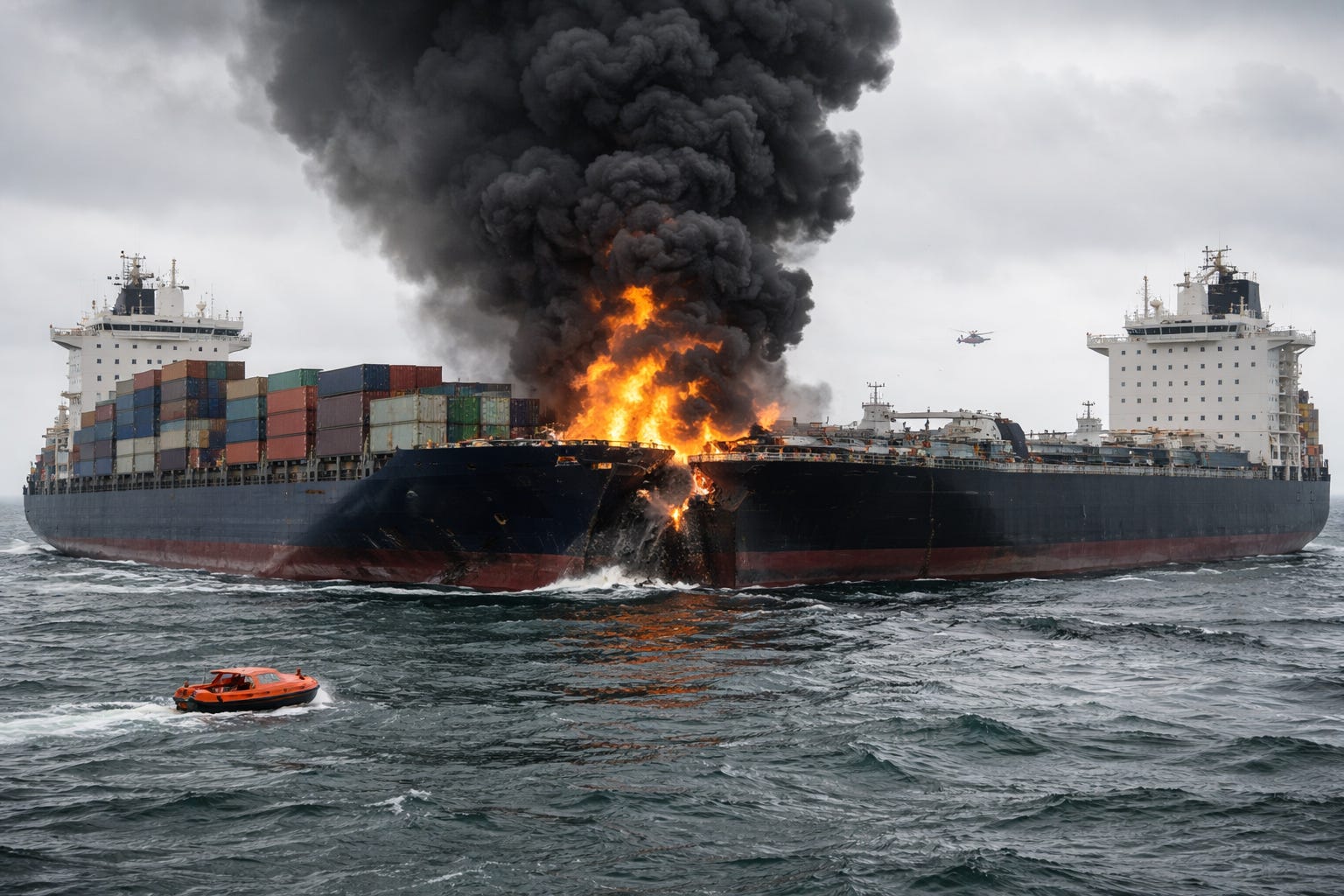
On March 10, 2025, the container ship Solong collided with the anchored oil tanker Stena Immaculate in the North Sea, 14 nautical miles northeast of Spurn Head at the entrance to the Humber Estuary. The Solong was travelling at approximately 16 knots. The Stena Immaculate was carrying 220,204.5 barrels of aviation fuel for the United States Air Force. The collision breached the tanker’s No.7 port cargo tank. Aviation fuel spilled into the sea and onto Solong’s bow. The heat from the impact ignited it. Both vessels caught fire. Both crews abandoned ship. Able seaman Mark Angelo Pernia, 38, a Filipino father of one with a second child on the way, was working on Solong’s bow at the time of impact. His body was never recovered. On February 2, 2026, following a three-week trial at the Old Bailey, Captain Vladimir Motin, 59, was found guilty of gross negligence manslaughter. He was sentenced to six years in prison. The judge said he had fallen prey to his own complacency and arrogance.
📋 In this issue:
⚖️ The Verdict: Guilty at the Old Bailey
🔥 The Collision: 36 Minutes of Nothing
📊 By The Numbers
🔍 The Training Failures the Court Exposed
🛡️ How SwiftAction Training Addresses These Gaps
👀 What to Watch
🚨 SwiftAction Signal
📋 Competency-Based Maritime Training Mapped to Every PSC Deficiency Code
→ Academy.SwiftAction.AI
🎯 2026 CIC Cargo Securing Bundle: 30 Courses, 60% Off
→ CIC Bundle 60% OFF
📌 SwiftAction Data Card
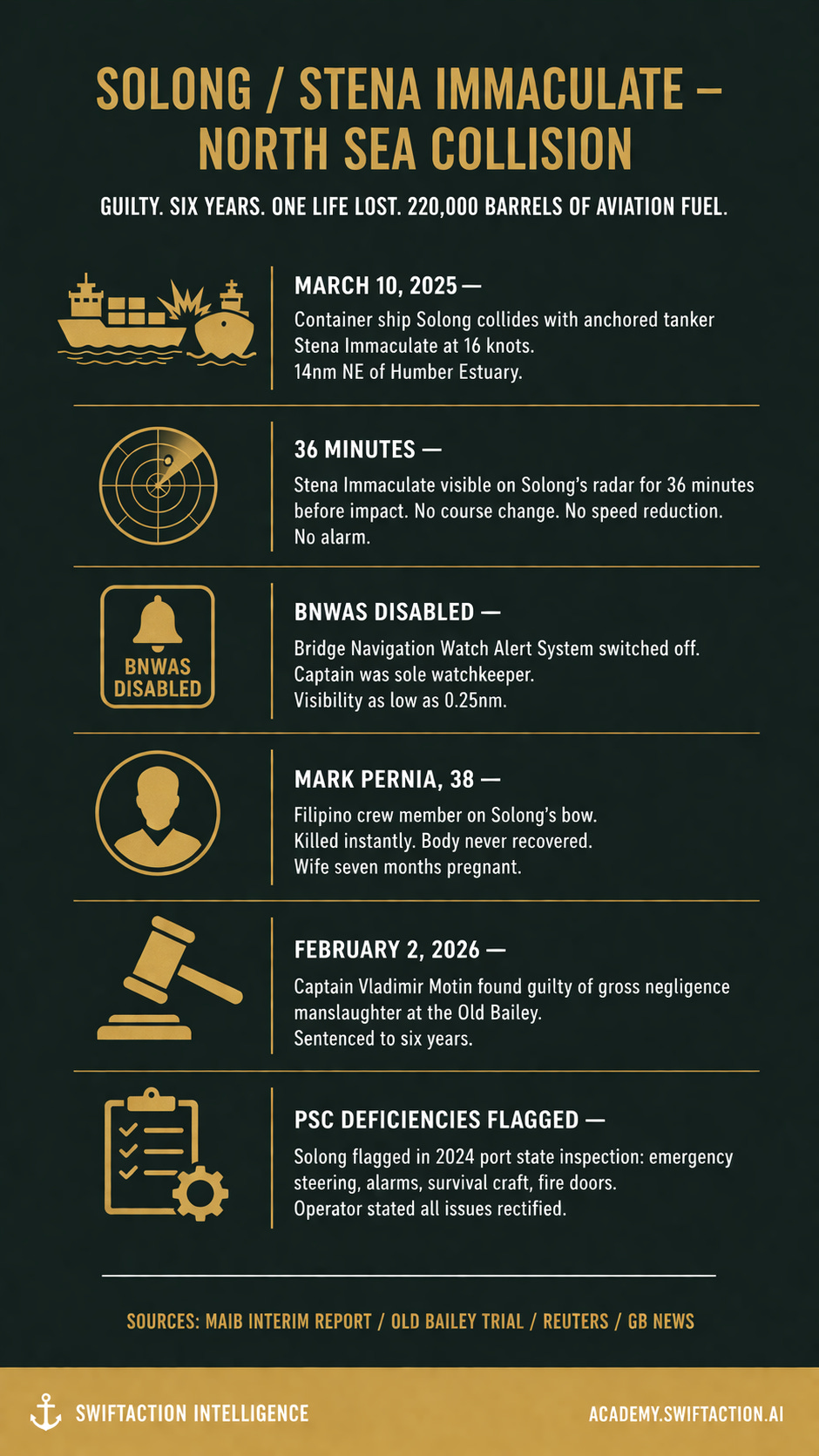
→ ⚓ March 10, 2025: Container ship Solong collided with anchored oil tanker Stena Immaculate at approximately 16 knots, 14 nautical miles NE of Spurn Head, Humber Estuary. (Source: MAIB Interim Report, April 2025)
→ 📡 36 minutes: The Stena Immaculate was visible on Solong’s radar display for 36 minutes before impact. The prosecution stated that Motin did nothing: no course change, no speed reduction, no alarm, no crash stop. (Source: GB News, February 2, 2026)
→ 🔇 BNWAS disabled: The Bridge Navigation Watch Alert System, designed to ensure someone is physically on the bridge and awake, had been switched off. Motin was the sole watchkeeper from 0700. Neither vessel had a dedicated lookout. (Source: GB News, Reuters, February 2, 2026)
→ ☠️ Mark Angelo Pernia, 38, Filipino national, was working on Solong’s bow at the time of impact. He was killed instantly in the fire. His body has never been recovered. His wife was seven months pregnant. Their second child was born two months after his death. He never met them. (Source: GB News, Reuters, February 2, 2026)
→ ⚖️ Guilty: On February 2, 2026, following a three-week trial at the Old Bailey, a jury deliberated for eight hours and found Captain Vladimir Motin, 59, guilty of gross negligence manslaughter. He was sentenced to six years in prison. (Source: Bridlington Echo, GB News, Reuters, February 2, 2026)
→ 🔍 PSC deficiencies flagged: In 2024, months before the collision, the Solong was flagged during a port state control inspection with multiple outstanding issues including an emergency steering compass not readable, inadequate alarms, poorly maintained survival craft, and fire door defects, according to publicly available PSC records reported by multiple outlets. Ernst Russ stated all issues had been rectified. (Source: Publicly available PSC records, as reported in multiple outlets including gCaptain and IMarEST)
⚖️ The Verdict: Guilty at the Old Bailey
On February 2, 2026, following a three-week trial at London’s Central Criminal Court, a jury deliberated for eight hours and found Captain Vladimir Motin guilty of gross negligence manslaughter, according to reporting by Reuters, GB News, and the Bridlington Echo.
Motin, 59, a Russian national from St Petersburg, had captained the Solong for 15 years. He showed no emotion as the verdict was read. He was remanded in custody and sentenced to six years in prison.
Justice Andrew Baker said Motin had fallen prey to his own complacency and arrogance, according to Human Rights at Sea’s reporting on February 15, 2026. Prosecutor Michael Gregory described the death of Mark Pernia as “a tragic, and entirely avoidable death of a member of crew caused by truly, exceptionally bad negligence,” as reported by the News Express.
Detective Chief Superintendent Craig Nicholson of Humberside Police described the collision as a “simple, senseless tragedy” and said it was “a miracle that there weren’t more fatalities or serious injuries,” according to GB News.
Mark Angelo Pernia was 38 years old. He was a Filipino national, married, with a five-year-old child. His wife was seven months pregnant at the time of the collision. Their second child was born two months after his death. According to Reuters, Pernia’s wife lives in a remote area of the Philippines. His body was never recovered.
🔥 The Collision: 36 Minutes of Nothing
The Portugal-registered container ship Solong, a 130-metre feeder vessel operated by Ernst Russ AG, departed Grangemouth, Scotland, on the evening of March 9, 2025, bound for Rotterdam. The vessel was on a fixed trade route in the North Sea it had used many times before.
The master remained on the bridge until shortly before 2300, then handed the watch to the second officer and retired to rest, according to the MAIB interim report published in April 2025.
At approximately 0130 on March 10, Solong passed the Longstone Lighthouse and altered course to approximately 150 degrees. The vessel maintained this heading with only a minor deviation at 0345.
At 0700, Captain Motin returned to the bridge as the sole watchkeeper.
The visibility in the area was patchy, ranging between 0.25 and 2.0 nautical miles, according to the MAIB interim report. Neither Solong nor the anchored Stena Immaculate had a dedicated lookout on the bridge.
The US-registered oil/chemical tanker Stena Immaculate, a 183-metre, 49,729 DWT vessel managed by Crowley Maritime and chartered by the US military, had been directed to anchor approximately 5 nautical miles north of the Humber light float on March 9. It was carrying 220,204.5 barrels of aviation fuel, bound for Killingholme. There were eight other vessels anchored in the same area.
According to the prosecution’s case as reported by GB News on February 2, 2026, the Stena Immaculate was visible on Solong’s radar display for 36 minutes before impact. During that time, Motin made no course correction, no speed reduction, sounded no alarm, and did not initiate a crash stop.
The Bridge Navigation Watch Alert System, designed to ensure someone is physically present and awake on the bridge, had been switched off, as reported by GB News and Reuters. The Solong’s black box showed no course or speed adjustments before the collision, according to the CPS.
Audio recordings from the Solong’s bridge control room were played to the jury. An hour before the collision, men could be heard speaking calmly in Russian about the price of cigarettes. Then a Russian folk song was heard, an apparent phone ringtone which went unanswered. As the Solong approached the anchored tanker, no conversation could be heard on the bridge at all, according to the News Express.
At 0947, Solong collided with the port side of the anchored Stena Immaculate at approximately 16 knots. A full minute elapsed before Motin was heard to react, according to GB News.
The collision breached Stena Immaculate’s No.7 port cargo tank. Aviation fuel spilled into the sea and onto Solong’s bow. The heat from the impact ignited the fuel. Fire spread to containers aboard Solong. Both crews abandoned ship to lifeboats and were recovered by local boats and emergency responders coordinated by His Majesty’s Coastguard, according to the MAIB interim report.
Motin’s defense argued he attempted to take the Solong off autopilot and change course, but was unsuccessful, according to Reuters reporting on January 14, 2026. The prosecution maintained he did “absolutely nothing.”
After being brought ashore in Grimsby, Motin messaged his wife on WhatsApp saying he would be “guilty,” according to GB News. His wife responded telling him to think of an alibi and to say he had not seen the other vessel on the ship’s equipment. The prosecution said these messages undermined his credibility.
Motin was arrested on March 14, 2025, and charged with gross negligence manslaughter.
Crowley Maritime, the Stena Immaculate’s manager, stated that the vessel was operating in compliance with applicable watch-standing safety regulations and that its 23 mariners acted with bravery and operational focus, limiting the fire to one of the tanker’s 16 cargo holds, according to gCaptain’s reporting on April 3, 2025.
Burnt material and plastic pellets, also known as nurdles, washed up along the UK’s east coast in the days following the collision, raising environmental concerns, according to MaritimeCyprus. The Solong burned for eight days following the collision, according to DCS Nicholson of Humberside Police as reported by GB News.
📊 By The Numbers
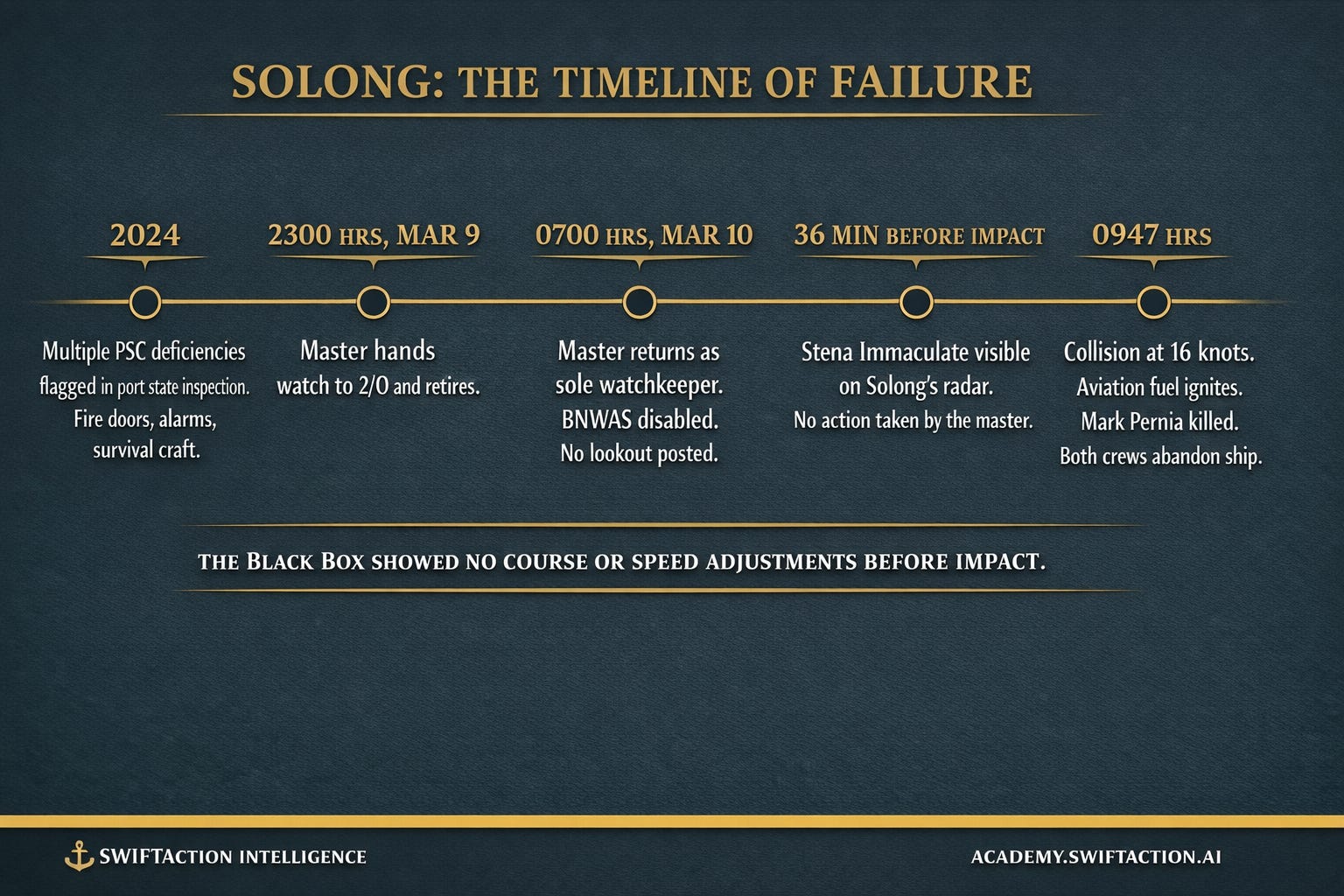
→ 2024: A port state control inspection flagged the Solong with multiple outstanding issues, including emergency steering compass not readable, inadequate alarms, poorly maintained survival craft, and fire door defects. Ernst Russ stated all issues had been rectified. (Source: Publicly available PSC records, as reported by multiple outlets)
→ 220,204.5 barrels of aviation fuel aboard the Stena Immaculate, chartered by the United States Air Force. (Source: MAIB Interim Report)
→ 0.25 to 2.0 nautical miles visibility, patchy, at the time of the collision. Neither vessel had a dedicated lookout on the bridge. (Source: MAIB Interim Report)
→ 15.2 knots speed at the point of impact, per the prosecution. No course or speed change was recorded on the black box before the collision. (Source: GB News, CPS)
→ One minute elapsed between the collision and Motin’s first audible reaction on the bridge recording. (Source: GB News, February 2, 2026)
→ Six years prison sentence for Captain Motin. The judge cited complacency and arrogance. (Source: Human Rights at Sea, February 15, 2026)
→ Safety of navigation deficiencies (Category 10) accounted for 12% of all PSC detentions globally in 2025. The Solong’s watchkeeping failures fall squarely within this category. (Source: SAFETY4SEA PSC Focus 2025)
Related Coverage
→ Two Firefighters Died on a Ship Nobody Trained Them to Enter. The NTSB Says It Was Preventable.
The jury deliberated for eight hours. The captain was found guilty. But the court exposed failures that go far beyond one man on one bridge. Below: the specific watchkeeping, fatigue, and bridge resource management failures that training is designed to prevent, how these failures connect to PSC deficiency codes that are checked at every port, and what the Solong’s own PSC record reveals about the systemic gap between inspection findings and operational competency.
🔍 The Training Failures the Court Exposed
The prosecution’s case against Motin rested on gross negligence. But the failures exposed during the three-week trial describe a competency collapse that the maritime training system is designed to prevent.
No dedicated lookout in restricted visibility.
COLREGs Rule 5 requires that every vessel maintain a proper lookout at all times by sight and hearing, as well as by all available means appropriate to the prevailing circumstances. In visibility ranging between 0.25 and 2.0 nautical miles, the requirement for a dedicated lookout is not discretionary. Neither vessel had one, according to the MAIB interim report. Motin was alone on the bridge. The MAIB is investigating whether manning and fatigue management contributed to this failure.
This is not an unusual finding. The MAIB’s Chief Inspector of Marine Accidents highlighted the Solong/Stena Immaculate collision in the opening remarks of Safety Digest 1/2025, stating that it appeared to be “yet another collision that should not have happened” and emphasising that a good lookout is key to preventing collisions, according to IIMS reporting.
The BNWAS was deliberately disabled.
The Bridge Navigation Watch Alert System exists for one purpose: to confirm that a watchkeeper is present, alert, and responsive. If the system detects no activity on the bridge within a set period, it triggers escalating alarms, first on the bridge, then to the master’s cabin, then to the officer of the watch. Motin switched it off, according to GB News and Reuters, leaving himself as the sole barrier between a 16-knot vessel and everything in its path.
The prosecutor stated that disabling the BNWAS left Motin “alone to be on watch as the eyes and ears of the ship,” according to the CPS. This failure falls directly under PSC Code 10138 (Bridge Navigation Watch Alarm System) and the broader Category 10 (Safety of Navigation), which accounted for 12% of all PSC detentions globally in 2025.
36 minutes of radar contact with no response.
The Stena Immaculate appeared on Solong’s radar 36 minutes before the collision. The vessel was anchored. It was not moving. It was transmitting AIS. Motin took no action. He did not alter course, reduce speed, sound the fog signal, alert the crew, or initiate a crash stop. The black box confirmed no navigational inputs were made before impact.
This represents a fundamental failure of radar watchkeeping, ARPA use, and collision avoidance, all of which are STCW competency requirements and are tested during PSC inspections under Safety of Navigation codes.
The PSC record that preceded the collision.
In 2024, months before the collision, the Solong was flagged during a port state control inspection with multiple outstanding issues, according to publicly available PSC records reported by multiple outlets including gCaptain and IMarEST. These included an emergency steering compass that was not readable, inadequate alarms, poorly maintained survival craft, and fire door defects. Ernst Russ stated that all identified safety issues had been rectified. Similar issues had been reported in previous inspections.
These were not obscure technical findings. Inadequate alarms and fire door deficiencies are among the most common PSC detention drivers globally. A vessel that accumulates these findings, rectifies them to satisfy the inspector, and then continues to operate with its bridge alarm system deliberately disabled is exhibiting exactly the pattern that ISM audits and crew competency verification are designed to catch.
The MAIB investigation is ongoing. The final report will examine navigation and watchkeeping practices, manning and fatigue management, vessel maintenance, the use of the offshore anchorage, and environmental conditions. It is expected in 2026.
🛡️ How SwiftAction Training Addresses These Gaps
The Solong/Stena Immaculate collision involved deliberate decisions by an experienced master, including disabling the BNWAS and operating as sole watchkeeper in restricted visibility. No training program can guarantee that an individual will follow procedures they choose to ignore. But the systemic failures this incident exposed, the same failures PSCOs check for at every port, are exactly the gaps that structured, code-specific training is designed to close before they reach a courtroom.
The following SwiftAction Academy courses map directly to the failures identified in this case. Each course produces a completion certificate referencing the specific PSC deficiency code, creating a documented record that the crew was assessed on the exact competency a PSCO will check.
Bridge Navigation Watch Alarm System (Code 10138). The BNWAS was disabled on the Solong. SwiftAction’s Code 10138 module covers the operational requirements for BNWAS under SOLAS V/19.2.5.2, the consequences of disabling bridge watchkeeping alarm systems, and the master’s responsibility to ensure the system functions as designed. PSCOs routinely verify BNWAS functionality during inspections. Completing this module produces a certificate referencing Code 10138 specifically.
Radar (Code 10103) and Automatic Radar Plotting Aid (Code 10107). The Stena Immaculate was visible on Solong’s radar for 36 minutes. No action was taken. SwiftAction’s Code 10103 and 10107 modules cover radar watchkeeping obligations, ARPA target tracking, risk of collision assessment under COLREGs Rule 7, and the OOW’s responsibility to act on radar information in restricted visibility.
Voyage or Passage Plan (Code 10127) and Monitoring of Voyage or Passage Plan (Code 10135). The Solong was on a fixed route through an active anchorage area. SwiftAction’s Code 10127 and 10135 modules cover SOLAS Chapter V voyage planning requirements, the obligation to monitor progress against the plan, and the procedures for identifying and responding to developing hazards, including anchored vessels.
Bridge Operation (Code 10133) and Use of the Automatic Pilot (Code 10125). Motin’s defense argued he attempted to take the Solong off autopilot but was unsuccessful. SwiftAction’s Code 10133 module covers bridge resource management, watchkeeping standards in restricted visibility, and the requirement to post a dedicated lookout under COLREGs Rule 5. Code 10125 covers autopilot operational requirements, including manual override capability and transition procedures.
Masters Responsibility and Authority (Code 15104) and Resources and Personnel (Code 15105). The MAIB is investigating fatigue management and manning. SwiftAction’s ISM modules under Codes 15104 and 15105 cover the master’s obligations to ensure adequate watchkeeping, the company’s obligations to provide sufficient manning, and the procedures for reporting when safe watch conditions cannot be maintained. Whether fatigue contributed to this collision is a question the MAIB will answer. Whether your fleet’s crew has been trained on these ISM requirements is a question a PSCO can ask at any time.
Why this matters for your fleet: The Solong had PSC deficiencies flagged in 2024, according to publicly available inspection records. The operator stated they were rectified. Months later, the vessel’s bridge alarm was disabled and no lookout was posted. Rectifying a finding on paper is not the same as verifying that the crew understood and internalised the competency. SwiftAction’s completion certificates reference the specific PSC deficiency code, creating a documented link between the finding, the training, and the crew member’s assessed competency. That link is what turns a PSC rectification from paperwork into evidence.
SwiftAction courses relevant to this incident:
PSC Code: Course - Relevance
10138: Bridge Nav. Watch Alarm System (BNWAS) - BNWAS deliberately disabled
10103: Radar - Stena visible on radar 36 min, no action
10107: Automatic Radar Plotting Aid (ARPA) - Collision risk not assessed
10127: Voyage Or Passage Plan - Route through active anchorage
10135: Monitoring Of Voyage Or Passage Plan - No monitoring of developing risk
10133: Bridge Operation - Sole watchkeeper, no lookout
10125: Use Of The Automatic Pilot - Failed autopilot disengage
15104: Masters Responsibility And Authority - Master failed watchkeeping duties
15105: Resources And Personnel - Manning/fatigue under investigation
07105: Fire Doors/Openings in Fire-Resisting Div. - Fire door defects in 2024 PSC inspection
👉 Browse all Safety of Navigation courses: academy.swiftaction.ai/collections/10-safety-of-navigation
👉 Browse all ISM courses: academy.swiftaction.ai/collections/15-ism
👉 Try a free course: academy.swiftaction.ai/enroll/3527149?price_id=4454402
👀 What to Watch
The MAIB final report on the Solong/Stena Immaculate collision is expected in 2026 following a 30-day stakeholder consultation. It will examine navigation and watchkeeping practices, manning and fatigue management, vessel maintenance, and the use of the offshore anchorage. The findings will likely generate safety recommendations directed at flag states, operators, and potentially the IMO.
The criminal conviction of Captain Motin has reignited the debate over the criminalisation of seafarers’ operational decisions. Human Rights at Sea noted on February 15, 2026, that the case highlights contrasts in how different jurisdictions treat seafarers involved in incidents. The IMO’s Legal Committee adopted new guidelines in 2025 to protect seafarers from unfair treatment when detained in foreign jurisdictions.
Civil litigation is also underway. Ernst Russ, Solong’s owner, is facing a lawsuit at London’s High Court and has applied to have the case dismissed. A hearing is pending.
For fleet operators, the immediate lesson is not about one captain’s failure. It is about the system that allowed a vessel with documented PSC deficiencies, a disabled bridge alarm, and no lookout to operate at 16 knots in restricted visibility without anyone ashore knowing until the collision happened. The ISM system is supposed to catch this. When it does not, the gap shows up in PSC findings, in investigation reports, or in a courtroom.
Fleet managers preparing for inspections in Paris MOU, Tokyo MOU, or USCG regimes can review their crew’s training records against the specific Safety of Navigation and ISM deficiency codes raised in this case. If those records do not reference the specific codes PSCOs are checking, the gap that existed on the Solong may exist on your vessel. The difference between a clean inspection and a finding is often whether the training addressed the exact item the inspector checked.
🚨 SwiftAction Signal
The Stena Immaculate was on his radar for 36 minutes. He turned off the alarm that was designed to make sure he was awake. He was the only person on the bridge in visibility that dropped to a quarter of a nautical mile. He did not change course. He did not slow down. He did not sound the alarm. A full minute passed after the collision before he reacted. Mark Pernia was 38. He had a five-year-old child. His wife was seven months pregnant. He was on the bow doing his job. His body was never found. His second child was born two months later and will never know their father. The jury took eight hours. The judge said complacency and arrogance. Six years. The Solong had PSC deficiency findings flagged months earlier. The industry read the inspection report, filed it, and moved on. A training module on watchkeeping and BNWAS compliance costs $17. The industry does not have a knowledge problem. It has an action problem.
⚓ The SwiftAction Team SwiftAction Intelligence Is Published Daily. For Partnership Inquiries Contact admin@swiftaction.ai
📋 Full Training Catalog: academy.swiftaction.ai
📋 SwiftAction Training Resources Referenced in This Article
👉 Safety of Navigation Modules (Category 10): academy.swiftaction.ai/collections/10-safety-of-navigation
👉 ISM Modules (Category 15): academy.swiftaction.ai/collections/15-ism
👉 Free Course (No Credit Card): academy.swiftaction.ai/enroll/3527149?price_id=4454402
👉 Request Fleet Demo: academy.swiftaction.ai/pages/contact-us