

|⚓ About Us | 📋 Training Catalog | 🎯 CIC 2026 Bundle |
🏅 Free Course Access (No Credit Card)
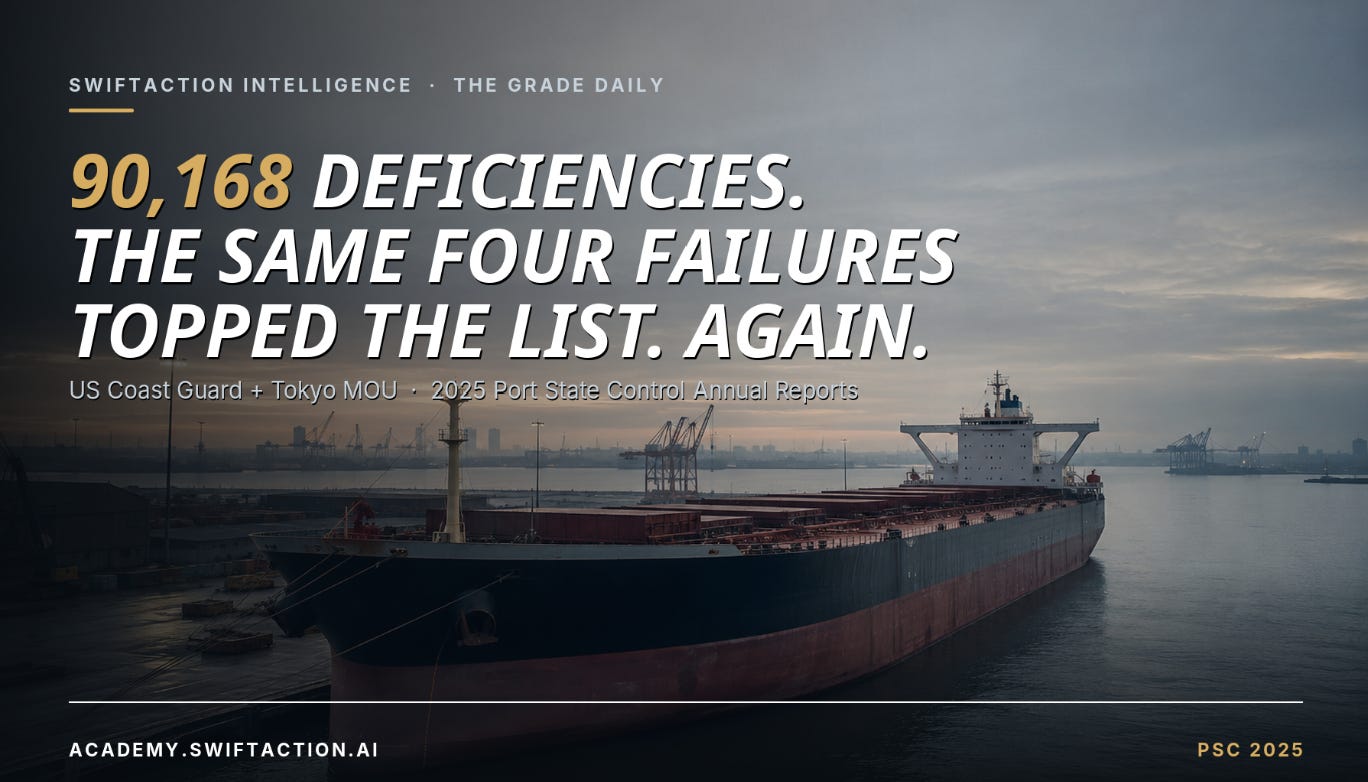
In May 2026, the Tokyo MOU published its 2025 annual report on port State control in the Asia-Pacific region. The following month, on 8 June 2026, the United States Coast Guard published its own. The two regimes inspect different oceans, target different fleets, and answer to different authorities. Their 2025 numbers tell one story.
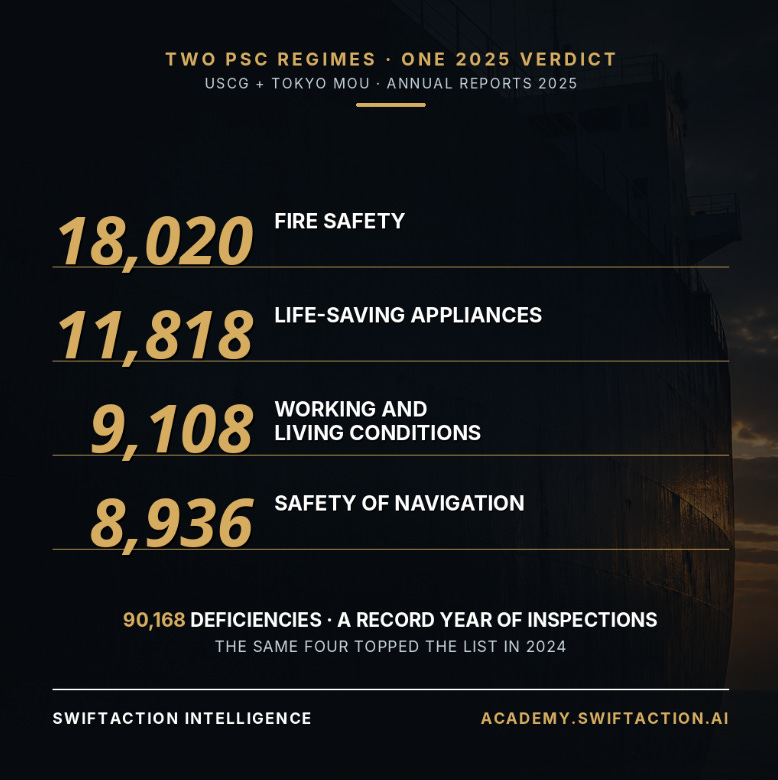
The Tokyo MOU carried out 35,546 inspections in 2025, the highest total in its history. Its officers recorded 90,168 deficiencies, up from 77,526 the year before. Four categories accounted for 53% of them: fire safety, life-saving appliances, working and living conditions, and safety of navigation. They were the same four categories, in the same order, that topped the list in 2024. The US Coast Guard, reporting separately, attributed its falling detention numbers not to better equipment but to one thing: the effective implementation of a Safety Management System.
Thanks for reading SwiftAction Intelligence! Subscribe for free to receive new posts and support my work.
The findings were rectified on paper. The competency gap persisted at sea.
📋 In this issue:
📋 The Reports
📊 By The Numbers
🚨 The Pattern
🧭 What Should Be Happening
👀 What to Watch
🎯 SwiftAction Signal
🔔 Not yet subscribed? SwiftAction Intelligence Covers Maritime Accidents, Detentions, and the Training Failures Behind Them. Subscribe For Free!
📋 Competency-Based Maritime Training Mapped to Every PSC Deficiency Code → academy.swiftaction.ai
🎯 2026 CIC Cargo Securing Bundle: 30 Courses, Tokyo & Paris MOU Aligned → academy.swiftaction.ai/bundles/2026-cargo-securing-cic-tokyo-paris-mous
📋 The Reports
Two of the world’s three principal port State control regimes published their 2025 results within three weeks of each other. They are the closest thing the industry has to an annual report card on the operating fleet, and they are built from real inspections in real ports, not surveys or projections.
The Tokyo MOU. In 2025, member authorities of the Tokyo MOU conducted 35,546 inspections, the most in the organisation’s history. Those inspections covered 19,980 individual ships registered under 111 flags, an estimated 66% of the ships operating in the Asia-Pacific region. Officers found deficiencies in 23,230 of those inspections and recorded 90,168 deficiencies in total, up from 77,526 in 2024. A total of 1,255 ships, registered under 73 flags, were detained. The detention rate of ships inspected was 3.53%, continuing a slow decline from 3.71% in 2024, though the Tokyo MOU notes it remains above pre-pandemic levels.
The composition of those deficiencies is the part worth reading twice. Of 90,168 recorded deficiencies, four categories accounted for 53% of the total: 18,020 in fire safety measures, 11,818 in life-saving appliances, 9,108 in working and living conditions, and 8,936 in safety of navigation. In 2024, the same four categories led the list in the same order, at 15,406, 10,263, 8,193 and 8,066 respectively. The Tokyo MOU also flagged that deficiencies in structural conditions, watertight and weathertight conditions, emergency systems, and propulsion and auxiliary machinery have risen continuously over recent years, which it attributes to a lack of effective maintenance carried out on board.
The Tokyo MOU also published its under-performing ships data. A total of 222 vessels, involving 52 individual ships, were identified as under-performing in 2025, meaning detained three or more times in the previous twelve months. From the beginning of 2026, the organisation has begun publishing performance lists for companies as well as flags, a notable shift that puts the operator, not just the registry, on the public record.
The US Coast Guard. Reporting on the same calendar year, the Coast Guard conducted more examinations than the 8,710 it carried out in 2024. The total number of ships detained in 2025 for safety, security, and environmental deficiencies fell to 77, down from 82 in 2024 and 101 in 2023. The QUALSHIP 21 program, which rewards flags with strong three-year performance, ended 2025 with 4,659 enrolled vessels, down from 5,141 the year before. Four flag administrations lost QUALSHIP 21 eligibility during the year, while four gained it: the Bahamas, Germany, Italy, and the Philippines.
The most telling line in the Coast Guard report is not a number. In the program’s own assessment, the multi-year decline in the detention ratio was driven by the work of flag States and class societies on material condition, on maintenance, and, in its words, most importantly, on the effective implementation of a comprehensive Safety Management System. The Coast Guard calls the SMS the cornerstone of proactive ship management. Its 2025 Enhanced Exam Program, the quarterly equivalent of a concentrated inspection campaign, focused on engine room automation, security under the ISPS Code, emergency power and electrical systems, and the closures that form carbon dioxide protective zones.
Different basins. Different targeting models. Different legal frameworks. One conclusion. The fleet’s recurring failures are not, for the most part, failures of equipment that did not exist. They are failures to operate, maintain, and run the equipment and the systems that were already on board. That is a competency story, and it is the same competency story the data has told for years. The next section maps it to the codes your ships are being graded against.
📊 By The Numbers
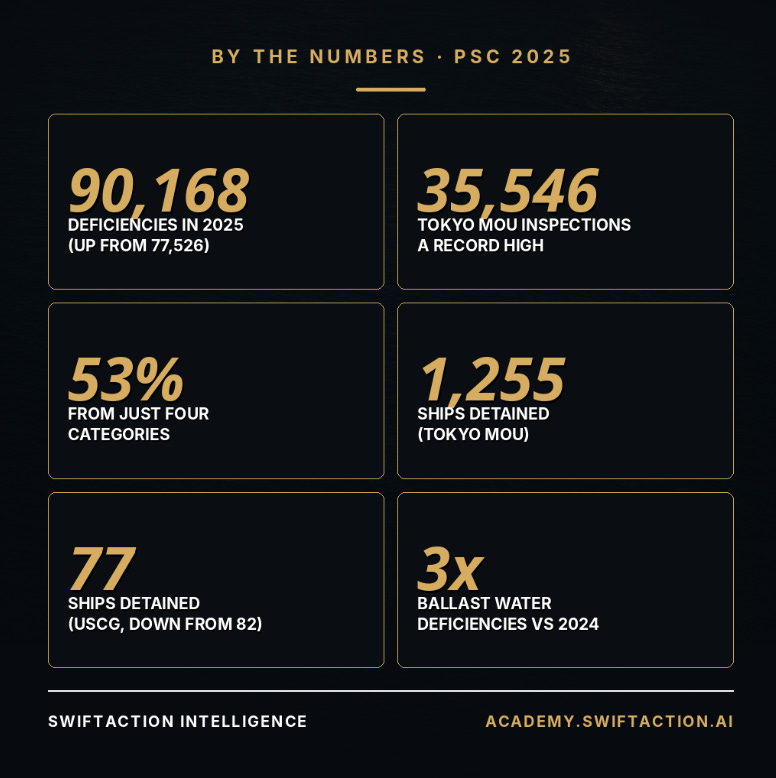
90,168 deficiencies recorded by the Tokyo MOU in 2025, up from 77,526 in 2024
35,546 Tokyo MOU inspections in 2025, the most in its history
53% of all 2025 deficiencies came from just four categories
18,020 fire safety deficiencies, the single largest category
11,818 life-saving appliance deficiencies
9,108 working and living condition deficiencies
8,936 safety of navigation deficiencies
Same four categories topped the list in 2024, in the same order
1,255 ships detained by the Tokyo MOU in 2025, under 73 flags
3.53% Tokyo MOU detention rate, down from 3.71% in 2024
222 under-performing ships (detained three or more times in twelve months) in 2025
3x increase in ballast water management deficiencies during the 2025 inspection campaign versus the prior year
77 ships detained by the US Coast Guard in 2025, down from 82 in 2024 and 101 in 2023
4,659 vessels enrolled in QUALSHIP 21 at the end of 2025, down from 5,141 in 2024
4 flag administrations lost QUALSHIP 21 eligibility in 2025
All data: Tokyo MOU Annual Report on Port State Control in the Asia-Pacific Region 2025 (published May 2026) and US Coast Guard Port State Control Annual Report 2025 (published 8 June 2026).
🚨 The Pattern
A deficiency category that tops the list for two years running, across a record number of inspections, is not bad luck. It is a signal. And in all four leading categories, the signal points at the same place: not the hardware, but the crew trained to run it.
Fire safety. 18,020 deficiencies. The largest category, again. Fire safety on a modern ship is rarely a problem of a missing extinguisher. It is a fire damper that was never tested, a detection and alarm panel nobody can interrogate, a drill that was logged but not run under load, and a crew whose performance in that drill was never honestly evaluated. Those are Tokyo MOU and Paris MOU code 07106 (Fire Detection And Alarm System), 07105 (Fire Doors And Openings In Fire-Resisting Divisions), 07110 (Fire Fighting Equipment And Appliances), 07123 (Operation Of Fire Protection Systems) and 07124 (Maintenance Of Fire Protection Systems) findings, sitting on top of a drill-quality problem captured by 04109 (Fire Drills) and 07125 (Evaluation Of Crew Performance In Fire Drills).
Life-saving appliances. 11,818 deficiencies. A liferaft, a lifejacket, and a launching appliance are inspected for one thing above all: whether they are ready, and whether the crew can use them. The recurring findings cluster around operational readiness, on-board training, and maintenance discipline. That is code 11129 (Operational Readiness Of Life-Saving Appliances), 11131 (On Board Training And Instructions), 11132 (Maintenance And Inspections) and 11134 (Operation Of Life Saving Appliances), with the abandon-ship competency itself captured by 04110 (Abandon Ship Drills).
Working and living conditions. 9,108 deficiencies. This category is where the Maritime Labour Convention meets fatigue. The findings that recur are hours of rest, records of rest, and fitness for duty: the paper trail and the underlying reality of whether the crew is rested enough to do the job. That is code 01307 (Minimum Hours Of Rest), 01308 (Records Of Rest), 09235 (Fitness For Duty, Work And Rest Hours) and the MLC conditions-of-employment codes 18201 and 18202 (Legal Documentation On Work And Rest Hours).
Safety of navigation. 8,936 deficiencies. The navigation findings that keep recurring are not broken radars. They are passage plans that were not properly made or monitored, bridge procedures that were not followed, and equipment that was available but not used correctly. That is code 10127 (Voyage Or Passage Plan), 10133 (Bridge Operation), 10135 (Monitoring Of Voyage Or Passage Plan), 10103 (Radar), 10107 (Automatic Radar Plotting Aid) and 10138 (Bridge Navigation Watch Alarm System).
The campaign confirms it. The 2025 concentrated inspection campaign, run jointly by the Tokyo MOU and Paris MOU on ballast water management, found that the most common detainable deficiency fell under code 14811 (Ballast Water Management System), the simple question of whether the system was actually operational. Ballast water deficiencies during the campaign ran three times higher than the previous year. A treatment system is hardware. Operating it correctly, day in and day out, and keeping the records straight, is code 14806 (Crew Training And Familiarization) and 14813 (Ballast Water Management Plan Implementation).
And the US Coast Guard, in plain language, named the root that ties all of it together. When it credited the effective implementation of a Safety Management System for falling detentions, it was pointing at the ISM Code: code 15106 (Shipboard Operations), 15109 (Maintenance Of The Ship And Equipment), 15107 (Emergency Preparedness) and the responsibility codes 15104 (Master’s Responsibility And Authority) and 15102 (Company Responsibility And Authority). An SMS is not a binder. It is whether the crew runs the procedures the binder contains.
These are not equipment line items. They are competency line items. The hardware behind almost every one of them can be repaired in a single port call. The competency that operates and maintains it cannot be installed overnight, and it does not show up in a certificate that says the deficiency was rectified.
🧭 What Should Be Happening
It would be wrong to read these reports as an indictment of port State control. The opposite is true. Detention rates are easing in both regimes. The Tokyo MOU ran a record number of inspections. Flag States and class societies are, by the Coast Guard’s own account, doing real and effective work on material condition and on safety management. The system is functioning, and it is catching substandard ships. None of that is in dispute.
But the recurrence is the point. When the same four categories lead the list year after year, across more inspections than ever before, it tells you that rectifying a finding on one ship in one port does not, on its own, change the competency that produced it across the fleet. The deficiency is closed. The gap that created it travels to the next ship, the next crew, and the next inspection. That is the SwiftAction thesis, written not in a single casualty report but in two years of global enforcement data.
The closure of that gap is a training problem with a training solution, and it is specific. For every one of the deficiency codes driving the 2025 numbers, there is a defined competency a crew member can be trained on and assessed against before a port State control officer ever steps aboard.
SwiftAction Academy modules that map directly to the 2025 leading categories:
Fire safety
07106 — Fire Detection and Alarm System
07105 — Fire Doors and Openings in Fire-Resisting Divisions
07110 — Fire Fighting Equipment and Appliances
07123 — Operation of Fire Protection Systems
07124 — Maintenance of Fire Protection Systems
07125 — Evaluation of Crew Performance in Fire Drills
04109 — Fire Drills
Life-saving appliances
11129 — Operational Readiness of Life-Saving Appliances
11131 — On Board Training and Instructions
11132 — Maintenance and Inspections
11134 — Operation of Life Saving Appliances
04110 — Abandon Ship Drills
Working and living conditions
01307 — Minimum Hours of Rest
01308 — Records of Rest
09235 — Fitness for Duty, Work and Rest Hours
18202 — Legal Documentation on Work and Rest Hours
Safety of navigation
10127 — Voyage or Passage Plan
10133 — Bridge Operation
10135 — Monitoring of Voyage or Passage Plan
10138 — Bridge Navigation Watch Alarm System
ISM, the root the Coast Guard named
15106 — Shipboard Operations
15107 — Emergency Preparedness
15109 — Maintenance of the Ship and Equipment
Each module carries the Tokyo MOU and Paris MOU deficiency code on its face. A completion record shows that a named crew member completed the code-specific module and passed its assessment, which creates a documented, auditable link between the deficiency a port State control officer can cite, the training that addresses it, and the person who was trained. That link is what converts a rectified finding from a line in a report into evidence that the competency behind it was actually closed. With more than 600 modules mapped one to one to the deficiency codes inspectors cite, the catalogue covers every category in the 2025 reports.
👀 What to Watch
The Paris MOU 2025 annual report and the new flag lists, due 30 June 2026. The third major regime completes the picture at the end of June, when the Paris MOU is due to publish its 2025 report and refresh its White, Grey and Black lists for the year. In 2024, fire safety under SOLAS Chapter II-2 was its single largest deficiency category at 17.2%, and its detention rate rose to 4.03%. Watch whether the 2025 figures echo the Tokyo MOU’s top four, and watch the flag movements between lists, which reset every vessel’s targeting exposure for the year ahead.
The 2026 joint Cargo Securing CIC. The Paris MOU and Tokyo MOU run their joint concentrated inspection campaign on cargo securing from 1 September to 30 November 2026. Cargo securing is a competency before it is a checklist: lashing loads, sea state, and the cargo securing manual. Crews boarded during the window will be questioned against it directly.
Tokyo MOU company performance lists. From the start of 2026, the Tokyo MOU publishes performance lists for companies, not only flags. Operators now appear on the public record alongside the registries they choose. Expect charterers and insurers to start reading those lists.
USCG QUALSHIP 21 churn. Four flags lost eligibility in 2025 and four gained it. The list that runs from 1 July 2025 to 30 June 2026 sets which flags carry the reduced-examination benefit, and which do not. A flag’s movement on or off that list changes the inspection burden on every vessel under it.
The 2027 enclosed space entry CIC. The Tokyo MOU and Paris MOU have already agreed a joint campaign on enclosed space entry for 2027 (code 04118, Enclosed Space Entry And Rescue Drills). Enclosed space entry remains one of the most dangerous recurring competency failures at sea, and operators have more than a year to get ahead of it.
🎯 SwiftAction Signal
Two regimes. Different oceans. One 2025 verdict. Fire safety, life-saving, working conditions, navigation. The same four every year, across the most inspections ever run. Port State control can confirm the box is ticked again at the next port. It cannot confirm the crew can actually do the thing the box describes. That is the gap a $17 SwiftAction Academy module is built to close, because the inspectors have already moved on from “is it fixed?” to “can your crew prove they can run it?”
⚓ The SwiftAction Team
SwiftAction Intelligence Is Published Weekly.
For Partnership Inquiries Contact admin@swiftaction.ai
📋 Full Training Catalog: academy.swiftaction.ai