

|⚓ About Us | 📋 Training Catalog | 🎯 CIC 2026 Bundle |
🏅 Free Course Access (No Credit Card)
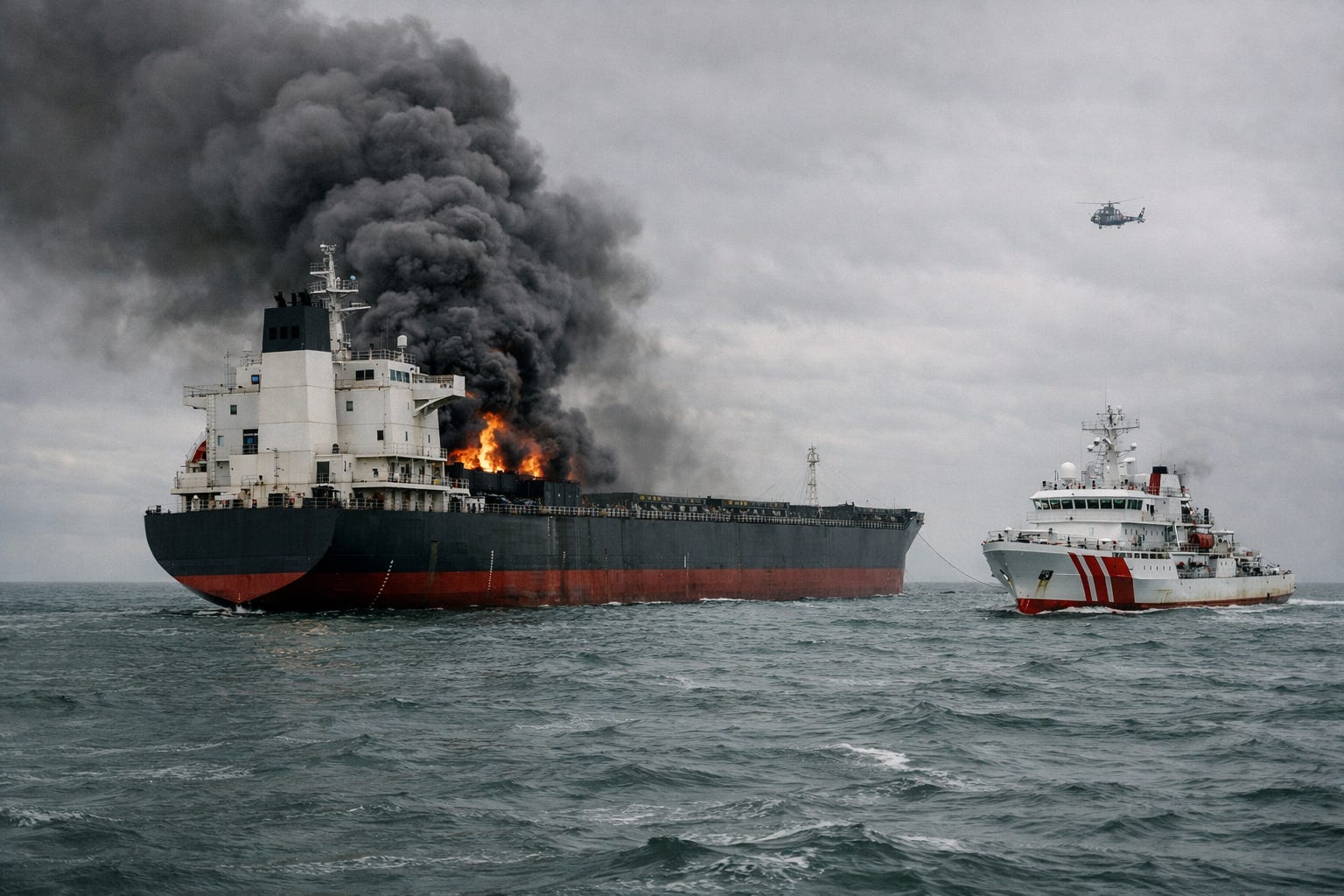
The bulk carrier Mandy was detained in Rotterdam in June 2025. Inspectors found 25 deficiencies. Nine were grounds for detention. Seven were fire safety. Eight months later, two crew members were lost in an engine room fire off the coast of China. The Maritime and Port Authority of Singapore is investigating.
📋 In this issue:
🔥 The Fire: Engine Room, Off the Coast of China
📋 The Detention: Rotterdam, June 2025
📊 By The Numbers
🔍 The Training Failures the PSC Record Exposed
🛡️ How SwiftAction Training Addresses These Gaps
👀 What to Watch
🚨 SwiftAction Signal
🔔 Not yet subscribed? SwiftAction Intelligence Covers Maritime Accidents, Detentions, and the Training Failures Behind Them. Subscribe For Free!
📋 Competency-Based Maritime Training Mapped to Every PSC Deficiency Code → academy.swiftaction.ai
🎯 2026 CIC Cargo Securing Bundle: 30 Courses, 60% Off → academy.swiftaction.ai/bundles/2026-cargo-securing-cic-tokyo-paris-mous
📌 SwiftAction Data Card
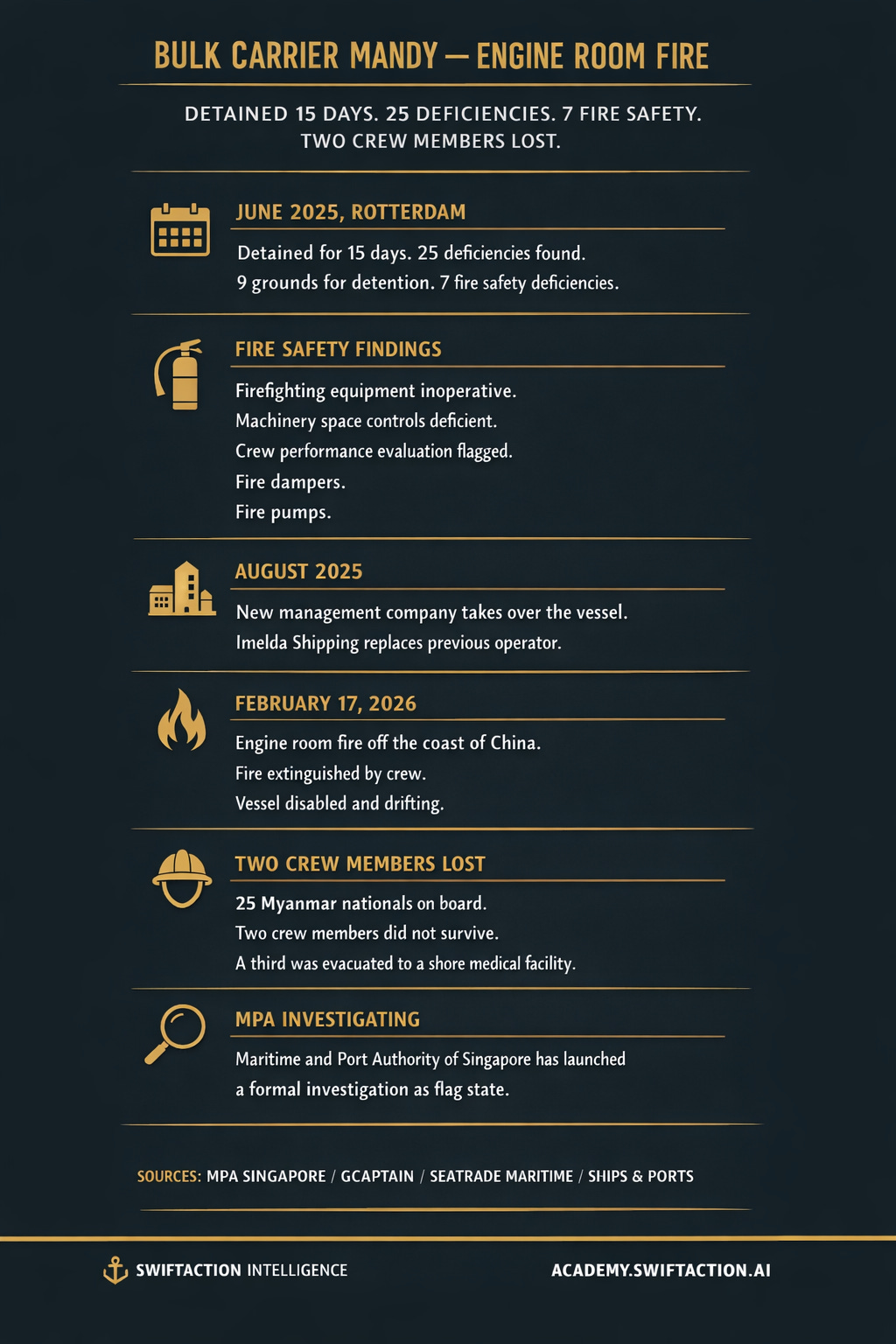
→ ⚓ June 2025, Rotterdam: The bulk carrier Mandy was detained for 15 days after PSC inspectors found 25 deficiencies, nine of which were grounds for detention. Seven deficiencies were in the fire safety category. (Source: Seatrade Maritime, February 19, 2026)
→ 🔥 Fire safety findings: Two defects classified as “inoperative” under ready availability of firefighting equipment. Additional deficiencies in machinery space controls, crew performance evaluation, fire dampers, and fire pumps. (Source: Ships & Ports, February 23, 2026)
→ 🔄 August 2025: Imelda Shipping took over management of the vessel. (Source: Seatrade Maritime, February 19, 2026)
→ 🔥 February 17, 2026: An engine room fire broke out aboard the Mandy off the coast of Shandong, China, at approximately 1935 hours Singapore time. The fire was extinguished by the crew. The vessel was disabled and arrangements were made to tow it to Yantai Port. (Source: MPA Singapore, February 18, 2026)
→ ☠️ Two crew members lost: Of the 25 Myanmar crew members on board, two did not survive. A third was evacuated to a shore medical facility for further treatment. Unconfirmed reports indicated the chief engineer and an oiler were among the casualties. (Source: MPA Singapore / Maritime Executive, February 18, 2026)
→ 🔍 Investigation: The Maritime and Port Authority of Singapore, as flag state, has launched a formal investigation into the circumstances of the fire. No pollution was reported. (Source: MPA Singapore, February 18, 2026)
🔥 The Fire: Engine Room, Off the Coast of China
On February 17, 2026, at approximately 1935 hours Singapore time, a fire broke out in the engine room of the Singapore-registered bulk carrier Mandy off the coast of Shandong, China. The vessel was nearing the end of a voyage from Kamsar Anchorage in Guinea, West Africa, bound for Yantai, China, according to The Week.
The crew extinguished the fire. But two of the 25 Myanmar crew members on board did not survive. A third was evacuated to a shore medical facility for further treatment. Unconfirmed reports from Chinese media outlet Xinde Marine News indicated the chief engineer and an oiler were among the casualties, according to the Maritime Executive.
No Singaporeans were on board. No pollution was reported. Chinese authorities dispatched rescue vessels and a helicopter to assist, according to Alpha Navigation. The vessel was disabled by the fire and arrangements were made to tow it to Yantai Port, according to the Maritime and Port Authority of Singapore.
The MPA issued a statement on February 18, 2026, confirming the incident and extending condolences to the families of those who were lost. The authority stated it would investigate the incident as the flag state for the vessel, in coordination with relevant Chinese authorities, according to gCaptain.
The Mandy is a 180,371 DWT bulk carrier built in 2010. At the time of the fire, the vessel was managed by Imelda Shipping, which had taken over management in August 2025, according to Seatrade Maritime. The vessel was previously managed by Pacific Rim Shipmanagement.
Engine room fires remain one of the most serious hazards in maritime operations. They involve complex machinery, high-pressure fuel systems, hot exhaust surfaces, and limited escape routes for crew members. Fire safety has been the leading category of PSC detentions globally for over a decade.
📋 The Detention: Rotterdam, June 2025
Eight months before the engine room fire, the Mandy had been detained in the port of Rotterdam.
In June 2025, Port State Control inspectors found 25 deficiencies on board the vessel, according to Seatrade Maritime and Ships & Ports. Nine of these deficiencies constituted grounds for detention. The vessel was held for 15 days.
Seven of the recorded deficiencies were in the fire safety category, according to Ships & Ports. The following descriptions are consistent with the corresponding Paris MOU deficiency codes, based on standard PSC code definitions. The exact codes from the inspection report should be verified against the THETIS database before republishing. Among them:
→ Two defects classified as “inoperative” under ready availability of firefighting equipment, consistent with PSC Code 07108.
→ One deficiency under control mechanisms within machinery spaces, consistent with PSC Code 07114.
→ Deficiencies in crew performance evaluation during fire drills, consistent with PSC Code 07125.
→ Deficiencies in fire dampers, consistent with PSC Code 07115.
→ Deficiencies in fire pumps and pipes, consistent with PSC Code 07113.
Additional shortcomings were identified in other categories beyond fire safety, bringing the total to 25 deficiencies.
The vessel was released after 15 days, indicating the deficiencies were rectified to the satisfaction of the inspectors. Two months later, in August 2025, new management company Imelda Shipping took over the vessel, according to Seatrade Maritime.
Eight months after the detention, the engine room caught fire. Two crew members never came home.
The MPA investigation will determine whether the fire was connected to any of the previously identified deficiencies. SwiftAction Intelligence is not asserting a causal link between the Rotterdam detention and the February 2026 fire. But the pattern — a vessel with documented fire safety findings that subsequently experiences a fire with crew casualties — is the pattern that the PSC system and the ISM Code are designed to break. When a vessel accumulates seven fire safety deficiencies in a single inspection, the question is not whether the individual findings were rectified. The question is whether the underlying competency gap that produced them was addressed.
📊 By The Numbers
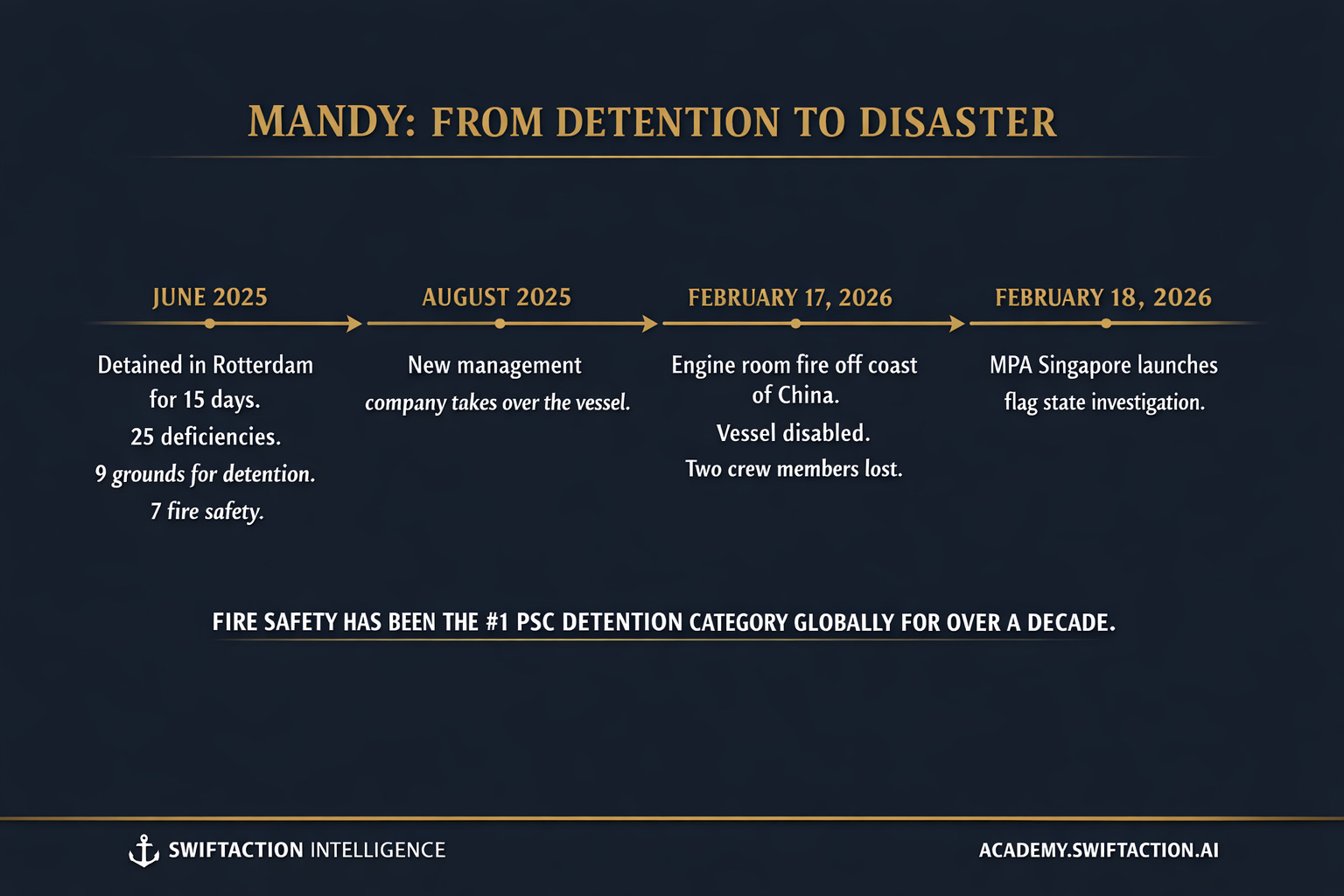
→ 15 days detained in Rotterdam, June 2025. (Source: Seatrade Maritime)
→ 25 deficiencies found during the inspection. (Source: Seatrade Maritime / Ships & Ports)
→ 9 grounds for detention out of 25 total deficiencies. (Source: Seatrade Maritime / Ships & Ports)
→ 7 fire safety deficiencies including inoperative firefighting equipment, machinery space controls, crew performance evaluation, fire dampers, and fire pumps. (Source: Ships & Ports)
→ 25 Myanmar crew members on board at the time of the fire. (Source: MPA Singapore)
→ Two crew members did not survive. A third was evacuated for medical treatment. (Source: MPA Singapore)
→ Fire safety has been the #1 PSC detention category globally for over a decade. It accounted for the highest number of detainable deficiencies in 2025 across both the Paris MOU and Tokyo MOU regimes. (Source: SAFETY4SEA PSC Focus 2025)
Related Coverage
Two crew members lost. Seven fire safety deficiencies flagged eight months earlier. The vessel was detained for 15 days and released. Below: the specific fire safety and ISM failures the Rotterdam inspection exposed, how they connect to PSC deficiency codes that are checked at every port, and what fleet operators can do to close the gap between a rectified finding and verified crew competency.
🔍 The Training Failures the PSC Record Exposed
The MPA investigation will determine the cause of the engine room fire aboard the Mandy. SwiftAction Intelligence is not pre-empting those findings. But the Rotterdam PSC record from June 2025 tells its own story about the state of fire safety readiness on this vessel, and the specific competency gaps that were documented months before two crew members were lost.
Firefighting equipment was inoperative.
Two defects under ready availability of firefighting equipment, consistent with PSC Code 07108, were classified as “inoperative” during the Rotterdam inspection, according to Ships & Ports. This is not a minor paperwork finding. An “inoperative” classification means the equipment was not functional at the time of inspection. In an engine room fire, the ready availability of firefighting equipment is the difference between containment and catastrophe. PSCOs classify this as a detainable deficiency because the consequences of inoperative firefighting equipment in an emergency are immediate and severe.
Machinery space controls were deficient.
A deficiency was recorded under control mechanisms within machinery spaces, consistent with PSC Code 07114. In an engine room emergency, remote shutdown and ventilation controls allow the crew to isolate fuel supplies and close ventilation flaps from outside the space, reducing the fire’s oxygen supply without requiring crew members to enter the burning compartment. When these controls are deficient, the crew’s ability to fight the fire safely is compromised.
Crew performance during fire drills was flagged.
The Rotterdam inspection identified a deficiency under evaluation of crew performance during fire drills, consistent with PSC Code 07125, according to Ships & Ports. This is not an equipment finding. It is a competency finding. It means the inspector observed or assessed the crew’s response during a fire drill and determined it did not meet the required standard. This is the most direct evidence that a training gap existed on board this vessel in the fire safety category.
Fire dampers and fire pumps were deficient.
Additional fire safety deficiencies were recorded under fire dampers, consistent with PSC Code 07115, and fire pumps and pipes, consistent with PSC Code 07113. Fire dampers prevent the spread of fire through ventilation ducts. Fire pumps supply the water that firefighting teams depend on. Both are critical systems in an engine room fire scenario.
Seven fire safety deficiencies in a single inspection is not routine. It indicates a systemic breakdown in fire safety readiness, not an isolated oversight. The vessel was detained for 15 days. The deficiencies were rectified. The vessel was released. Two months later, a new management company took over. Eight months after the detention, the engine room was on fire.
The question the MPA investigation will answer is whether the cause of the February 2026 fire was connected to any of the previously identified deficiencies. The question SwiftAction Intelligence raises is different: when a vessel accumulates seven fire safety deficiencies including inoperative equipment and a crew performance failure, was the underlying competency gap addressed, or was the finding rectified on paper while the gap persisted at sea?
🛡️ How SwiftAction Training Addresses These Gaps
No training program can guarantee that equipment will not fail or that a fire will not occur. But when PSC inspectors flag seven fire safety deficiencies in a single inspection, including a crew performance failure during fire drills, the training system has a specific role: to verify that the crew’s competency on fire safety procedures has been assessed, documented, and evidenced before the next inspection — and before the next emergency.
The following SwiftAction Academy courses address the fire safety and ISM competency gaps relevant to this case. Five map directly to deficiency codes flagged during the Mandy’s Rotterdam detention. Five additional modules address related fire safety and ISM competencies that strengthen overall readiness. Each course produces a completion certificate referencing the specific PSC deficiency code, creating a documented record that the crew was assessed on the exact competency a PSCO will check.
Ready Availability of Fire Fighting Equipment (Code 07108). Two “inoperative” defects were flagged on the Mandy. SwiftAction’s Code 07108 module covers the SOLAS requirements for firefighting equipment readiness, the inspection and testing procedures crew members must follow, and the operational standards for portable and fixed firefighting appliances. Completing this module produces a certificate referencing Code 07108 specifically.
Remote Means of Control in Machinery Spaces (Code 07114). SwiftAction’s Code 07114 module covers the operation of remote shutdown valves, ventilation flap controls, and fuel isolation procedures from outside the engine room. These are the controls that allow a crew to fight an engine room fire without entering the space.
Evaluation of Crew Performance During Fire Drills (Code 07125). This was the competency finding on the Mandy. SwiftAction’s Code 07125 module covers the standards PSCOs use to evaluate crew performance during fire drills, the SOLAS requirements for drill frequency and content, and the documented evidence crew must produce to demonstrate competency. This is the code that bridges equipment readiness and crew capability.
Fire Dampers (Code 07115) and Fire Pumps and Pipes (Code 07113). SwiftAction’s modules under these codes cover the operational testing, maintenance, and inspection requirements for fire containment and suppression systems. Fire dampers prevent the spread of fire through ventilation ducts. Fire pumps supply the water that crews depend on during firefighting operations.
Maintenance of Fire Protection Systems (Code 07124) and Operation of Fire Protection Systems (Code 07123). These modules cover the ISM Code requirements for maintaining and operating the vessel’s fire protection systems, including the documentation that must be available for PSC inspection.
Oil Accumulation in Engine Room (Code 07126). Engine room fires frequently originate from fuel or lubricating oil contact with hot surfaces. SwiftAction’s Code 07126 module covers the SOLAS requirements for engine room cleanliness, oil leak prevention, and the lagging of exhaust pipes and hot surfaces that can serve as ignition sources.
Why this matters for your fleet: The Mandy had seven fire safety deficiencies in a single PSC inspection. The deficiencies were rectified. The vessel was released. The question is whether rectification meant the crew’s competency on fire safety was verified, or whether it meant the equipment was repaired and the paperwork was filed. SwiftAction’s completion certificates reference the specific PSC deficiency code, creating a documented link between the finding, the training, and the crew member’s assessed competency. That link is what turns a PSC rectification from paperwork into evidence.
SwiftAction courses relevant to this incident:
PSC Code - Course - Relevance to Mandy - Basis
07113 - Fire Pumps And Its Pipes - Fire pumps deficient in Rotterdam - Rotterdam Finding
07115 - Fire-Dampers - Fire dampers deficient in Rotterdam - Rotterdam Finding
15107 - Emergency Preparedness - ISM emergency response procedures - SwiftAction Recommendation
👉 Browse all Fire Safety courses: academy.swiftaction.ai/collections/07-fire-safety
👉 Browse all ISM courses: academy.swiftaction.ai/collections/15-ism
👉 Try a free course: academy.swiftaction.ai/enroll/3527149?price_id=4454402
👀 What to Watch
The MPA investigation into the Mandy engine room fire is ongoing. As flag state, Singapore will examine the cause and circumstances of the fire, the condition of fire safety equipment on board, the crew’s response, and whether the vessel’s ISM system was effectively implemented. The findings will determine whether any connection exists between the June 2025 PSC detention and the February 2026 fire.
The change of management between the detention and the fire adds a layer of complexity. Imelda Shipping took over in August 2025, two months after the Rotterdam detention. Whether the new management company was aware of the full scope of the detention findings, whether it conducted its own assessment of fire safety readiness, and whether crew competency on fire safety was re-verified under the new ISM system are all questions the investigation may address.
For fleet operators, the Mandy case raises a systemic question that extends beyond a single vessel. When a ship changes management, the incoming company inherits the vessel’s PSC history but may not inherit the context behind it. A 15-day detention with nine grounds for detention and seven fire safety deficiencies is not a routine finding. It is a signal that the vessel’s fire safety culture required intervention beyond equipment repair. Whether that intervention occurred is the gap the investigation will examine.
Fire safety has been the #1 PSC detention category globally for over a decade. Fleet managers preparing for inspections in any MOU regime can review their crew’s training records against the specific fire safety deficiency codes flagged in this case. If those records do not reference the specific codes PSCOs are checking, the gap that existed on the Mandy may exist on your vessel.
🚨 SwiftAction Signal
Twenty-five deficiencies. Nine grounds for detention. Seven fire safety. Firefighting equipment classified as inoperative. Crew performance during fire drills flagged. The ship was detained for 15 days in Rotterdam. The deficiencies were rectified. The ship was released. A new company took over management. Eight months later, the engine room was on fire off the coast of China. Twenty-five Myanmar crew members were on board. Two of them never came home. A third was evacuated to hospital. The MPA is investigating. Fire safety has been the number one PSC detention category globally for over a decade. A training module on firefighting equipment readiness costs $17. The industry does not have a knowledge problem. It has an action problem.
⚓ The SwiftAction Team SwiftAction Intelligence Is Published Daily. For Partnership Inquiries Contact admin@swiftaction.ai
📋 Full Training Catalog: academy.swiftaction.ai
📋 SwiftAction Training Resources Referenced in This Article
👉 Fire Safety Modules (Category 07): academy.swiftaction.ai/collections/07-fire-safety
👉 ISM Modules (Category 15): academy.swiftaction.ai/collections/15-ism
👉 Free Course (No Credit Card): academy.swiftaction.ai/enroll/3527149?price_id=4454402
👉 Request Fleet Demo: academy.swiftaction.ai/pages/contact-us