

|⚓ About Us | 📋 Training Catalog | 🎯 CIC 2026 Bundle |
🏅 Free Course Access (No Credit Card)
China’s Maritime Safety Administration does not just inspect your ship. It inspects whether your crew can operate it. China MSA conducts more PSC inspections than any other single authority in the Tokyo MOU — 7,721 in 2023, up 137% from 3,251 in 2022. For Cyprus-flagged vessels — one of the largest white-list fleets — China had the highest number of detentions of any country in 2023–2025, with Shenzhen, Ningbo, and Guangzhou recording the highest detention frequency in 2025, according to the Cyprus Shipping Deputy Ministry’s PSC performance analysis. On 1 December 2023, the MSA enacted a revised Special Follow-up scheme that fundamentally changed the risk calculus for every vessel trading to Chinese ports. Two PSC detentions anywhere in the world within 12 months — not just in China — and your vessel is placed on a mandatory inspection list. Every Chinese port call. Every time. Inspections conducted “in a detailed manner,” unaffected by sailing schedule or cargo operations. At the time of the circular’s issuance, 38 foreign vessels were already on the list. Regional MSA offices in Shanghai, Guangzhou, and Zhoushan now operate their own additional enforcement requirements on top of the national scheme. In 2025, China MSA launched an Enclosed Space Safety campaign running from 15 January to 15 October, adding another layer of inspection focus. And when Chinese PSCOs inspect, they don’t just check certificates and equipment condition — they ask your crew to demonstrate competency. Can your oiler start the emergency generator? Can your AB operate the fire pump? If not, detention.
📋 In this issue:
🔥 The Regulation
📊 By The Numbers
🔍 The Training Failure
✅ What Should Have Happened
👀 What to Watch
🚨 SwiftAction Signal
🔔 Not yet subscribed? SwiftAction Intelligence Covers Maritime Accidents, Detentions, and the Training Failures Behind Them. Subscribe For Free!
📋 Competency-Based Maritime Training Mapped to Every PSC Deficiency Code
→ Academy.SwiftAction.AI
📌 SwiftAction Data Card
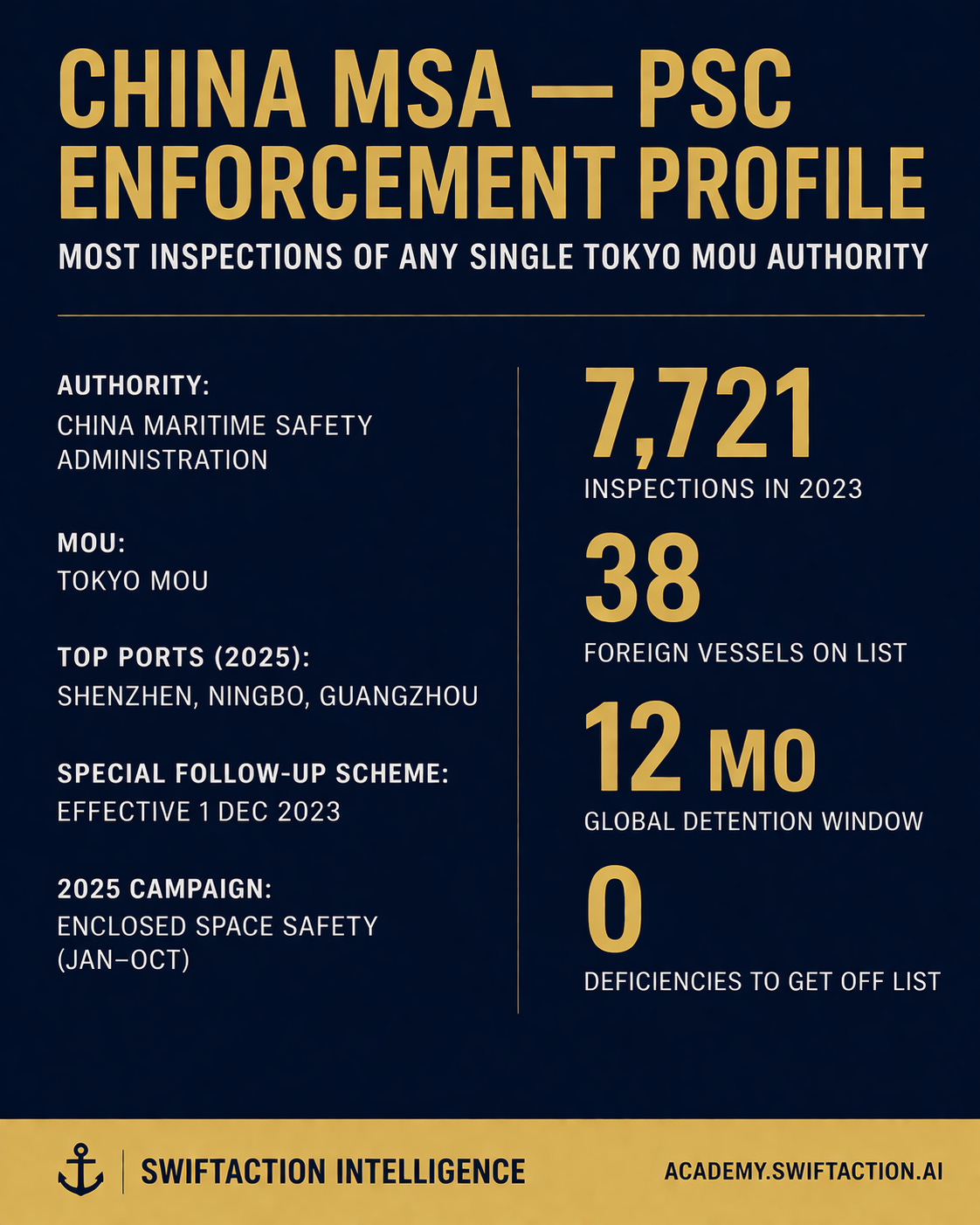
→ China MSA Conducts More PSC Inspections Than Any Other Single Authority in the Tokyo MOU
→ For Cyprus-Flagged Vessels, China Had the Highest Number of Detentions of Any Country (2023–2025) (Source: Cyprus SDM PSC Performance Report)
→ Top Detention Ports for Cyprus Fleet in 2025: Shenzhen, Ningbo, and Guangzhou (Source: Cyprus SDM PSC Performance Report)
→ China MSA Conducted 7,721 PSC Inspections in 2023, Up 137% From 3,251 in 2022
→ 38 Foreign Vessels on the Special Follow-up List at Time of Circular Issuance (October 2023)
→ 17 Vessels Added to the List in 2023 Alone; 21 Carried Over From 2014–2022
→ Special Follow-up Scheme Effective 1 December 2023, Replacing 2013 Provisions
→ Two PSC Detentions Anywhere in the World Within 12 Months = Mandatory Inspection at Every Chinese Port Call
→ Shanghai: Fire Safety Defects Made Up 35.7% of All Deficiencies on Detained Ships (May 2025)
→ Guangzhou: Fire Safety Accounted for 45.7% of Defects Across 6 Detained Ships (May 2025)
→ Tokyo MOU Regional Detention Rate Decreased 0.6 Percentage Points in 2024, But Remains Above Pre-Pandemic Levels
→ 2025 Campaign: China MSA Enclosed Space Safety Inspection Campaign, 15 January to 15 October 2025 (Source: IRClass Circular 008/2025)
Sources: Cyprus SDM PSC Performance Report 2023–2025; China MSA Circular (23 October 2023); Britannia P&I via SAFETY4SEA; ABS PSC Annual Report 2023; Phoenix Register NL 322/25; Tokyo MOU Annual Report 2024; IRClass Circular 008/2025
🔥 The Regulation
On 23 October 2023, the Maritime Safety Administration of the People’s Republic of China issued revised “Provisions on the Supervision and Administration of Vessels under Special Follow-up.” The provisions came into force on 1 December 2023, replacing the 2013 version, according to IRClass, DNV, Britannia P&I, Dromon, and the Japan P&I Club.
The revision expanded the scheme in three critical ways.
First, the detention trigger is now global. Under the previous 2013 rules, only detentions by China MSA counted toward the threshold. Under the revised provisions, foreign vessels that have been detained twice in any PSC inspection — in any port, under any MOU, anywhere in the world — within a consecutive 12-month period are listed as Special Follow-up vessels, according to IRClass and Xinde Marine News. A detention in Rotterdam, Sydney, or Houston now counts toward the China MSA threshold.
Second, the list of triggering violations expanded. Beyond two detentions, the following can now place a vessel on the Special Follow-up list, according to Dromon’s analysis of the provisions:
→ Two administrative penalties from China MSA within 12 months for serious illegal acts, including inadequate manning, malicious AIS shutdown, wilful discharge of pollutants, overloading, or inland river vessels engaged in sea transportation
→ Departure after maritime administrative violations, or refusal to accept administrative penalties
→ Forged, altered, transferred, traded, or leased ship certificates
→ Major conversion without inspection and authorisation
→ Causing significant navigational accidents with equal or higher responsibility
→ Vessels managed by shipping companies that are themselves under Special Follow-up
→ Vessels designated by China MSA under the Provisions on the Administration of Maritime Law Enforcement Assistance in Investigation
Third, regional MSA offices can now publish and update the list. Under the 2013 rules, only central China MSA managed the list. The revised provisions extend this authority to MSA offices directly affiliated with China MSA and provincial-level MSA offices, according to Britannia P&I via SAFETY4SEA. This means Shanghai MSA, Guangzhou MSA, and Zhoushan MSA — each with their own additional enforcement requirements — can independently add vessels.
What happens when a vessel is listed: The inspection conducted by China MSA on Special Follow-up vessels “shall not be affected by such factors as sailing schedule, cargo loading and unloading and where conditions permit, such inspection will be conducted at each port and will be more detailed in nature,” according to IRClass’s translation of the provisions.
In practice, this means every Chinese port call becomes a full expanded inspection. Commercial pressure to sail on schedule is explicitly overridden by the regulation. The vessel’s operator cannot negotiate timing.
How to get off the list: A foreign vessel under Special Follow-up may be removed once three months have passed since the date of listing AND the vessel has undergone a China MSA PSC inspection with zero deficiencies recorded, according to Dromon and IRClass. For a vessel already flagged for systemic problems, achieving zero deficiencies in a Chinese expanded inspection is a high bar.
📊 By The Numbers
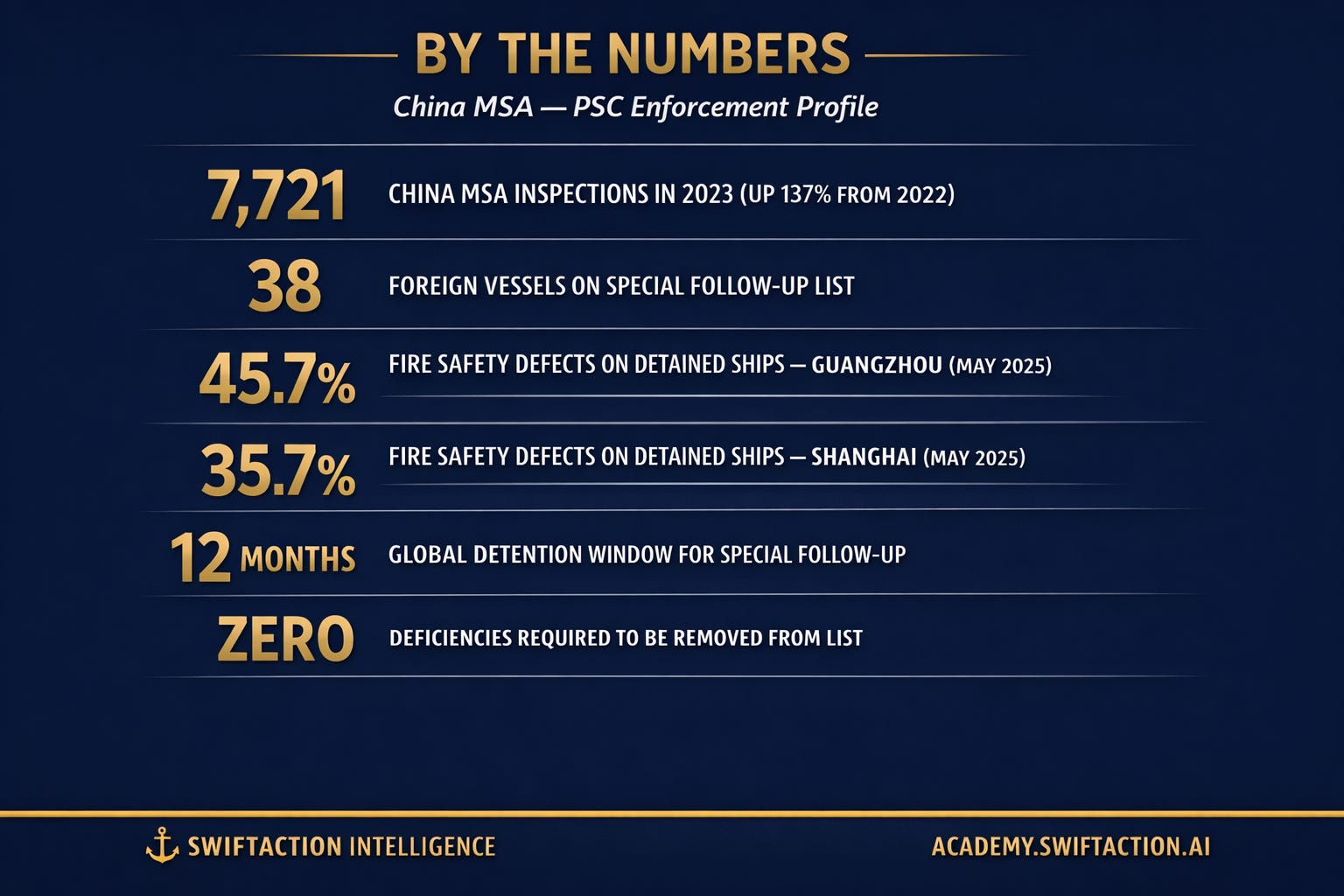
→ 7,721 PSC Inspections by China MSA in 2023, Up 137% From 3,251 in 2022 (Source: ABS PSC Annual Report 2023)
→ 32,054 Total Inspections Across All Tokyo MOU Member States in 2024 (Source: Tokyo MOU Annual Report 2024)
→ 38 Foreign Vessels on the Special Follow-up List at Time of Circular Issuance (Source: Britannia P&I via SAFETY4SEA, December 2023)
→ 12 Months: The Rolling Window for Two Detentions Anywhere to Trigger Mandatory Chinese Port Inspection (Source: China MSA Circular, 23 October 2023)
→ 3 Months + Zero Deficiencies: The Minimum Standard to Be Removed From the List (Source: IRClass, Dromon)
→ 35.7% of All Deficiencies on Detained Ships in Shanghai Were Fire Protection System Defects (May 2025) (Source: Phoenix Register NL 322/25)
→ 45.7% of Defects on 6 Detained Ships in Guangzhou Were Fire Safety Issues (May 2025) (Source: Phoenix Register NL 322/25)
→ Shanghai MSA: Zero-Tolerance on Concealment of Defects — Treated as SOLAS, MARPOL, and ISM Code Violation (Source: Lloyd’s Register Class News 22/25)
Under-performing ships in the Tokyo MOU region nearly doubled in 2024 vs. the prior year. Source: Tokyo MOU Annual Report 2024
🔍 The Training Failure
Most fleet operators prepare their vessels for PSC inspection by checking equipment condition, updating certificates, and ensuring paperwork is in order. In Chinese ports, that is not enough.
China MSA’s mechanical and electrical equipment campaign, conducted from April to October 2024 across all Chinese ports, added a requirement that catches operators off guard: crew competency demonstrations, according to IRClass and DNV. PSC officers could request crew members to demonstrate proper operational ability on machinery and electrical equipment onboard. Crew unfamiliar with equipment operation requirements could result in detention.
This is not standard PSC practice at this scale anywhere else. Paris MOU and Tokyo MOU inspections can include operational tests, but the China MSA campaign made crew demonstration a systematic, nationwide expectation. The campaign focused on propulsion machinery, generators, boilers, steering gears, anchoring devices, and MARPOL-related equipment. An oiler who cannot start the emergency generator. A 3/O who cannot demonstrate the correct procedure for switching to emergency steering. An engineer who cannot explain the maintenance history of the main engine fuel injection system. Any of these gaps is grounds for detention under the campaign.
The deficiency data from Chinese ports confirms where the competency gaps are concentrated:
Fire safety dominates. In Shanghai, fire protection system defects made up 35.7% of all deficiencies on detained ships in May 2025, followed by alarm system failures at 17.9%, according to Phoenix Register’s analysis of China PSC detention data. In Guangzhou, fire safety accounted for 45.7% of defects across six detained ships in the same period. This is consistent with the top detainable deficiency categories across the Tokyo MOU region: fire safety, lifesaving appliances, ISM, pollution prevention, and emergency systems, according to the RMI PSC presentation citing China-specific data.
Age matters. Shanghai detentions in May 2025 mainly involved ships older than 15 years. In Taizhou, all detained ships were more than 20 years old, according to Phoenix Register. Older vessels are not inherently less safe, but they require more rigorous maintenance — and more rigorous crew competency on that maintenance.
Bulk carriers are over-represented. In Qinzhou, bulk carriers accounted for 71.4% of detentions in May 2025, with defects primarily in emergency systems and firefighting facilities, according to Phoenix Register.
Shanghai MSA takes concealment personally. Concealment of defects is considered by Shanghai MSA to be a violation of SOLAS, MARPOL, and the ISM Code, according to Lloyd’s Register. This results in strict penalties including vessel detention and legal action. Shanghai MSA has emphasised a zero-tolerance approach towards negligence in machinery and electrical system management. Any vessel experiencing a machinery or electrical failure in the Shanghai region is subject to an expanded PSC inspection.
The pattern is clear: Chinese PSCOs are not looking for paperwork compliance. They are looking for evidence that the crew can actually operate and maintain the vessel. When they find gaps — and fire safety alone accounts for 35–46% of deficiencies on detained ships in Shanghai and Guangzhou — the vessel does not sail.
✅ What Should Have Happened
The deficiency categories that drive detentions in Chinese ports are the same categories that drive detentions everywhere. The difference is what China MSA does with the finding. A fire safety deficiency that earns a Code 17 correction in a European port can trigger an expanded inspection, a detention, and placement on the Special Follow-up list in China — with every subsequent Chinese port call becoming another full inspection.
The following SwiftAction Academy courses map to the deficiency categories that drive the majority of detentions in Chinese ports. Each course produces a completion record referenced to the specific PSC deficiency code. That record sits in the ship’s training files at the time of inspection.
Fire Safety (35–46% of deficiencies on detained ships in Shanghai and Guangzhou, May 2025):
Code 07106 (Fire Detection and Alarm System) — alarm system failures were the second-highest deficiency category in Shanghai at 17.9%. This course is free.
Code 07108 (Ready Availability of Fire Fighting Equipment) — fire fighting equipment readiness is routinely tested during Chinese inspections.
Code 07123 (Operation of Fire Protection Systems) — the course covers the operational demonstrations that Chinese PSCOs require.
Code 07124 (Maintenance of Fire Protection Systems) — maintenance records are scrutinised, particularly on vessels older than 15 years.
Code 07126 (Oil Accumulation in Engine Room) — oil accumulation is both a fire safety and ISM finding.
ISM Code (consistent top-three detention driver in Chinese ports):
Code 15106 (Shipboard Operations) — when a PSCO finds multiple small deficiencies across the vessel (untested fire detectors, incomplete maintenance logs, gaps in drill records), the pattern indicates systemic SMS failure. This triggers a separate ISM detention under Code 15150 that can only be cleared after an external ISM audit by the flag state or class society. One observation becomes two detainable deficiencies. Code 15106 addresses the shipboard operations competency that prevents the cascade.
Code 15107 (Emergency Preparedness) — emergency systems and firefighting facilities were the primary deficiency categories on bulk carriers detained in Qinzhou.
Code 15109 (Maintenance of the Ship and Equipment) — planned maintenance records are a specific focus of the mechanical/electrical campaign. Maintenance records must be up-to-date with sufficient detail, according to DNV’s guidance on preparing for China MSA inspections.
Propulsion and Auxiliary Machinery (mechanical/electrical campaign focus):
Code 13101 (Propulsion Main Engine) — crew demonstration of engine operation is explicitly part of the campaign.
Code 13102 (Auxiliary Engine) — generator start-up, load sharing, and emergency operation procedures are tested.
Code 13108 (Operation of Machinery) — the catch-all code for machinery operational competency that covers the demonstrations Chinese PSCOs require.
Emergency Systems (primary deficiency on bulk carriers in Qinzhou + 2025 enclosed space campaign):
Code 04118 (Enclosed Space Entry and Rescue Drills) — China MSA’s 2025 Enclosed Space Safety campaign (January–October 2025) will inspect enclosed space entry procedures, rescue drills, atmosphere testing, and crew competency. This is an active campaign now.
Code 04114 (Emergency Source of Power — Emergency Generator) — can your crew demonstrate emergency generator start and automatic switchboard connection? Chinese PSCOs are asking.
Code 04121 (Crew Familiarization with Emergency Systems) — covers the broad familiarisation requirements that underpin every crew demonstration test.
👉 Browse all Fire Safety courses: academy.swiftaction.ai/collections/07-fire-safety
👉 Browse all ISM courses: academy.swiftaction.ai/collections/15-ism
👉 Browse all Machinery courses: academy.swiftaction.ai/collections/13-propulsion-and-auxiliary-machinery
👉 Browse all Emergency Systems courses: academy.swiftaction.ai/collections/04-emergency-systems
👉 Try a free course: academy.swiftaction.ai/enroll/3527149?price_id=4454402
👀 What to Watch
The Special Follow-up list is growing. At the time of the circular’s issuance in October 2023, 38 foreign vessels were on the list. With regional MSA offices now empowered to add vessels independently, and the trigger expanded to include global detentions and a broader range of violations, the list will grow. Operators with vessels detained anywhere in the Tokyo MOU or Paris MOU regions in the last 12 months should check whether their vessels are approaching the two-detention threshold.
Shanghai MSA zero-tolerance is escalating. Any vessel experiencing a machinery or electrical failure in the Shanghai region is now subject to an expanded PSC inspection, according to Lloyd’s Register. Shanghai MSA has stated that concealment of defects will be treated as a violation of SOLAS, MARPOL, and the ISM Code. For vessels calling on Shanghai — consistently ranked as the world’s busiest container port by throughput — this is a standing enforcement posture, not a campaign with an end date.
The mechanical/electrical campaign may be permanent. The April–October 2024 campaign focused on propulsion, generators, boilers, steering, and MARPOL equipment. DNV and class societies have published extensive preparation guidance. Whether this becomes a permanent feature of Chinese PSC enforcement or repeats as an annual campaign, the crew competency demonstration requirement has established a precedent. Operators should assume it continues.
Tokyo MOU under-performing ships nearly doubled in 2024. The Tokyo MOU Annual Report 2024 noted that the number of under-performing ships was nearly double that of the previous year. The Tokyo MOU is exploring the possibility of banning under-performing ships from the region entirely. China MSA is the largest single inspection authority in the Tokyo MOU. Ships that accumulate deficiency histories in the region face compounding risk: the Tokyo MOU risk profile increases inspection probability at every member state port, while China MSA’s Special Follow-up scheme adds a separate, more punitive layer on top.
2025 Campaign: Enclosed Space Safety (active now). China MSA launched an Enclosed Space Safety inspection campaign on 15 January 2025, running through 15 October 2025, according to IRClass Circular 008/2025. This campaign runs concurrently with any standard or expanded PSC inspection. Vessels calling Chinese ports should expect enclosed space entry procedures, rescue drills, atmosphere testing equipment, and crew competency on enclosed space hazards to be inspected. This is the third major campaign layer on top of the standard inspection regime and the Special Follow-up scheme.
2025 CIC: Ballast Water Management. The Tokyo MOU and Paris MOU are conducting a joint Concentrated Inspection Campaign on Ballast Water Management from 1 September to 30 November 2025. Vessels calling Chinese ports during this period should expect BWM to be inspected in addition to any standard, expanded, or campaign inspection.
2026 CIC: Cargo Securing. The Tokyo MOU PSCC35 approved a joint CIC on cargo securing for 2026. SwiftAction’s CIC 2026 Cargo Securing Bundle covers the deficiency codes inspectors will check.
🚨 SwiftAction Signal
China MSA conducts more PSC inspections than any other single authority in the Tokyo MOU — 7,721 in 2023, up 137% from the previous year. For Cyprus-flagged vessels, China had the highest number of detentions of any country in 2023–2025, with Shenzhen, Ningbo, and Guangzhou recording the highest detention frequency in 2025. Fire safety deficiencies account for 35–46% of all findings on detained ships in Shanghai and Guangzhou. The mechanical/electrical campaign required crew to demonstrate operational competency on the spot. An enclosed space safety campaign is running through October 2025. Shanghai MSA treats concealment of defects as a SOLAS, MARPOL, and ISM violation. And since 1 December 2023, two detentions anywhere in the world within 12 months put your vessel on a mandatory inspection list at every Chinese port call, with inspections conducted “in a detailed manner” that is not affected by your sailing schedule or cargo operations.
Most operators know about Paris MOU targeting. Most know about AMSA’s enforcement reputation. Few understand the China MSA Special Follow-up scheme. Fewer still have prepared their crews for the competency demonstrations that Chinese PSCOs now routinely conduct.
The free Code 07106 module (Fire Detection and Alarm System) takes less time than reading this article. Fire safety is the number one deficiency category on detained ships in Shanghai and Guangzhou. Start there.
⚓ The SwiftAction Team
SwiftAction Intelligence Is Published Daily.
For Partnership Inquiries Contact admin@swiftaction.ai
📋 Full Training Catalog: academy.swiftaction.ai
📋 Resources
📋 Full Training Catalog: academy.swiftaction.ai/collections
🆓 Code 07106: Fire Detection and Alarm System (Free, No Credit Card): academy.swiftaction.ai/courses/07106
🏅 Try Any Free Course: academy.swiftaction.ai/enroll