

|⚓ About Us | 📋 Training Catalog | 🎯 CIC 2026 Bundle |
🏅 Free Course Access (No Credit Card)
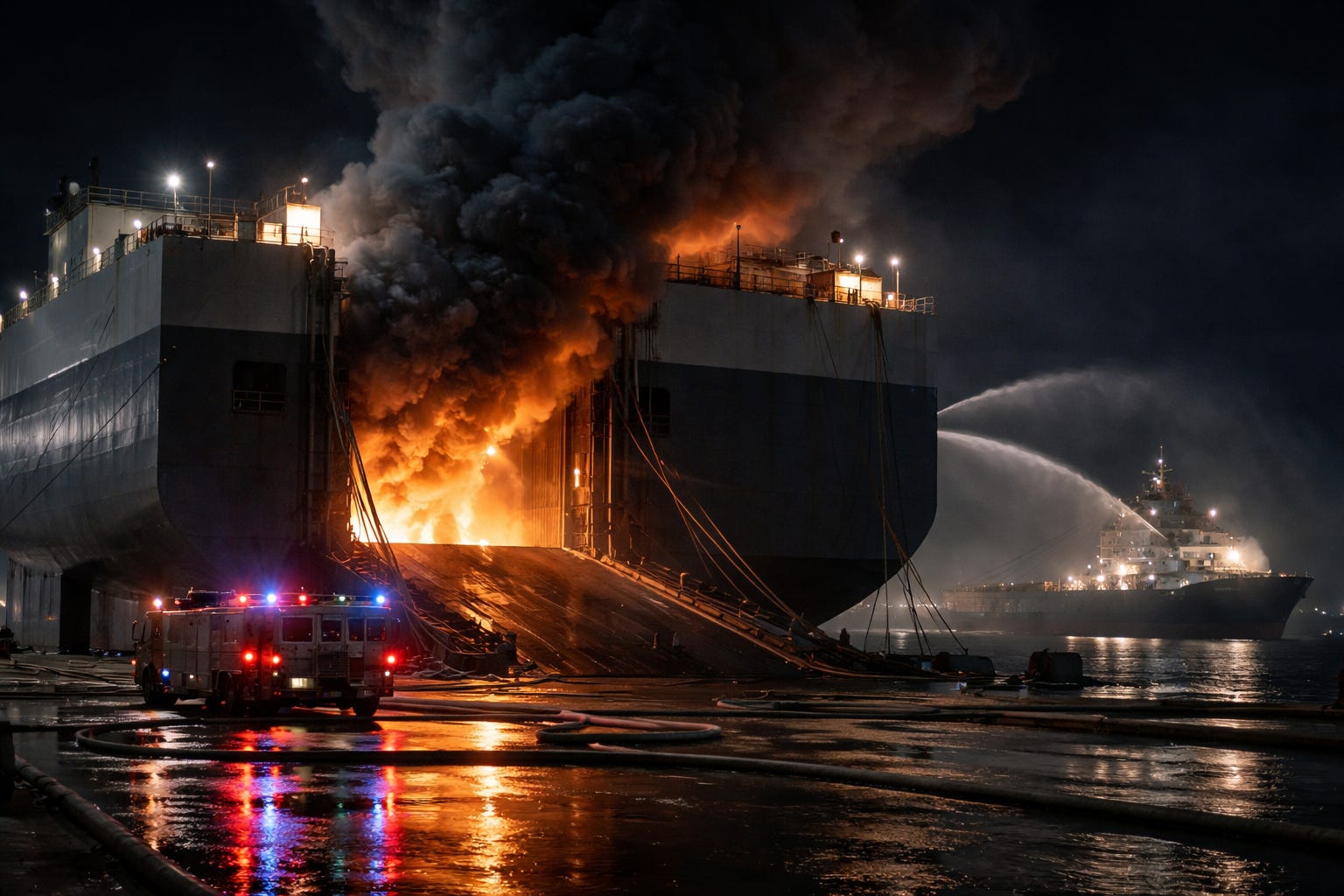
On the night of July 5, 2023, a Jeep Wrangler being used to push inoperable cars inside the garage decks of the Italian-flagged RoRo vessel Grande Costa D’Avorio caught fire at Port Newark, New Jersey. The fire spread across 1,200 vehicles. The ship’s crew attempted to fight it and failed. The Newark Fire Department responded. Two captains, Augusto “Augie” Acabou, 45, and Wayne “Bear” Brooks Jr., 49, entered the smoke-filled decks and became disoriented. They were found dead, trapped between lashed-down vehicles on a lower deck. The Coast Guard released its Report of Investigation in January 2026. The NTSB approved its final report in April 2025. Both investigations arrived at the same finding: the local fire department had little to no maritime firefighting training, experience, or familiarization with cargo ships of any type. The ship’s crew could not extinguish the fire either. The vessel burned for five days.
📋 In this issue:
🔥 The Incident: Grande Costa D’Avorio, Port Newark
📊 By The Numbers
🔍 The Three Failures That Killed Two Men
🛡️ How Targeted Training Could Have Changed This Outcome
👀 What to Watch
🚨 SwiftAction Signal
📋 Competency-Based Maritime Training Mapped to Every PSC Deficiency Code
→ Academy.SwiftAction.AI
🎯 2026 CIC Cargo Securing Bundle: 30 Courses, 60% Off
→ CIC Bundle 60% OFF
📌 SwiftAction Data Card
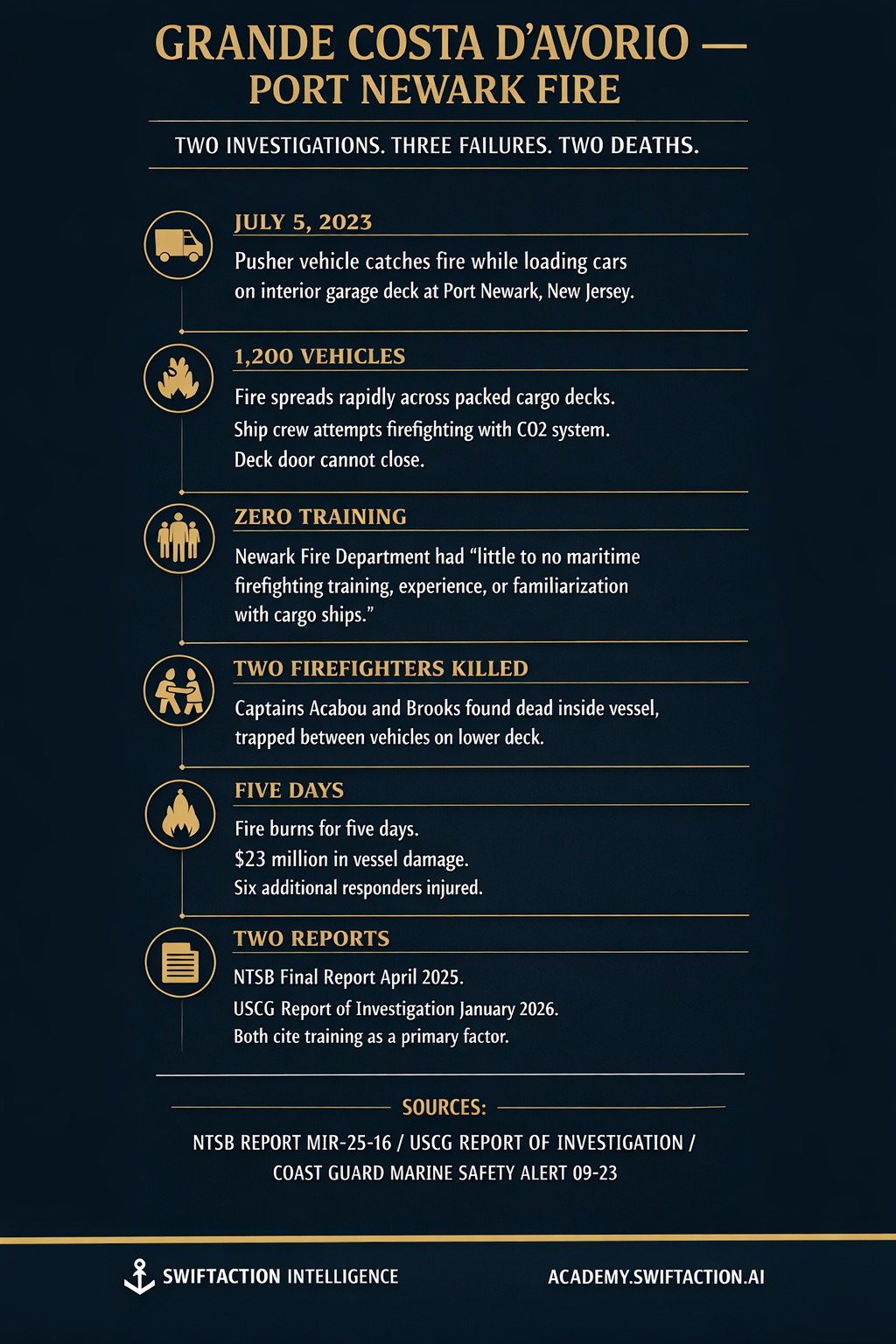
→ 🔥 July 5, 2023: Shoreside workers were loading cars onto interior garage decks when a pusher vehicle (Jeep Wrangler) caught fire inside the RoRo vessel Grande Costa D’Avorio at Port Newark, New Jersey. (Source: NTSB Final Report, April 2025)
→ 🚗 1,200+ vehicles on board. Fire spread rapidly across combustible cargo on enclosed garage decks. (Source: USCG Marine Safety Alert 09-23)
→ 🚒 Zero maritime firefighting training: The Coast Guard found the Newark Fire Department had “little to no maritime firefighting training, experience, or familiarization with cargo ships of any type.” The department had not conducted marine firefighting training in nearly a decade. (Source: USCG Marine Safety Alert 09-23, NJ Advance Media)
→ ☠️ Two firefighters killed on board: Captains Augusto Acabou, 45, and Wayne Brooks Jr., 49, became disoriented in smoke-filled garage decks and were found dead, trapped between lashed-down vehicles on a lower deck. (Source: NTSB Final Report, USCG ROI, Stars and Stripes)
→ 🔥 Five days: The fire burned for five days. $23 million in estimated vessel damage. Six additional emergency responders injured. (Source: USCG ROI, January 2026)
→ ⚠️ Crew also failed: The USCG cited “ineffective initial firefighting efforts by vessel crew,” including failure to use available portable foam and failure to close a critical watertight door. (Source: USCG ROI)
🔥 The Incident: Grande Costa D’Avorio, Port Newark
The Grande Costa D’Avorio is a 692-foot Italian-flagged RoRo/container vessel operated by the Grimaldi Group. On the evening of July 5, 2023, the vessel was conducting cargo operations at Berth 18, Port Newark, New Jersey.
Shoreside workers were loading new and used cars onto the vessel’s interior garage decks. A 16-year-old Jeep Wrangler was being used as a “pusher” vehicle to move inoperable cars up the vessel’s internal ramps. It was the 38th push operation the longshoreman had performed that day, according to the NTSB’s final report approved on April 15, 2025.
Midway through a push, the longshoreman heard a loud noise and saw flames dripping from under the Jeep. The vehicle had overheated under conditions far beyond its design parameters. The NTSB found the Jeep had been subject to a safety recall related to transmission overheating during off-road use, but the manufacturer’s modifications were limited to a dashboard warning light and a software update. Neither modification was designed for sustained, high-load pushing of vehicles up steep ramps in enclosed spaces.
The fire spread rapidly across the packed vehicles on the garage decks. With over 1,200 vehicles on board, the cargo was highly combustible.
The ship’s crew responded. A fitter dressed in firefighting gear and an SCBA attempted to fight the fire. The crew activated the vessel’s fixed CO2 fire-extinguishing system to flood the affected space. But they could not close the Deck 12 hydraulic garage door because the controls to operate it were located on the interior side of the door, within the fire zone. Without that door closed, the CO2 could not contain the fire.
The USCG’s Report of Investigation, released in January 2026, cited multiple crew failures: ineffective initial firefighting efforts, failure to use available portable foam, and the failure to close watertight door WTD-12 once it was no longer needed for cargo operations, according to the Newark Patch report on January 15, 2026.
The Newark Fire Department arrived on scene. What followed was a cascade of failures.
Firefighters entered the vessel’s enclosed garage decks. Battalion Chief B-4 positioned himself in a port aft ladderwell on Deck 10 without an SCBA, according to the NTSB report. Additional companies staged on Deck 12, awaiting direction. Radio communications were severely hampered by the vessel’s steel structure. Dispatchers were often unable to communicate with firefighters inside the ship.
Captains Augusto “Augie” Acabou and Wayne “Bear” Brooks Jr. entered the lower decks. They became disoriented in the smoke-filled garage spaces and could not find their way out. They were found dead inside the vessel, trapped between lashed-down vehicles on a lower deck, according to Stars and Stripes reporting on January 9, 2024.
The department had Pak-Tracker receivers in battalion chief vehicles, electronic devices designed to locate missing firefighters by homing in on SCBA transmitters. None were deployed during the search, according to the Coast Guard report, as reported by FireRescue1 on January 14, 2026.
Six additional emergency responders were injured. The fire burned for five days. The estimated damage to the vessel reached $23 million. Legal proceedings on behalf of the families of Acabou and Brooks are ongoing, according to ABC7 New York’s reporting on April 15, 2025.
📊 By The Numbers
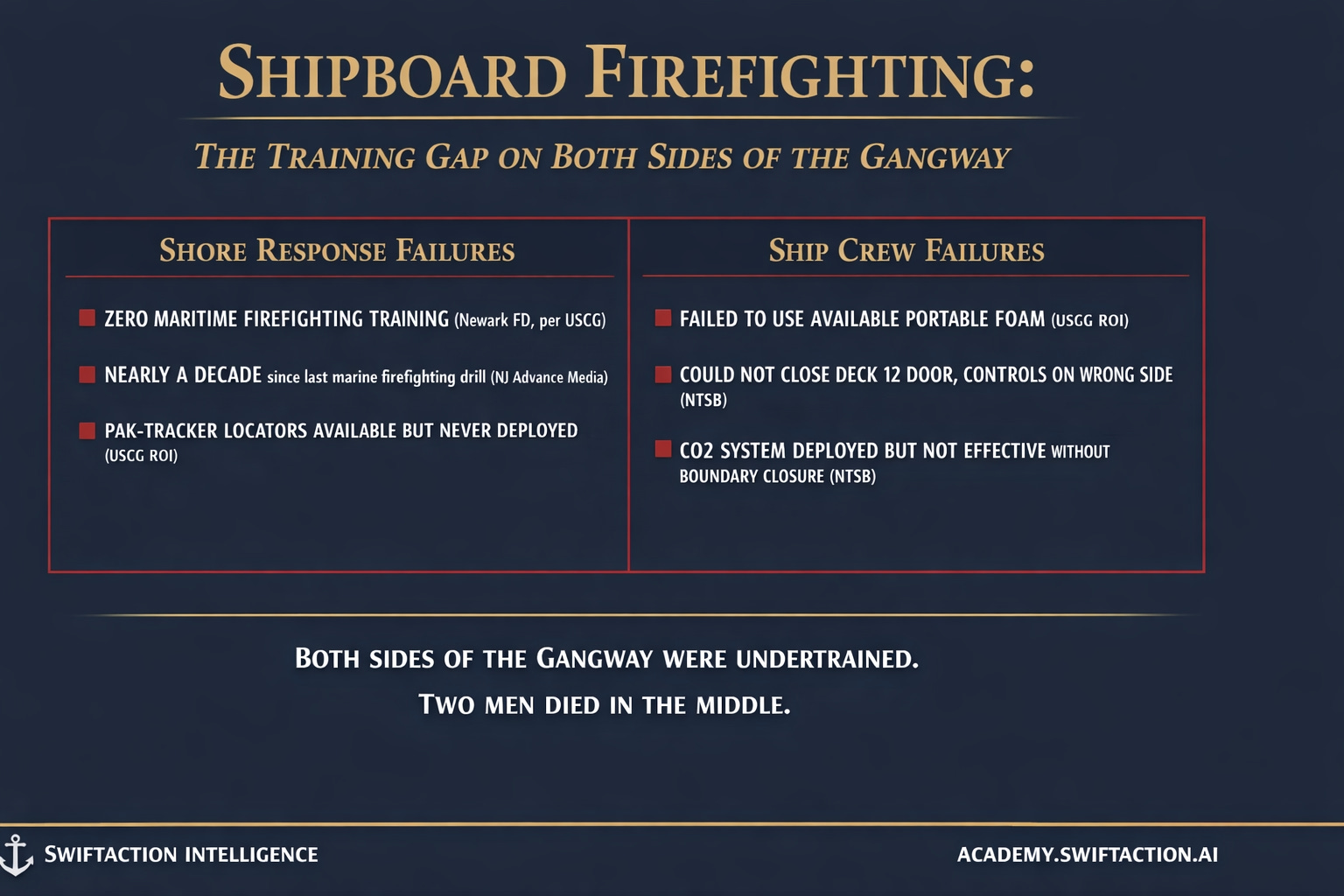
→ Zero maritime firefighting training for the responding fire department. The Coast Guard’s November 2023 safety alert stated this was “only one of several vessel fires occurring within the last five years where the lack of familiarity with commercial vessels and inexperience with shipboard firefighting techniques unduly endangered the safety of responding personnel.” (Source: USCG Marine Safety Alert 09-23)
→ Nearly a decade since the Newark Fire Department had conducted marine firefighting training, despite being the department responsible for fires at one of the busiest ports on the US East Coast. (Source: NJ Advance Media investigation)
→ Firefighters did not know they needed an international shipboard adapter to connect their hoses to the vessel’s internal standpipe system. Without it, they could not pump the volume of water needed. (Source: NJ Advance Media, reported by Stars and Stripes, January 2024)
→ The ship’s fireboat was out of action that night and could not start. No one requested assistance from the FDNY and its fleet of fireboats until hours had passed. (Source: NJ Advance Media, reported by Stars and Stripes)
→ According to ABC7 New York’s coverage of the April 15, 2025 NTSB hearing, the NTSB chairman said the Newark firefighters “were poorly trained before fighting the massive cargo ship fire and they are still poorly trained after.” (Source: ABC7 New York, April 15, 2025)
→ Fire safety deficiencies accounted for 18% of all PSC detentions globally in 2025, the #1 category for over a decade. The crew’s inability to manage the fire aboard Grande Costa D’Avorio reflects the same competency gaps PSCOs find during routine inspections. (Source: SAFETY4SEA PSC Focus 2025)
The shore firefighters had no maritime training. The ship’s crew could not contain the fire. Both investigations identified the same gap. Below: the three specific failures the NTSB said killed Acabou and Brooks, how training mapped to the exact deficiency codes involved would have changed the outcome, and what every fleet manager should check on their own vessels before the next port call.
🔍 The Three Failures That Killed Two Men
The NTSB’s final report, approved during a public hearing on April 15, 2025, identified a chain of three failures. Each was preventable. Each involved a training or competency gap.
Failure 1: The pusher vehicle should never have been on the ship.
The Jeep Wrangler was being used for industrial pushing operations far beyond its design capacity. It had been subject to a safety recall for transmission overheating. The NTSB concluded the fire was preventable and that the use of a consumer vehicle for this purpose was inappropriate and dangerous. The board recommended the American Association of Port Authorities warn port operators about the risks. This was an operational decision failure by the terminal operator, not the crew.
Failure 2: The CO2 system could have worked, but the crew could not close the door.
The vessel’s fixed CO2 system was deployed. But the Deck 12 hydraulic garage door could not be closed because its controls were accessible only from the interior, which was on fire. Without boundary closure, the CO2 dissipated. The NTSB called on the classification society to revise guidelines ensuring SOLAS-compliant fire doors can be operated from both sides. NTSB investigator Bart Barnum stated during the hearing that the most effective method to extinguish the fire would have been to work with the crew to close the Deck 12 door and allow the CO2 to function, as reported by JOIFF on April 16, 2025.
This was a combined design and crew competency failure. The door design was inadequate. But the crew’s response also included what the USCG described as ineffective initial firefighting efforts and failure to use available portable foam. This failure falls under PSC Code 07108 (Fire Doors/Openings in Fire-Resisting Divisions), one of the most frequently cited fire safety deficiency codes globally. A crew trained specifically on fire boundary management, the limitations of their vessel’s suppression architecture, and alternative firefighting procedures when primary boundary closure fails would have approached this response differently.
Failure 3: The firefighters entered a space they should not have entered, without training to survive it.
The NTSB concluded that the decision to send firefighters into the CO2-flooded, smoke-filled garage decks was a fatal misjudgment based on inadequate training and communication. The Coast Guard found the Newark Fire Department had never conducted vessel familiarization at Port Newark, despite the port being within their area of responsibility. Firefighters did not know the layout of the vessel, the locations of escape routes, or the operation of shipboard fire suppression systems.
The USCG report identified additional specific training gaps: the failure to deploy available SCBA PASS alarm training in the event of a mayday, the failure of one of the deceased firefighters to carry his radio, and the failure to deploy Pak-Tracker location devices that were available in battalion chief vehicles.
The Coast Guard’s November 2023 Marine Safety Alert called for improved coordination of marine firefighting preparation nationwide, noting that vessel fires require different technical skills than many land-based firefighting agencies possess.
Maritime incidents are complex. The Grande Costa D’Avorio fire involved a defective vehicle, a flawed door design, a terminal operator’s decision, a crew’s failed response, and a fire department’s absent training. Multiple parties bear responsibility. But the factor that determined whether two men lived or died was whether anyone on that vessel, crew or responder, had been trained on the specific emergency procedures that this situation demanded. They had not.
🛡️ How Targeted Training Could Have Changed This Outcome
Every investigation report recommends “improved training.” The question the industry never answers is: what training, specifically?
The Grande Costa D’Avorio produced two federal investigation reports, five Coast Guard safety recommendations, and a Marine Safety Alert. All of them point to the same gap. Not a lack of training in general. A lack of training on the specific competencies that this specific emergency required.
The following analysis focuses on the crew-side failures, where vessel operators can take direct action.
Fire detection and response procedures (PSC Code 07106, 07101).
The crew had a CO2 system and portable foam available. They deployed one and failed to use the other. Training mapped to these specific deficiency codes covers fixed fire-extinguishing system operation, the requirements for boundary integrity before CO2 release, portable foam deployment procedures, and the decision framework for when to escalate from portable equipment to fixed systems. A crew that had completed training on these codes would have recognised that CO2 without boundary closure is ineffective and would have either managed the boundary first or defaulted to portable foam while addressing the door.
Fire door and fire boundary management (PSC Code 07108, 07113).
The USCG cited the failure to close WTD-12 while it was no longer needed for cargo operations. This is a fire boundary management issue. Training on fire boundary integrity covers when watertight and fire doors must be closed during cargo operations, the SOLAS requirements for fire zone boundaries, and the procedures for maintaining fire integrity during loading and unloading. The crew left the door open. The fire walked through it.
Emergency drills and crew coordination (PSC Code 07113, 15101).
The USCG cited ineffective initial firefighting efforts as a whole-crew failure, not an individual one. ISM-related training mapped to Code 15101 covers the requirements for conducting effective fire drills, the roles and responsibilities of each crew member during a fire emergency, and the communication protocols between the fire party and the bridge. The NTSB found the crew responded promptly but could not contain the fire. Prompt response without effective execution is not competency.
Why this matters at inspection:
These are not theoretical deficiency codes. Fire safety (Category 07) drove 18% of all PSC detentions globally in 2025, according to SAFETY4SEA. ISM non-compliance (Category 15) drove 16%. Together, they account for more than a third of all detentions worldwide. A PSCO checking these codes is checking whether the crew can demonstrate exactly the competencies that the Grande Costa D’Avorio crew could not: operate the fire suppression system, manage fire boundaries, deploy portable equipment, and execute coordinated emergency response.
SwiftAction Academy maps one training module to each of these deficiency codes, with completion certificates that reference the specific code for inspection readiness.
The full fire safety training catalog is at
SwiftAction Fire Safety Catalog
👀 What to Watch
The NTSB issued recommendations to the AAPA, port authorities, and the classification society. The Coast Guard issued five safety recommendations, six administrative recommendations, and five findings of concern. Whether these translate into actual training programs at US ports remains to be seen. According to ABC7 New York’s coverage of the April 2025 hearing, the NTSB chairman indicated the Newark Fire Department’s training has not materially improved since the incident.
For vessel operators, the immediate takeaway is the crew-side failures. The inability to manage a fire before shore responders arrived, the failure to use available portable foam, the failure to maintain fire boundary integrity during cargo operations. These are the exact competencies PSCOs check during fire safety inspections in every MOU regime, every port, every day.
The 2026 CIC on Cargo Securing (September through November) and the 2027 CIC on Enclosed Space Entry will test whether the same competency gaps that contributed to the deaths of Acabou and Brooks persist across the global fleet. Different categories. Same underlying question: when the inspector checks, will the crew be able to demonstrate the specific skill?
🚨 SwiftAction Signal
The Coast Guard said the Newark Fire Department had not conducted maritime firefighting training in nearly a decade. The ship sat at one of the busiest ports on the US East Coast, within their response area, every week. Nobody trained. The ship’s crew deployed the CO2 system but could not close the door it needed to work. They had portable foam available and did not use it. The NTSB said the firefighters should never have gone inside. They went inside anyway, because nobody told them not to, because nobody had trained them on when to enter a vessel and when to stay out. Two families buried someone who went to work that night. According to ABC7 New York, the NTSB chairman said the firefighters who remain are still poorly trained. Fire safety has been the #1 PSC detention category for over a decade. A corrective training module addressing a specific fire safety deficiency code costs $17. The industry does not have a knowledge problem. It has an action problem.