

|⚓ About Us | 📋 Training Catalog | 🎯 USCG Detention Prevention Bundle | 🏅 Free Course Access (No Credit Card)
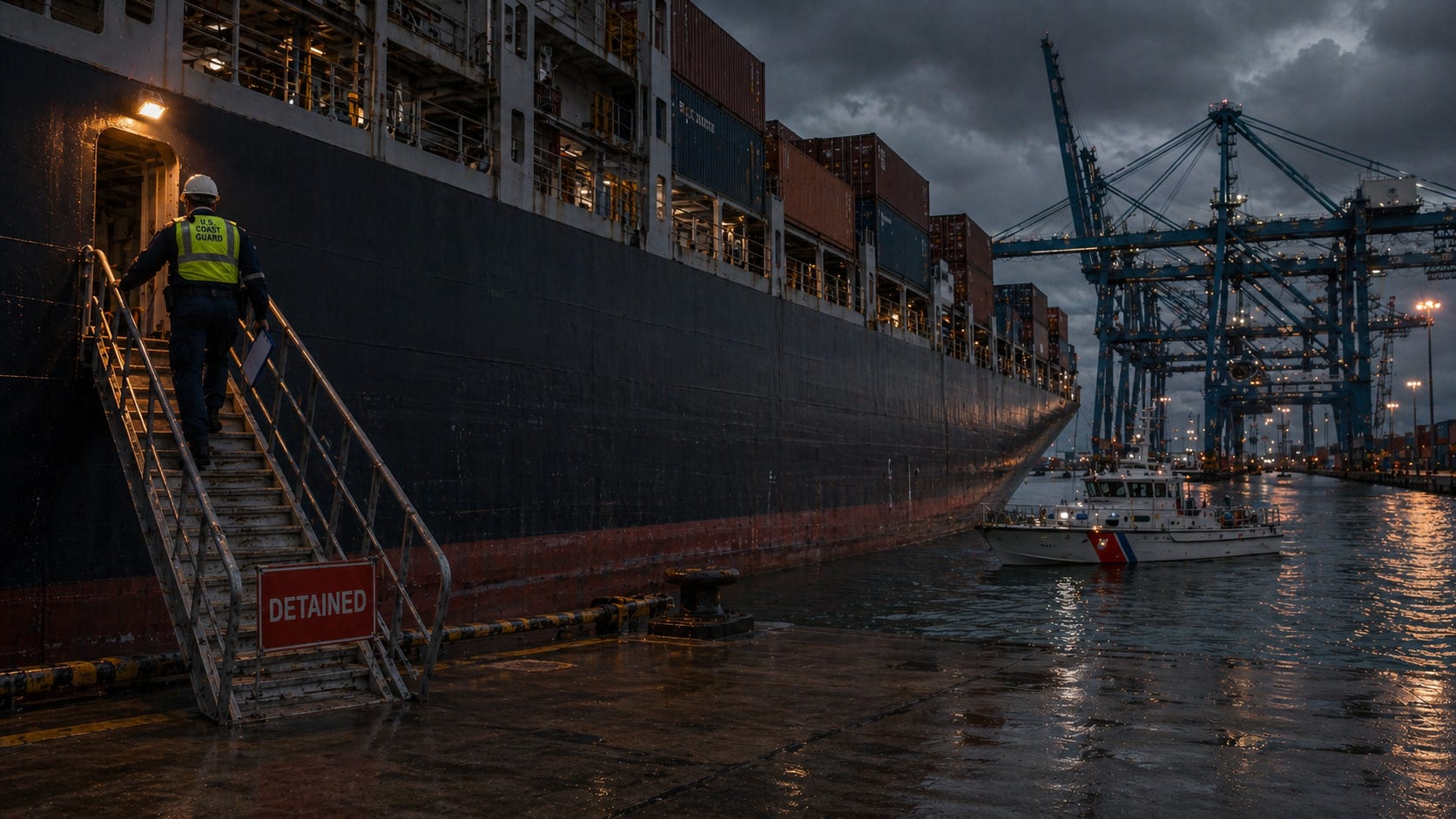
Across 14 months, the U.S. Coast Guard validated 81 IMO-reportable detentions. One container ship was caught three separate times in six months. Six vessels failed more than once. Across every category, the through-line is competency at the moment of inspection.
The U.S. Coast Guard’s monthly IMO Reportable Detentions list, covering January 2025 through February 2026, validates 81 foreign-flag vessel detentions in U.S. ports. The 14-month total tracks a pace below the 2024 annual figure of 82 detentions across 8,711 inspections, which the USCG reported as a 0.94% detention ratio. The headline number is not the story. The story is what the data does not show in aggregate. It shows a concentration. One flag administration accounts for more than a quarter of every detention. One Liberian-flagged Post-Panamax container ship, built in 1996, appears in three separate months under the same IMO number. Six different vessels appear more than once. The pattern is not flag-driven, not size-driven, and not age-driven. The through-line across every detention category is crew competency at the moment of inspection.
🔔 Not yet subscribed? SwiftAction Intelligence Covers Maritime Accidents, Detentions, and the Training Failures Behind Them. Subscribe For Free.
📋 Competency-Based Maritime Training Mapped to Every PSC Deficiency Code → academy.swiftaction.ai 🎯 2026 CIC Cargo Securing Bundle: 30 Courses, 60% Off
📌 DATA CARD
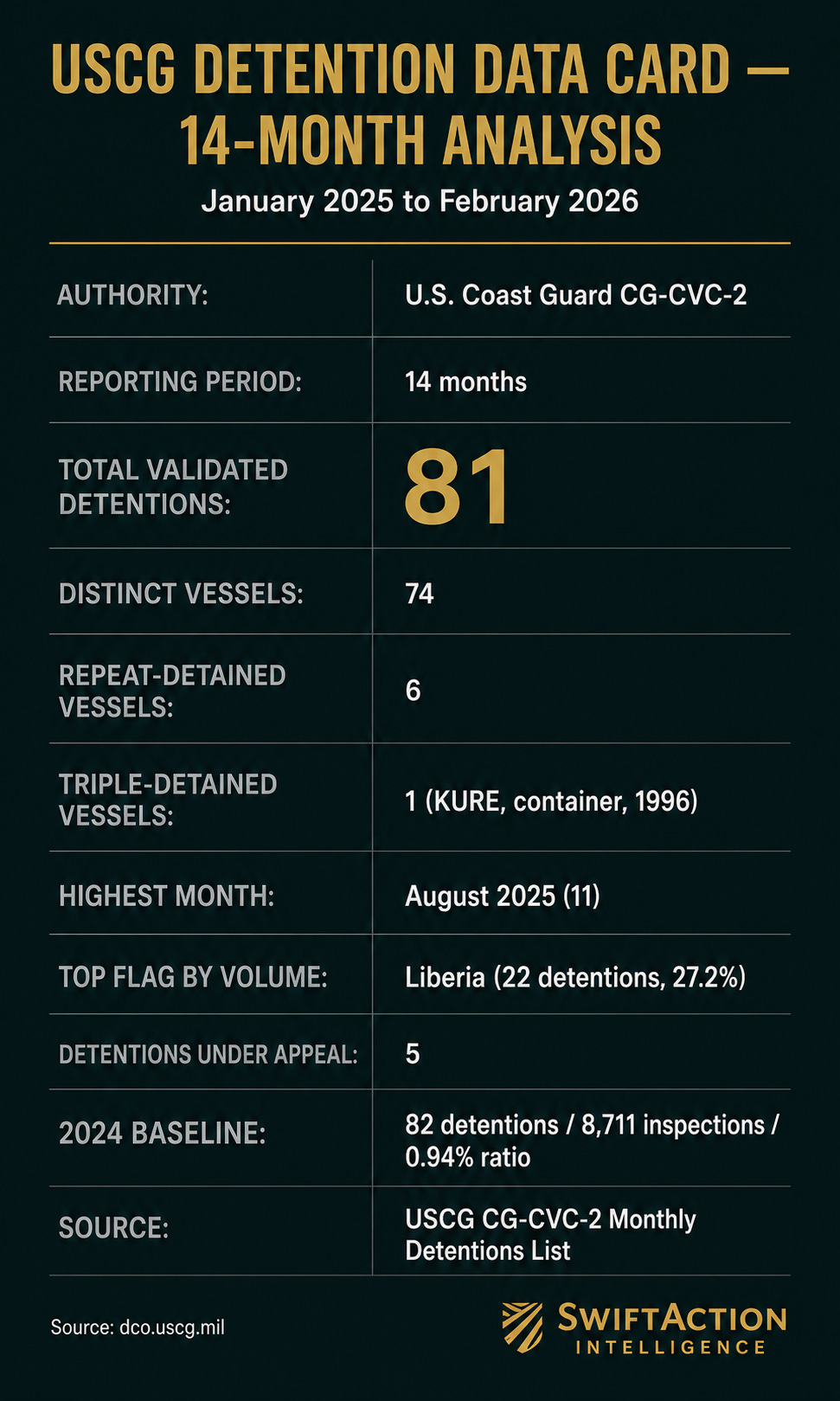
🏛️ Authority: U.S. Coast Guard, Office of Commercial Vessel Compliance(CG-CVC-2)
📅 Reporting Period: January 2025 to February 2026 (14 months)
🚨 Total Validated Detentions: 81
🚢 Distinct Vessels Detained: 74
🔁 Vessels Detained More Than Once: 6
⚠️ Vessels Detained Three Times: 1 (KURE, IMO 9085522)
📈 Highest Single Month: August 2025 (11 detentions)
📉 Lowest Single Month: December 2025 / February 2026 (2 each)
🏴 Top Flag by Volume: Liberia (22 detentions, 27.2%)
⚖️ Detentions Under Active Appeal: 5 (per 46 CFR 1.03-15(h)(1))
📊 2024 USCG Comparative Baseline: 82 detentions / 8,711 inspections / 0.94% ratio
🔗 Source: USCG CG-CVC-2 Monthly IMO Reportable Detentions List
📝 THE TEST
The deficiency. What inspectors found.
The 81 detentions did not happen because the U.S. Coast Guard changed its inspection methodology, increased officer headcount, or introduced new convention requirements. Every inspection in the 14-month window was conducted under the same SOLAS, MARPOL, MLC, and STCW frameworks that have been in force for years. Every detainable deficiency raised was raised against codes that have appeared in USCG annual reports for more than a decade.
What inspectors found, repeatedly, were operational gaps that crews could not close in real time. Fire detection systems with no logged weekly tests. Lifesaving appliances that crews could not launch within the time-bounded standard the SOLAS regulation specifies. Steering gear emergency procedures that no bridge team rehearsed. Bridge navigational watch alarm systems that were silenced or bypassed. Oily water separators that crews could not operate to the 15-ppm function-test standard. Emergency drills documented in the SMS but not demonstrable on demand.
The USCG inspector’s question is not “do you have a procedure?” The question is “show me a crew member who can perform it now.” Across 14 months and 81 detentions, that is the question that crews kept answering wrong.
The deficiency-level distribution across the 81 detentions is documented in the individual USCG IMO Reportable Detention PDFs linked from the source page. Categories consistent with the recurring USCG annual-report patterns, including fire safety, lifesaving appliances, propulsion and auxiliary machinery, and ISM-related findings, dominate the underlying narratives. KURE alone (IMO 9085522) generated three separate detention reports in the period; the categories that repeated across those three reports are the categories that the rectification process did not close on the vessel.
📊 BY THE NUMBERS
📅 Detention Volume by Month
🔥 August 2025: 11
🔥 October 2025: 10
🔴 July 2025: 8
🔴 February 2025: 7
🔴 April 2025: 7
🔴 May 2025: 7
🟠 January 2025: 6
🟠 September 2025: 6
🟠 March 2025: 5
🟡 November 2025: 4
🟢 January 2026: 3
🟢 June 2025: 3
🟢 December 2025: 2
🟢 February 2026: 2
📊 Total: 81
Q3 2025 (July, August, September) produced 25 detentions, the heaviest quarter in the 14-month window. That is more detentions in 90 days than the entire November 2025 to February 2026 period combined.
🚩 Top Open-Registry and Targeted Flag Administrations by Detention Volume
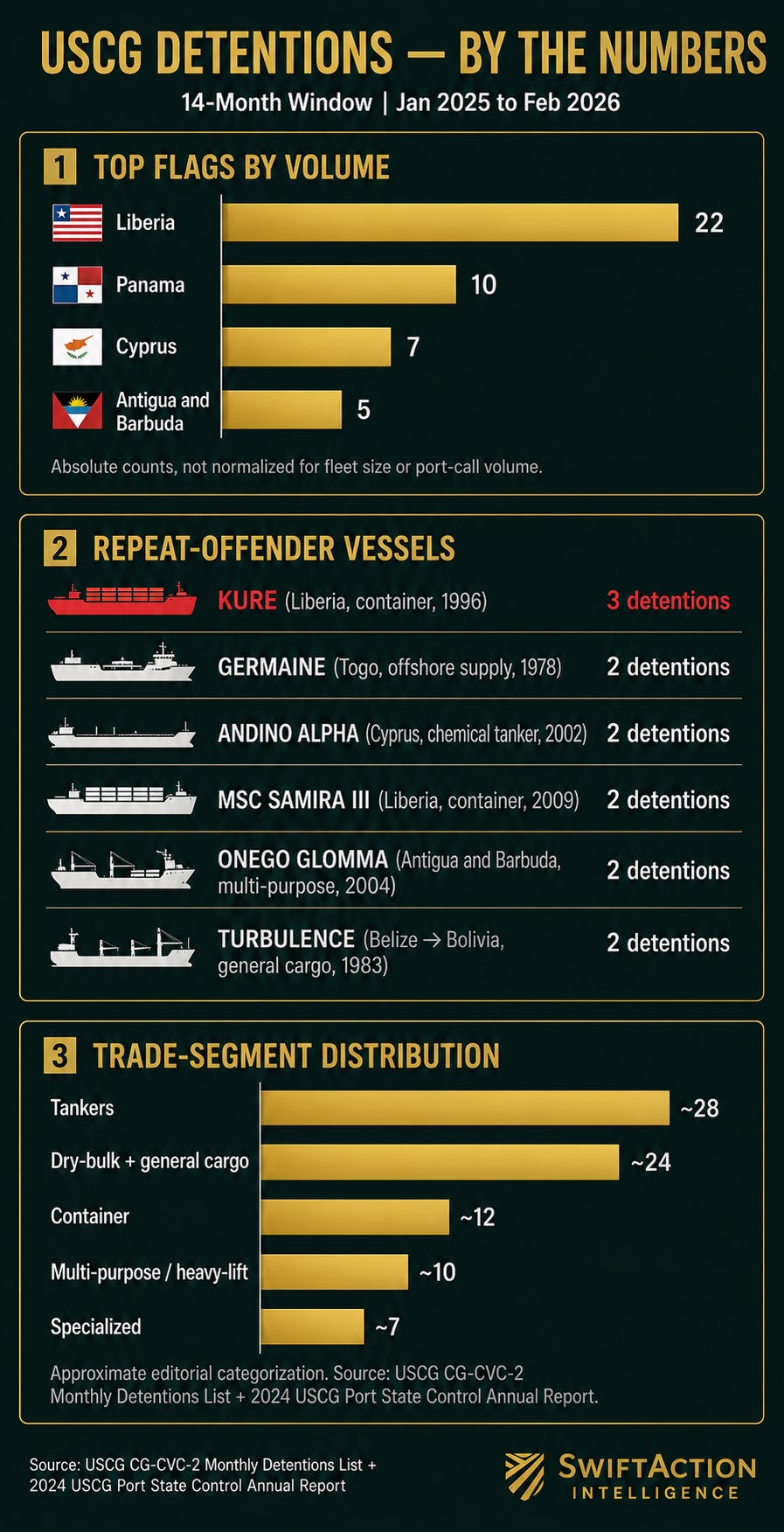
🔥 🚩 Liberia: 22 detentions · 27.2%
🔴 🚩 Panama: 10 detentions · 12.3%
🟠 🚩 Cyprus: 7 detentions · 8.6%
🟠 🚩 Antigua and Barbuda: 5 detentions · 6.2%
🟡 🚩 Singapore: 3 detentions · 3.7%
🟡 🚩 Portugal: 3 detentions · 3.7%
🟡 🚩 Tanzania: 3 detentions · 3.7%
🟡 🚩 Netherlands: 3 detentions · 3.7%
📊 Top 8 subtotal: 56 detentions · 69.1%
Methodology note: Counts shown are absolute detention totals and are not normalized for fleet size, port-call volume, or per-inspection detention rates. The USCG publishes per-inspection detention ratios annually; the 2024 ratio was 0.94% (82 detentions across 8,711 SOLAS safety exams). The next official rate publication will indicate how the 2025 per-inspection rate compares.
The remaining 25 detentions are distributed across 17 additional flag administrations. Liberia, the world’s largest open registry by gross tonnage and currently a participant in the USCG QUALSHIP 21 program (readmitted effective July 2022 per LISCR), accounts for more than one in every four U.S. detentions in this window. The first counter to a flag-by-flag concentration analysis is fleet size: Liberia has the largest fleet, so absolute detention counts will scale with port-call frequency. That counter is fair, and the methodology note above acknowledges it. The relevant question is not whether the absolute count is high in proportion to the fleet, but whether the rectification process closes the underlying competency gap. KURE answers that question.
🚢 Vessels Detained More Than Once (14-Month Window)
🔥 KURE · IMO 9085522 · 🚩 Liberia 📦 Container (Post-Panamax, ~6,418 TEU) · 🛠️ Built 1996 3 detentions · Feb 2025, Jul 2025 (×2)
🔴 GERMAINE · IMO 7914482 · 🚩 Togo ⚓ Offshore Tug / Supply Ship · 🛠️ Built 1978 2 detentions · May 2025, Aug 2025
🔴 ANDINO ALPHA · IMO 9254202 · 🚩 Cyprus 🛢️ Chemical / Oil Products Tanker · 🛠️ Built 2002 2 detentions · May 2025, Sep 2025
🔴 MSC SAMIRA III · IMO 9434462 · 🚩 Liberia 📦 Container (Feeder, ~2,578 TEU) · 🛠️ Built 2009 2 detentions · Jan 2025, Feb 2025
🔴 ONEGO GLOMMA · IMO 9294977 · 🚩 Antigua and Barbuda 🏗️ Multi-purpose / Heavy-lift · 🛠️ Built 2004 2 detentions · Aug 2025 (×2)
🔴 TURBULENCE · IMO 8203256 · 🚩 Belize → Bolivia 📦 General cargo · 🛠️ Built 1983 2 detentions · Mar 2025, Apr 2025
KURE is the standout case. A 1996-built Liberian-flagged Post-Panamax container ship detained three times by the U.S. Coast Guard in a six-month window. Twice in the same calendar month (July 2025). Each detention was validated. Each detention required release before sailing. Each detention represents a finding that the previous rectification process did not close.
TURBULENCE is the second case worth flagging for a different reason. The vessel was detained in March 2025 under the Belize flag, then detained again in April 2025 under the Bolivian flag. Belize had been removed from the USCG Targeted Flag List in the 2024 annual reporting cycle. The vessel changed flag away from a recently-de-targeted administration and was detained again under the next flag down. Public vessel-tracking records also show TURBULENCE has operated under multiple prior name aliases (including ARISTOTE under Bahamian flag) before assuming its current name. The deficiencies followed the hull. The flag did not reset the targeting profile. Neither did the name.
Trade-Segment Distribution
The 81 detentions span every major foreign-trade segment serving U.S. ports. Approximate categorization based on vessel-name and public-database type fields, with appropriate hedging:
🏷️ Trade-Segment Distribution
🛢️ Tankers (crude, product, chemical, gas): ~28 detentions · ~35%
🚢 Dry-bulk and general cargo: ~24 detentions · ~30%
📦 Container ships (across all carrier sizes): ~12 detentions · ~15%
🏗️ Multi-purpose, heavy-lift, project cargo: ~10 detentions · ~12%
⚓ Specialized tonnage (OSV, dredger, tug, LNG/LPG newbuild deliveries): ~7 detentions · ~9%
📊 Total: ~81 detentions
Counts above are approximate and reflect SwiftAction Intelligence editorial categorization based on vessel name and public-registry type fields. Exact deficiency-code-to-trade-segment mapping requires the underlying USCG IMO Reportable Detention PDFs.
The mix indicates that no single trade segment is exempt from detention exposure. Vessels under newer hulls appear alongside vessels under hulls more than 30 years old. Box-trade tonnage in the global liner segment appears alongside small general-cargo vessels under flag-of-last-resort registries. Operator-level attribution (the operator and ISM Document of Compliance company fields on individual USCG detention documents) is outside the scope of this aggregate analysis and requires PDF-level verification.
✅ THE ANSWER
What should have happened.
Every one of the 81 detentions in this dataset was preventable at the crew level before the vessel ever entered U.S. waters. The U.S. Coast Guard does not detain vessels for the existence of a procedure in a manual. It detains vessels when the crew on watch cannot demonstrate the competency that the procedure describes. The gap between a procedure-on-paper and a competency-at-sea is the gap that drives detention numbers, even in a year when overall detention ratios trend down.
For the KURE case, three detentions in six months on the same hull, under the same flag, under the same IMO number, is consistent with a pattern where shore-side rectification closed each inspection finding (paperwork delivered, equipment repaired, surveyor signed off) but did not close the underlying competency gap on the bridge or in the engine room. The vessel sailed. The next inspection found the next gap. This is the textbook ISM Code Section 1.4 functional-requirements failure: the SMS did not produce continuous improvement between inspections.
For the TURBULENCE case, flag-hopping (and name-hopping) between consecutive detentions does not work. USCG targeting screens use IMO number, ship-management history, and prior detention records. They do not reset on flag change or name change. The competency that drove the March detention drove the April detention. The flag on the stern was not the variable. The name on the hull was not the variable. The 2024 USCG Annual Report removed Belize from the Targeted Flag List, which means the vessel’s first detention was under a flag the USCG had just acknowledged as improving. The crew-level competency did not improve in step with the flag.
For the broader segment distribution, the lesson is the same regardless of vessel type. Tankers, container ships, bulkers, multi-purpose, and specialized tonnage all appear in the list. Vessels under newer hulls appear alongside vessels under hulls more than 30 years old. Operator scale and SMS maturity do not, by themselves, prevent USCG detention. What prevents detention is the crew member on the bridge, in the engine room, on the boat deck, who can perform the competency on demand, in front of an inspector, in real time.
The signature pattern across all 81 detentions: the findings were rectified on paper. The competency gap persisted at sea.
🎯 THE PASS MARK
What compliant looks like.
A vessel that does not get detained by the U.S. Coast Guard is not a vessel with the cleanest paperwork. It is a vessel where every crew member on watch can perform the competency the inspector tests, on demand, without the master, the chief engineer, or the DPA being in the compartment.
The USCG inspector’s pass mark is observable, repeatable, and time-bounded. A fire team assembles in the time the SMS specifies. A lifeboat is launched within the SOLAS time-bounded standard for the vessel’s lifeboat type. The bridge officer demonstrates the BNWAS reset cycle without prompting. The duty engineer demonstrates the OWS 15-ppm function test without consulting the manual. The cargo officer can identify the segregation requirement for two adjacent containers using the IMDG Code without opening the book.
This is not a high bar. It is the bar SOLAS, MARPOL, and the ISM Code already require. It is the bar that the 81 detained crews did not clear.
🎓 THE STUDY GUIDE
Train your crew to the standard.
The deficiency narratives behind the 81 detentions cluster around a recurring set of competency themes. The SwiftAction courses below address the categories that recur most frequently in USCG and broader PSC detention narratives:
🔥 Course 07106 · Fire Detection And Alarm System Detention theme: Fire detection weekly tests not recorded
🔥 Course 07109 · Fixed Fire Extinguishing Installation Detention theme: Fixed fire suppression not demonstrable
🔥 Course 07115 · Fire-Dampers Detention theme: Fire damper inoperability or condition
⚙️ Course 07117 · Jacketed High Pressure Lines & Oil Leak Alarm Detention theme: Engine room fuel system and oil leak detection
🌊 Course 08110 · Closing Water-Tight Doors Alarm Detention theme: Watertight integrity systems
🧭 Course 10138 · Bridge Nav. Watch Alarm System (BNWAS) Detention theme: BNWAS bypass or non-functional
🛟 Course 11113 · Launching Arrangements For Rescue Boats Detention theme: Rescue boat launching beyond SOLAS time standard
⚙️ Course 02105 · Steering Gear Detention theme: Steering gear emergency procedures not rehearsed
📋 Course 15105 · Resources And Personnel (ISM) Detention theme: ISM Code crew familiarization gaps
🛢️ Course 14104 · Oil Filtering Equipment Detention theme: MARPOL Annex I oily water separator operation
❓ 3 QUESTIONS FOR YOUR DPA
Of our vessels that traded to U.S. ports in the last 24 months, how many were inspected by the USCG, what deficiencies were raised, and what specific competency training was deployed and verified afterward?
Do our pre-arrival U.S. port checklists go beyond paper sign-off? Inspection-aligned platforms like Nautilux AI by SolarisTech now deliver predictive deficiency analytics, ranking the most likely findings at the next inspection by AI before the vessel ever enters U.S. waters. A crew-demonstrable competency drill, witnessed by the master and captured against those predicted findings, with timestamped evidence and corrective learning loops, is the operational standard for vessels trading to U.S. ports across all four categories that drive USCG detentions: fire safety, lifesaving appliances, machinery, and ISM-related operations. Early-adopter fleets report fewer repeat findings, faster pre-PSC preparation, and stronger corrective-action traceability.
If our fleet operates under any of the top 4 detained flags (Liberia, Panama, Cyprus, Antigua and Barbuda), what additional crew competency assurance does our SMS require beyond the flag-state minimum?
👀 WHAT TO WATCH
KURE. If KURE (IMO 9085522, Liberian flag) reappears in the U.S. detention list in 2026 under the same operator or after a transfer, that is a fourth detention on the same hull. It would also place direct scrutiny on the rectification cycle for that vessel and on the Recognized Organization that signed off on each release. The next U.S. port call for KURE is the next data point.
MSC SAMIRA III. Two detentions in two consecutive months in early 2025, with an active appeal under 46 CFR 1.03-15(h)(1). The outcome of that appeal and any subsequent inspection record will indicate whether the underlying competency findings were closed or whether the vessel returns to the list.
Liberia's concentration. 27.2% in a 14-month window is a number that the Liberian Registry, LISCR (the Liberian International Ship & Corporate Registry), and the recognized organizations operating under Liberian authority will not want to see repeated in the official 2025 USCG Annual Report when it publishes (the 2024 report posted in late April 2025; the 2025 report can be expected on a similar timeline). Watch whether the per-inspection detention rate for Liberian-flagged vessels in 2025 confirms or contradicts the absolute-count concentration.
Recognized Organizations. The USCG IMO Reportable Detention documents include the Recognized Organization field for every safety detention. Aggregating the RO field across the 81 detentions is the next analytical step and a natural follow-up article for SwiftAction Intelligence. Whichever RO appears most often is the class society whose Liberia-flag and Panama-flag survey discipline most warrants attention.
🛡️ THE OPERATIONAL STANDARD
The SwiftAction Intelligence editorial position on USCG detention prevention is operational, not aspirational. SolarisTech, Inc., the parent firm of SwiftAction Academy, operates Nautilux AI, an inspection-aligned compliance intelligence platform that ranks the most likely deficiency codes at the next PSC inspection by AI, before the vessel arrives in port. Nautilux AI delivers real-time vessel scoring through CCI, ARPI, and SESI metrics, integrates with Power BI dashboards, and pairs predictive analytics with human-in-the-loop expert oversight. Combined with SwiftAction’s 600+ PSC-aligned micro-training modules (ISO 21001:2018 EOMS Certified), the SolarisTech ecosystem closes the gap between the procedure on paper and the competency at sea.
Predict. Reinforce. Defend.
The full SolarisTech service portfolio covers vessel compliance and audit services (internal audits, flag state and statutory inspections, pre-inspections, investigations), technical and safety support (corrective actions, risk assessments, cybersecurity, port security, superintendent advisory), crew services and training (AI-linked PSC learning, corrective and continuous training, predictive learning paths), and regulatory and flag advisory (white-list improvement, detention prevention, pre-port readiness, fleet reliability enhancement programs).
📩 Request a demo or fleet assessment: Admin@SolarisTechinc.com 🌐 Learn more: www.solaristechinc.com · www.nautilux.info
📡 SWIFTACTION SIGNAL
81 USCG detentions in 14 months. One 1996-built Liberian container ship caught three times. Six vessels caught more than once. One vessel changed flag and name between consecutive detentions and was caught again. Even in a year when the overall USCG detention ratio trended down, the same hulls kept returning. The findings were rectified on paper. The competency gap persisted at sea. A SwiftAction course costs $17 and takes 45 minutes to complete. A single hour of U.S. port detention costs more than the entire course catalog. The question is not whether the industry can afford to train. The question is why the same hulls keep failing the same inspections.
⚓ The SwiftAction Team SwiftAction Intelligence Is Published Daily. For Partnership Inquiries Contact admin@swiftaction.ai
📋 Full Training Catalog: academy.swiftaction.ai
🎯 PSC Deficiency Code Mapping: academy.swiftaction.ai/collections
🏅 Try a Free Course (No Credit Card): 07106 – Fire Detection and Alarm System
🛡️ Compliance Intelligence Platform: Nautilux AI by SolarisTech
🔔 Not yet subscribed? SwiftAction Intelligence Covers Maritime Accidents, Detentions, and the Training Failures Behind Them. Subscribe For Free.